

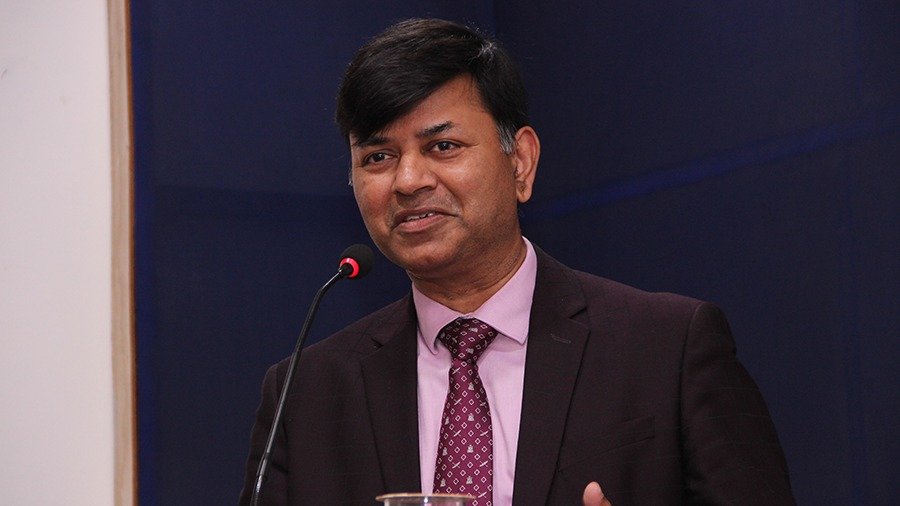
At the 7th Agri Business Conclave & Awards, organised by Diplomatist Magazine in association with the TERI School of Advanced Studies on March 24, Ambassador Raj Kumar Srivastava, Dean of the Sushma Swaraj Institute of Foreign Service, offered a deeply reflective perspective on agriculture, one that moved beyond economics to locate it at the heart of civilisation, diplomacy, and global cooperation.
He highlighted the importance of the platform itself, noting that agriculture is “not merely an economic issue, but foundational to human existence.” Drawing from India’s philosophical traditions, he spoke of the Panch Mahabhuta: the five elements of nature and positioned agriculture as their living manifestation. As he put it, “agriculture is not merely an economic activity or an ‘agribusiness.’ When we reduce it to business alone, we risk viewing it through the narrow lens of profit cycles. In reality, agriculture is civilizational; it sustains livelihoods, shapes cultures, and anchors economic resilience.”
Ambassador Srivastava also highlighted the expanding role of the Sushma Swaraj Institute of Foreign Service in strengthening India’s global engagement. Over the past year alone, the institute has hosted 529 diplomats from 118 countries, reflecting India’s growing emphasis on capacity building and knowledge exchange.
The core of his address was anchored in what he described as the “three I’s”—Innovation, Inclusivity, and International Partnerships—which together define India’s agricultural transformation. From the Green Revolution to today’s technology-driven farming systems, India’s journey has been marked by continuous adaptation. “Satellite-based crop monitoring, AI-driven advisory systems, and mobile-based farmer platforms are transforming the agricultural landscape,” he observed, pointing to how digital tools and biotechnology are reshaping the sector.
Yet, innovation alone is not sufficient. Emphasising the importance of equity, he remarked, “We no longer subscribe to the trickle-down theory; instead, we believe in a bottom-up approach, when the most vulnerable rise, the entire nation rises with them.” This shift towards inclusivity, he suggested, is equally central to India’s domestic policies and its engagement with the Global South.
In this context, he drew attention to India’s development partnerships, particularly in Africa. Recalling Prime Minister Narendra Modi’s 2018 address in Uganda, he highlighted a striking reality: “Africa possesses nearly 60% of the world’s arable land, yet contributes only about 10% of global agricultural output. Addressing this imbalance is central to global food security.” India’s response, he noted, has been grounded in action—from training programmes and mechanisation support to the promotion of drought-resistant crops such as millets and the development of agricultural value chains across countries like Ethiopia, Kenya, and Eritrea. “Normative vision must be backed by tangible action on the ground,” he emphasised.
At a broader level, Ambassador Srivastava pointed to the interconnected nature of agriculture in today’s world. Issues such as climate change, sustainable resource use, and equitable trade transcend national boundaries, making international collaboration indispensable. Describing India’s approach as “multi-aligned diplomacy,” he stressed that partnerships must span both the Global South and advanced economies.
Initiatives such as the International Solar Alliance and the Coalition for Disaster Resilient Infrastructure were cited as examples of how countries can come together to address shared challenges. These platforms, he noted, demonstrate the power of combining finance, technology, and natural resources to create global solutions.
Looking ahead, he stressed that the future of agriculture will depend on collective global action rather than isolated national efforts. “The future of agriculture will not be defined by isolated national efforts, but by collective global action,” he said, positioning India as a key bridge between the Global South and developed economies.
He also captured India’s agricultural journey as a story of convergence: “where innovation drives productivity, inclusivity ensures equity, and international partnerships build resilience.” Commending Diplomatist Magazine for sustaining focus on agriculture through this conclave over the years, he expressed confidence that such dialogues would continue to generate meaningful ideas for strengthening global agricultural cooperation.


Leave a Reply