

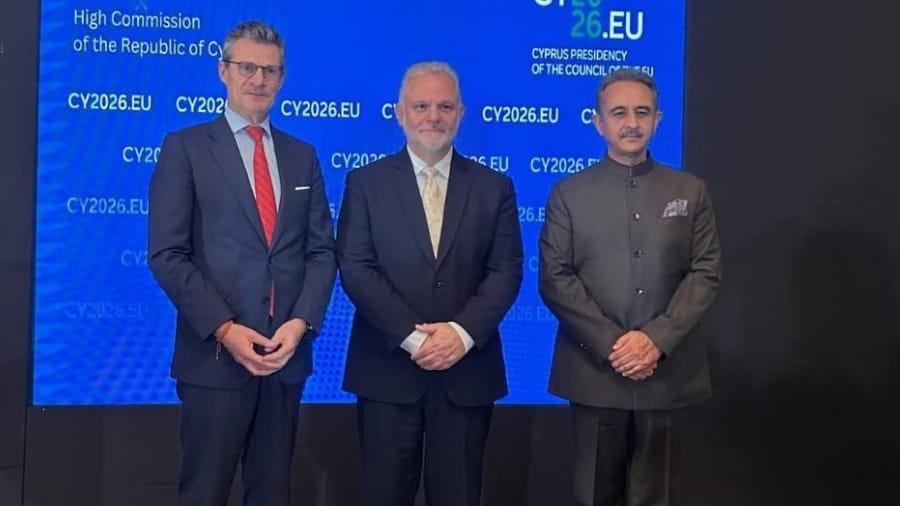
As Cyprus assumes the Presidency of the Council of the European Union for a six-month term in 2026, the High Commission of Cyprus in India hosted a reception in New Delhi on 2 February, bringing together senior diplomats, policymakers, and stakeholders from the European and Indian strategic communities.
Addressing the gathering, H.E. Mr. Evagoras Vryonides, High Commissioner of Cyprus to India, underlined the significance of the Presidency at a time of profound geopolitical and economic transition, while outlining Cyprus’s priorities for Europe and its expanding engagement with India.
Cyprus within the European Union
Recalling Cyprus’s journey within the European project, H.E. Vryonides noted that the country became part of the European Union in 2004, joining the Eurozone in 2008, and is currently undergoing evaluation by the European Commission for full accession to the Schengen Area.
“These milestones reflect Cyprus’s steady integration into the European family,” he remarked, emphasising that the Presidency would also be accompanied by a series of cultural engagements, including music, photography, and dance, aimed at showcasing Europe’s diversity and shared heritage.
Deepening India–Cyprus Relations
He focused on the strengthening of India–Cyprus bilateral relations, which he described as rooted in shared historical experiences—from the Non-Aligned Movement and the Commonwealth to sustained high-level political exchanges.
The relationship gained renewed momentum following Prime Minister Narendra Modi’s visit to Cyprus in June last year, which H.E. Vryonides described as “both symbolic and substantial.”
A Joint Action Plan signed during the visit outlines cooperation over the next five years in areas such as commerce, education, destination weddings, the film industry, and defence.
Looking ahead, he announced upcoming high-level visits, including that of Cyprus’s Minister of Foreign Affairs next month, followed by a planned visit of the President of Cyprus in May, underscoring the growing strategic convergence between the two countries.
Connectivity and the IMEC Vision
The High Commissioner also highlighted the strategic importance of the India–Middle East–Europe Economic Corridor (IMEC), describing it as a “visionary initiative aimed at strengthening connectivity between India and Europe.”
“Cyprus, as the first EU country geographically encountered by the corridor, seeks to play an active role in this endeavour,” he said. With one of the largest merchant fleets in Europe, Cyprus aims to contribute positively to regional connectivity, stability, and growth.
Priorities of the EU Presidency
Outlining the core priorities of Cyprus’s EU Presidency, H.E. Vryonides framed them around the principle of strategic autonomy.
“Autonomy through security remains a key priority,” he said, reaffirming Cyprus’s firm support for Ukraine and the importance of strong transatlantic relations, alongside cooperation with like-minded partners to enhance maritime security, freedom of navigation, and law enforcement collaboration.
A second pillar focuses on autonomy through competitiveness, with an emphasis on regulatory simplification, reducing red tape, and completing the Single Market. Particular attention will be given to cross-regional connectivity, especially for island states, through resilient digital networks.
The third pillar aims to build a Union that is open to the world,
by revitalising engagement with the EU’s southern neighbourhood and the Gulf region.
The fourth and equally important pillar, he noted, is an “autonomous Union of values that leaves no one behind.” Priorities under this framework include reinforcing the rule of law, advancing affordable housing, safeguarding children’s rights, promoting gender equality, and ensuring fair and inclusive employment. Cyprus will also engage actively in negotiations on the Multiannual Financial Framework 2028–2034, reflecting the EU’s long-term budgeting cycle.
Cyprus, Europe, and a Turbulent World
Addressing broader geopolitical realities, H.E. Vryonides reminded the audience that Cyprus remains the only EU Member State divided for the past 52 years, expressing hope that the renewed UN-led process would yield concrete results toward reunification.
Turning to Europe–India relations, he expressed optimism about recent developments, noting that the EU–India Free Trade Agreement had been finalised just days earlier.
“We look forward to its swift implementation, to the benefit of the business sectors on both sides,” he said, identifying key deliverables as trade and investment, security and defence, technology and digital cooperation, and commitments on climate, energy, and sustainability.
Reflecting on the evolving global order—from conflicts in the Mediterranean and Gaza to the war in Ukraine and wider geopolitical tensions—the High Commissioner called for collective responsibility and restraint.
“These developments call for caution about the state of the world and the need to cultivate a sense of planetary responsibility, with the ultimate goal of establishing lasting peace,” he concluded.


Leave a Reply