

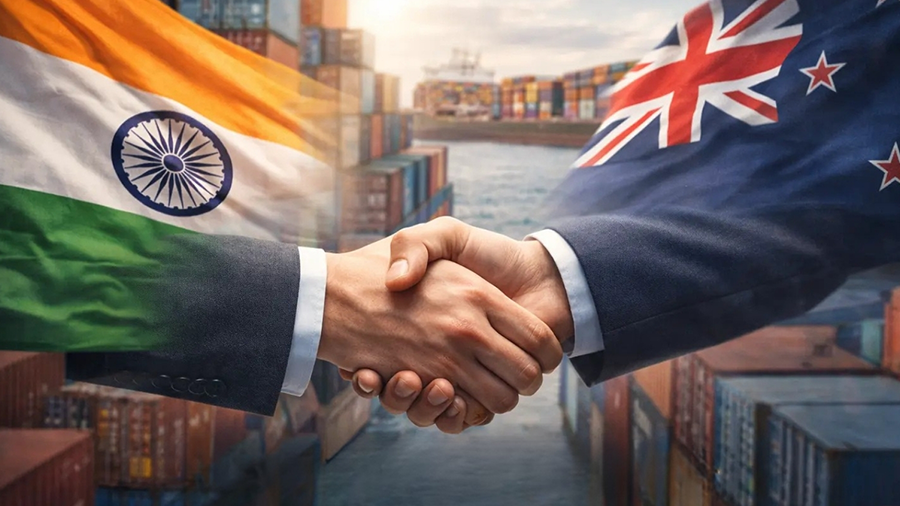
India-New Zealand diplomatic relations are long-standing, rooted in the ties of the Commonwealth of Nations, and are cordial and growing in strength. They share common values and growing economic and strategic interests, with collaborations in trade that culminated in a “fast-tracked” Free Trade Agreement (FTA) in December 2025. The FTA is anchored on ‘zero-duty accesses’ for most Indian exports to boost services trade (Information Technology, education, healthcare) and secure $20 billion investment commitment to New Zealand; it aims to double bilateral trade to $5 billion and create a framework for deeper Indo-Pacific economic ties (New Zealand Ministry of Foreign Affairs, 2025).
The Agreement encompasses education, defence, security, and climate change, driven significantly by citizen-to-citizen diplomacy and India’s rising global influence. The trade agreement is due for review after one year and will be signed in the first half of 2026 (Salve, 2025). This study adopts a neoliberal theoretical framework of analysis, which underscores cooperation between states, working together to attain a shared objective that promotes interdependence. Interdependence involves a relationship of mutual dependence in which actions and interests are intertwined (Political Science Teaching Aid, 2024). Among methods, the mediascape provides significant current data. The study is examined by taking a cursory look at what India and New Zealand represent geopolitically; FTA as a new chapter in Indo-Pacific diplomatic relations; what economic diplomacy is; and the conclusion.
India and New Zealand
Geopolitically, India is a vast country often referred to as a sub-continent, while New Zealand is a small but vibrant Pacific Island nation. Both countries have a cordial and longstanding relationship since the establishment of diplomatic relations in 1952. India’s strategic position to New Zealand is growing, reflecting India’s expanding economy, its growing geopolitical influence, its increasing openness to the rest of the world, and deep citizen-to-citizen ties through New Zealand’s significant Indian community (Radio New Zealand, 7 October, 2024). Thus, the FTA holds promise to deepen the Indo-Pacific economic relations. The Indo-Pacific is an expansive maritime region that connects the Indian and Pacific Oceans and stretches from East Africa to the West Coast of the Americas. In essence, the India and New Zealand FTA will provide an inroad for New Zealand into Oceania.
Free Trade Area: New Chapter in Indo-Pacific Diplomatic Relations
A Free Trade Area is a group of countries that eradicate or greatly reduce trade barriers, such as tariffs and quotas, among themselves. It fosters internal trade, while each member maintains its own external trade policies. It is a kind of economic integration, allowing for increased healthy competition, lower prices, and more efficient production of goods and services for the economic empowerment of citizens. The new chapter that has opened between the two countries, the India-New Zealand Free Trade Area (I-NZFTA), has prominent examples, including the US-Mexico-Canada (USMCA) and the African Continental Free Trade Area (AfCFTA).
While India and New Zealand have maintained cordiality for some 74 years, the current trade relationship is a new chapter for some good reasons. First, India and New Zealand successfully concluded a ‘fast-tracked’ Free Trade Agreement on December 22, 2025, which started in March, just within nine months of negotiations. Second, according to The Hindu,the FTA is a “historic milestone” that reflects India’s move towards larger economic partnerships and deeper integration with developed economies. Third, the Agreement will provide India with access to 100% duty-free exports on all tariff lines of New Zealand’s current imports (commerce.gov.in/…, Dec 22, 2025). And, fourth, the Agreement will diversify New Zealand’s export markets, providing preferential market access for 95% of its exports. It will further strengthen larger economic, cultural, and strategic links with India, as a member of the Group of Twenty (G20) in the world.
The economic pact offers zero-duty access on 100% of Indian exports to New Zealand and a $20 billion Foreign Direct Investment (FDI) commitment to New Zealand over the next 15 years. It also aims to double bilateral trade to $5 billion within five years (timesofindia.indiatimes.com/…, 22 December, 2025). While this FTA has been hailed as ambitious and a milestone, some New Zealanders have concerns over the Agreement. For instance, New Zealand’s First leader, Winston Peters, said his party had used the coalition’s “agree to disagree” provision and would oppose the enabling legislation, citing concerns over increased visa access for Indian nationals and limited gains for the dairy sector. (centrist.nz/…, 23 December, 2025). Putting the concern differently, the New Zealand parliament should move from ‘disagree’ to ‘agree’ for the overall interest of their people, looking forward to the formal signing of the pact.
Economic Diplomacy
Economic diplomacy has been a long practice between nations, from the ancient to the contemporary period. Broadly, economic diplomacy can be defined as any diplomatic action that projects the state’s economic interests. Also, it includes diplomacy that utilises economic resources to achieve a specific foreign policy goal (DiploFoundation, 2021). In their FTA, India and New Zealand have used veritable economic tools and policies (like trade and investment) to achieve foreign policy goals, to boost national prosperity, and secure strategic interests in the Indo-Pacific region. Clearly, the strategic imperative is the defining position both countries have taken. For New Zealand, in particular, it will serve as a gateway to Oceania and reflect India’s greater Indo-Pacific strategy for the security and economic strength of both countries.
Conclusion
A new chapter has opened in India and New Zealand’s long-standing relations in Indo-Pacific economic diplomacy, with the conclusion of the Free Trade Agreement in December 2025. After legislative ratification in both countries’ Parliaments, the formal signing of the Agreement will take place by mid-2026. This will open several doors of opportunity for the people and governments of both countries. The zero-duty access for most Indian and New Zealand exports will boost trade and economic development in both countries and strengthen Indo-Pacific relations.



Leave a Reply