

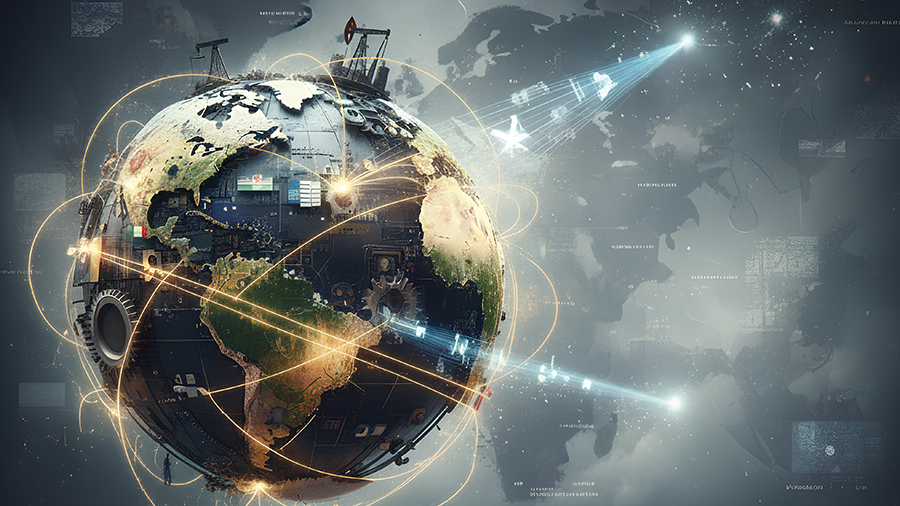
Globalisation would weaken national rivalries through shared wealth, and the post–Cold War age offered a world connected by economic interdependence. According to Francis Fukuyama’s “end of history” theory, free markets and liberal democracies are unstoppable forces that make conventional geopolitics obsolete. However, this vision had broken down by the 2020s. Trade policies, sanctions regimes, supply-chain reconfigurations, and financial architectures have been repurposed by rising powers like China and resurgent entities like Russia as weapons in zero-sum geopolitical confrontations rather than for mutual gain.
This paradigm change is fundamentally represented by geoeconomics, which replaces the integrative ethos of globalisation with the use of economic statecraft to accomplish security and influence goals. The phrase was first used in 1990 by Edward Luttwak, who cautioned that “geoeconomics would not only replace geopolitics but dominate it.” This is clearly seen today. The competition between the United States and China is a prime example of how trade flows are disrupted by tariffs, rivals are isolated by sanctions, supply chains are “friend-shored,” and financial systems like SWIFT turn into battlegrounds. This essay makes the case that geoeconomics has surpassed globalisation, turning these instruments into strategic competitive tactics. Through real-world examples, it explores each domain—trade, banking, supply chains, and sanctions—revealing a world of controlled interdependence tinged with coercion.
Trade as a Coercive Leverage Weapon
Once the cornerstone of globalisation, trade today functions as a front-line platform for tactical manoeuvres. Protectionism has weakened multilateral organisations like the World Trade Organisation (WTO), as governments impose tariffs and quotas to penalise competitors and shield domestic industries. This shift was embodied in the 2018 U.S.–China trade war, which began during the Trump administration. Washington imposed duties on USD 360 billion worth of Chinese imports, targeting industries such as steel and semiconductors, in response to China’s “Made in China 2025” project, which aims to achieve technological self-reliance. Beijing responded symmetrically, reducing U.S. agricultural imports and raising prices for both sides.
This was geoeconomic strategy rather than simple mercantilism. By forcing American companies to relocate production and undermining China’s export-led growth model, tariffs sought to disconnect critical technologies. Under the Biden administration, U.S. tariffs continued until 2023, altering international trade patterns and generating nearly USD 80 billion in revenue.
India offers another perspective. In response to a WTO dispute over solar panels, New Delhi imposed retaliatory duties on 28 U.S. exports. Later, in 2023, a mini trade agreement was negotiated to address concerns regarding Chinese dominance. Resource nationalism has also become part of trade weaponisation in the Global South. Following Russia’s invasion of Ukraine in 2022, Moscow rerouted energy supplies to China and India, exchanging discounted oil for yuan and rupees. By circumventing Western sanctions, this challenged the petrodollar monopoly and strengthened Russia’s war financing. These developments show how trade has evolved from a conduit of globalisation into a bilateral bargaining tool, where alliances are shaped by terms and volumes. As Robert Blackwill and Jennifer Harris argue in War by Other Means (2016), economic statecraft uses trade as a scalpel for precision pressure, filling the space left by military restraint.
Sanctions: The Economic Siege of the 21st Century
Bypassing the risks of kinetic conflict, sanctions have become the preferred instrument of geoeconomic coercion. Through the Office of Foreign Assets Control (OFAC), the United States alone now maintains over 9,000 sanctions designations, up from just 34 in 2000. Targeting leaders, institutions, and entire industries, these “smart” sanctions aim to alter behaviour without deploying military force.
Iran illustrates both the power and the limitations of sanctions. Following the U.S. withdrawal from the JCPOA in 2018, Iran’s oil exports fell from 2.5 million barrels per day to under 500,000, while its GDP contracted by 6 percent in 2019. Yet Tehran demonstrated the declining effectiveness of sanctions against resilient autocracies by adapting through “ghost fleets” and barter arrangements with China.
Russia’s experience after 2022 offers further insight. Western sanctions froze USD 300 billion in Russian central bank assets and cut Moscow off from SWIFT, pushing inflation to 17 percent. However, these effects were mitigated through parallel imports via Turkey and the UAE, as well as India’s purchase of nearly 40 percent of Russia’s seaborne oil. In 2023, Russia’s economy grew by 3.6 percent, defying predictions of collapse.
India navigates this environment with strategic caution. Despite pressure from the United States to align fully with Western sanctions as a Quad partner, New Delhi has preserved strategic autonomy. India’s trade with Russia exceeded USD 100 billion in 2023–24, largely driven by discounted energy imports, highlighting the multipolar nature of geoeconomics. Countermeasures are increasingly emerging from sanctions regimes themselves: China’s Cross-Border Interbank Payment System (CIPS) challenges SWIFT, processing nearly USD 7 trillion annually by 2024, while BRICS nations explore a trade currency resistant to sanctions.
Finance: The SWIFT Sword and the De-dollarisation Drive
Finance lies at the core of geoeconomics, with the U.S. dollar’s 58 percent share of global reserves enabling unparalleled extraterritorial influence. Each day, approximately USD 150 trillion flows through the Belgium-based SWIFT messaging network. Exclusion from SWIFT, as experienced by Iran in 2012 and Russia in 2022, amounts to economic strangulation.
However, alternatives are gaining ground. By 2024, the Chinese yuan accounted for nearly 4 percent of international payments, supported by the integration of Russia’s SPFS and China’s CIPS within the BRICS financial frameworks. India’s Unified Payments Interface (UPI) is piloting rupee-based transactions with over 20 countries across Africa. Meanwhile, the BRICS New Development Bank, with USD 100 billion in capital, competes with the IMF by offering infrastructure financing without political conditionalities.
This shift is further accelerated by cryptocurrencies and central bank digital currencies (CBDCs). China’s digital yuan is testing cross-border settlements, while El Salvador’s adoption of Bitcoin and Russia’s pivot toward cryptocurrency mining help evade sanctions. Nearly 20 percent of Russian oil trade is now settled via rupee internationalisation through Vostro accounts involving over 20 partner countries, reducing India’s foreign exchange exposure.
Such financial fragmentation poses risks to globalisation. While Barry Eichengreen warns that de-dollarisation could increase volatility, it also empowers the Global South, where 85 percent of states remain non-aligned.
Consequences for the Global South and India
India exemplifies effective geoeconomic navigation. Its USD 3.9 trillion economy reflects a strategy of “multi-alignment,” balancing Russian energy ties with U.S. partnerships such as the iCET semiconductor initiative. While the India–Middle East–Europe Economic Corridor (IMEC) counters China’s Belt and Road Initiative, domestic programmes like the Production-Linked Incentive (PLI) scheme aim to onshore USD 100 billion in manufacturing. Nonetheless, vulnerabilities persist, including heavy reliance on Chinese active pharmaceutical ingredients, which constitute nearly 60 percent of India’s inputs.
The Global South, representing 85 percent of the world’s population, is increasingly leveraging this era. India’s vaccine diplomacy—exporting over 1.5 billion doses—has generated substantial soft power. Latin America’s lithium triangle is attracting Indian interest amid U.S.–China competition, while Africa’s AfCFTA promotes intra-continental trade.
Conclusion
Globalisation has been decisively overtaken by geoeconomics, which has repositioned supply chains, finance, trade, and sanctions as instruments of strategic competition. According to IMF projections, this paradigm enhances resilience against shocks such as pandemics and conflicts, but fragments markets and reduces global growth to 2.6 percent in 2023. Policymakers must adopt pragmatic realism by diversifying dependencies, strengthening domestic capacities, and favouring plurilateral arrangements over traditional multilateralism. India, through G20 leadership, Quad logistics, and strategic multi-alignment, is well placed to shape this evolving order—balancing sovereignty with selective interdependence to secure long-term strategic autonomy as an emerging geoeconomic pole.
References



Leave a Reply