

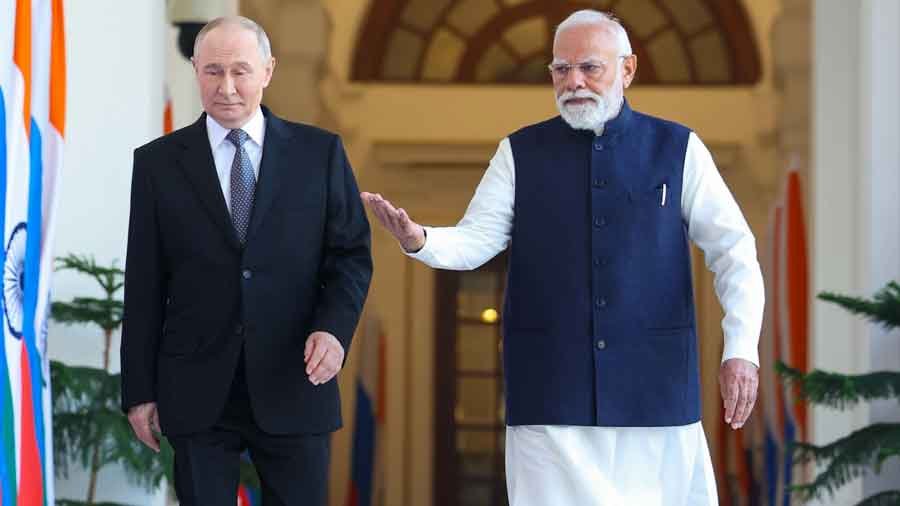
The month of December witnessed a flurry of high-level diplomatic engagements for India. Although the highlight of December month was the visit of Russian President Vladimir Putin, however given the current state of India-US relationship arrival of the US trade delegation assumes almost equal importance.
On 4–5 December, President Putin arrived in New Delhi for the 23rd Annual India–Russia Summit, reaffirming what both sides define as a “time-tested, special and privileged” strategic partnership.
The visit underscored not only the endurance of the bilateral relationship but also its adaptability and flexibility amid accelerating geopolitical churn—the increasingly complex Ukraine war; US President Donald J. Trump’s inconsistent policy signals—from the Alaska and Busan summits to tariff pressure on India over Russian oil imports; his proposition of a US–China G2; the strengthening of platforms such as BRICS and the Russia–India–China (RIC) troika; intensifying debates on de-dollarization; contestation over supply-chain dominance; the growing significance of critical technologies and minerals.
In this fluid environment, the steadiness of India–Russia cooperation emerges as a strategic message in itself—rooted partly in history, but anchored firmly in pragmatic realpolitik. The partnership reflects a shared recognition of the mutual value of each other at a time when reliable bilateral relationships are increasingly rare. It endures because it is organic, built on consistency, understanding, adaptability, and flexibility rather than cycles of friction or discontinuity.
Recalibration or Continuity?
Much attention was paid to President Putin’s visit after a ‘so-called’ four-year gap, leading some analysts to interpret it as a recalibration in New Delhi’s and Moscow’s respective equations with Washington. India’s rapidly expanding relationship with the United States—currently facing certain hurdles—and Russia’s fluctuating ties with Washington, depending on the trajectory of the Ukraine war, were seen as potential drivers behind a renewed push for bilateral engagement.
But a recalibration would mean a break that happened in India-Russia ties, which is not the reality. The fact that the India–Russia annual summit mechanism has remained consistent speaks to the opposite of what is perceived at the current moment. The leaders have alternated their visits almost every year, except in 2023. President Putin did not attend the G20 Summit hosted by India in September 2023. Both sides were planning to schedule a bilateral summit around that period, but it did not materialise. Many speculated that the International Criminal Court’s arrest warrant issued for President Putin in 2023 prevented his attendance. Yet the Kremlin clarified that his absence was due to Russia’s “special military operation” in Ukraine, not the ICC warrant. Moreover, India has never signed or ratified the Rome Statute of the ICC, rendering the warrant irrelevant to his potential visit.
The broader record of the strategic partnership shows that India and Russia have maintained continuity in engagement despite diversifying their external relationships—India with the US and Russia with China. The partnership remains independent, insulated from external pressures, and resilient to shifts in global alignments. Consistent and open channels of communication have enabled both sides to address misunderstandings when they arise. Thus, even amid heightened commentary and speculation, New Delhi and Moscow remained focused on substantive preparations for the December summit, prioritising economic and energy cooperation that featured prominently in the leaders’ discussions.
Key Takeaways from the Summit: Emphasis on Economic and Energy Cooperation
During their joint address, Prime Minister Modi and President Putin announced new or expanded cooperation across agriculture, energy, mining, manpower, diamonds, pharmaceuticals, and maritime transport, including on the Chennai-Vladivostok Maritime Corridor connectivity. President Putin’s assurance that Russia would ensure the “uninterrupted flow” of energy supplies to India was especially significant given President Trump’s threats on India’s import of Russian oil as well as global market volatility. Both leaders reiterated ongoing collaboration across the longstanding pillars of defence, civilian nuclear energy, hydrocarbons, and space.
In the defence domain, no major new agreements were signed, contrary to expectations surrounding platforms such as the S-500 advanced air defence system, technology transfer for the S-400, or the Su-57 fifth-generation stealth fighter. Nonetheless, both sides reaffirmed their commitment to co-development and co-production—a central theme of India’s defence modernisation strategy and a core feature of its partnership with Russia.
Importantly, the summit shifted focus toward correcting emerging imbalances in the economic relationship. India’s External Affairs Minister Dr. S. Jaishankar, speaking at the Hindustan Times Leadership Summit, highlighted that President Putin’s visit was aimed at significantly strengthening the economic dimension of bilateral cooperation, which had become increasingly skewed in Russia’s favour due to the post-2022 surge in energy trade. The renewed emphasis on diversified economic engagement—including manufacturing, agriculture, skilled labour mobility, and maritime connectivity—reflects an attempt to restore equilibrium and build a more sustainable economic partnership.
A Dynamic Strategic Partnership
International relations and foreign policy remain inherently dynamic, and the India–Russia relationship has successfully responded and adapted to this dynamism. The many meetings between the two leaders in various multilateral settings reflect an ability to maintain strategic conversation even amid geopolitical turbulence.
Before Putin’s visit to India, Prime Minister Modi met him in Tianjin during the Shanghai Cooperation Organisation (SCO) summit. During the same summit, the Indian prime minister also met the Chinese President Xi Jinping. Russia has long sought to revive the R-I-C trilateral mechanism as a platform to balance Eurasian dynamics. The meetings at SCO and also at the BRICS highlight New Delhi’s nuanced and autonomous response to shifting geopolitical currents. India is navigating a world of multiple power centres by retaining strategic flexibility. The recent hosting of the US trade negotiators to conclude a trade deal between the two countries is a good example of New Delhi’s flexibility and Russia’s adaptability.
Conclusion: A Partnership Rooted in Realism
The December summit reaffirmed that India–Russia relations remain stable and purpose-driven. The partnership continues to be guided by long-term strategic logic rather than short-term fluctuations in global politics. Both sides recognise each other’s role in safeguarding strategic autonomy, energy security, defence cooperation, and multipolarity in world affairs.
As global order continues to shift and confuse, as marked by sharper US–China rivalry on one hand and the proposal by President Trump of a G2 on the other, prolonged conflict in Europe, intensifying technology competition, and fragmented supply chain,s etc., the India–Russia strategic partnership retains its relevance not only because of nostalgia but because of alignment in interests. The visit ultimately underscored that despite new variables and uncertainties, New Delhi and Moscow remain committed to sustaining a relationship built on trust, adaptability, and pragmatic cooperation.



Leave a Reply