

School of Law ,Bennett University
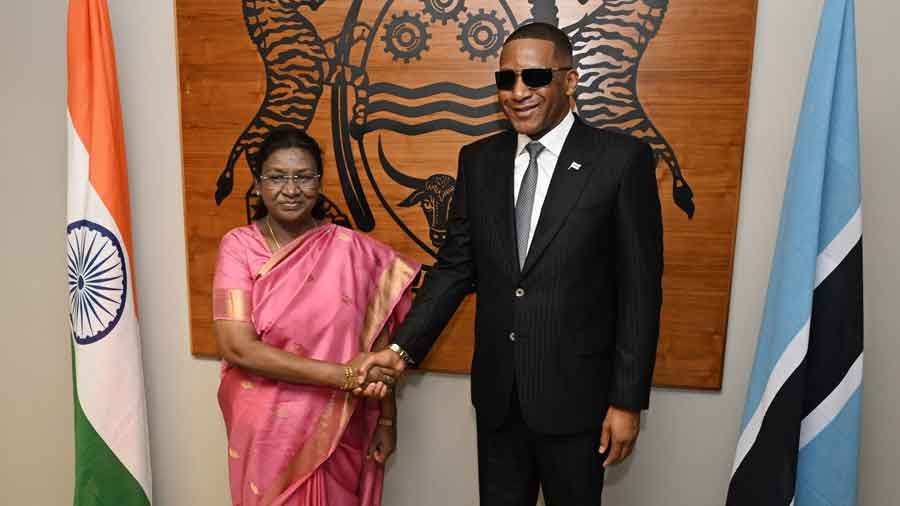
A new milestone in international diplomacy has been laid by India’s state visit to Botswana by President Droupadi Murmu in November. This event marks the first visit by India’s head of the state to this African country since establishing diplomatic ties back in 1966. With India and Botswana set to celebrate six decades of diplomatic relations in 2026, this visit represents much more than a ceremonial diplomatic tactic but embodies India’s strategic recalibration towards Africa and its commitment to engage with the African states through cooperation rather than patronage.In light of the G-20 summit in Johannesburg and India’s commitments during the summit,the timing of this visit furtheremphasizes India’s stance for greater ‘south-south’ co-operation at multilateral and bilateral levels. In this light, the visit came as India sought to consolidate its position as a credible development partner in the Global South, standing apart from the traditional ‘donors’ like China, through its emphasis on mutual respect, democratic values, increased economic partnerships and people-centric cooperation. This visit opens avenues for transformative development partnerships and allows India to transcend the symbolic diplomacy that currently prevails.
India’s Soft Power Dimensions and Botswana
The interactions between India and Botswana provide an example to the international community how soft power not only exist as a singular factor rather has multi-dimensional operational aspects in economic, cultural, ecological and normative form all of which contribute toward achieving a resilient partnership architecture which can operate beyond pure transactional relationships.
Economic Interdependence
The economic relationship between Indian and Botswana starts with diamonds which played a pivotal role in the development trajectory of both the nations and highlights the impact of post-colonial commodity distribution chains affecting present day economic specializations. Botswana exports rough diamonds that are processed and exported by India, commanding approximately 90 % of the global polished diamond manufacturing value. The annual bilateral trade amongst the two states is approximately 500 million dollars and is concentrated in diamonds and increasingly pharmaceuticals. Additionally, Bank of Baroda has established itself in Botswana since 2001, coupled with over 30 Indian diamond businesses operating on Botswanan soil and increasing trades in pharmaceutical sector, the channels for facilitating effective cooperation through local employment generation and skill transfer. During the latest visit, India and Botswana have further agreed to strengthen their cooperation in the pharma sector through pharmacopeia agreement which allows India to access the antiretroviral medicine sector in Botswana. With over 20% of the working age population suffering from HIV in Botswana, India’s decision to extend the supply of critical medicine further reinforces its identity as the ‘Pharmacy of Global South’ thereby operationalizing India’s soft power strategy.
Nonetheless, considering the position of both the nations, there exists certain structural asymmetries in this relationship. While India does not follow China’s ‘infrastructure-centric’ model, the ‘market-oriented’ and ‘partnership driven’ approach as envisioned in the 2011 India-Africa Forum Summit has yet to take form. The proposals made by India in Addis Ababa would have enabled technology transfer between India and Botswana thereby allowing Botswana to capture greater downstream value from its mineral wealth, however no substantial efforts has been made to materialize it.
Diasporic engagements
Indian diaspora is actively contributing in ensuring smooth collaboration between the countries. Approximately 10,000 Indians are residing in Botswana contributing in sectors such as education, healthcare, entrepreneurship and finance all of which constitute a vital link between both nations (PIB, 2025). The cultural sensitization and exchange programs conducted by Indian expat community though festive celebrations such as Diwali, Holi, Onam, Baisakhi, etc. have a positive impact in creating a favourable image of India (High Commission of India, Gaborone). The President of India has aptly characterized Indian diaspora as ‘Living bridge’ (President of India, 2025) between nations showcasing governmental awareness of the importance of diaspora in leveraging India’s soft power.
Project Cheetah and Conservation Diplomacy
The handover of eight cheetahsat the Mokolodi Nature Reserve from Botswana to India holds more strategic than symbolic value (PIB, 2025). The handover in presence of President Murmu showcases the innovative use of ecological cooperation as a soft power tool. This collaboration reflects shared priorities in biodiversity restoration and a demonstration by India of its ability to lead conservation efforts both regionally and globally. The partnership of both the states towards Project Cheetah is a tangible representation of commitment towards SDGs by both India and Botswana and places ecological cooperation as one of the core principles defining India’s multilateral partnerships.
Normative parallels
India and Botswana abide by similar normative principles rooted in democratic governance, rule of law and multilateral reforms. President Murmu did not hesitate in acknowledging this similarity in her parliamentary address where she highlighted that Botswana is “a shining example of democracy, good governance and effective leadership” (President of India, 2025) with consistent record of free and fair elections coupled with peaceful presidential transitions since independence. In the same vein, the President of Botswana acknowledged India as “the mother of democracy” (PIB, 2025). Botswana, further, supported India’s call for UN Security Council reforms and complemented India’s 2023 campaign that secured African Union a permanent position as G-20 member. These normative similarities align with India’s aspiration for leadership within Global South when it comes to multilateral justice and equitable good governance.
Capacity Building: South-South cooperation
The India- Botswana development partnership relies on the human capital development through systematic capacity building programs. Indian technical and Economic Cooperation (ITEC) program along with its counterparts ICCR and IAFS has been instrumental in providing technical training and scholarships to over 1300 Botswana candidates in the past decade. These initiatives align with India’s ‘Ten Guiding Principles for India-Africa Engagement’ as emphasized by Prime Minister Narendra Modi. The priority under these principles is given to capacity building and technology transfer as drivers of sustainable development (President of India, 2025). These are further reinforced through the multidimensional inter-personal interactions through sports and cultural exchanges. The simple gesture of the Karnataka State Cricket Association hosting Botswana’s Women Cricket team and offering them technical mentorship and institutional support highlights the spirit of mutual cooperation between the nations (High Commission of India, Gaborone). India’s emphasis on ‘mutual benefit’ and ‘win-win’ outcomes stems from the shared anti-colonial heritage and struggle for equitable global governance.
The Untapped Potential
Despite the current developments, multiple avenues of cooperation still remain unexplored. Firstly, The proposed diamond cutting hub in Botswana with Indian technical partnership will enable the nations to overcome the barriers of ‘transactional relationship’ and truly step into the domain of active partnership through investment-based development (Singh, 2025). Secondly, India holds expertise in agricultural mechanization, precision farming and integration of small holder farmer. These strengths can be utilized to catalyse agricultural reforms across African continent to ensure food sustainability. Thirdly, India’s technical expertise in providing sterile environments for “Fill and Finish” stage of pharmaceutical production could help in developing pharma sector in Botswana along with complementing the objectives of India’s ITEC healthcare training programs. Fourthly, India’s success with Aadhaar, UPI and e-governance systems lay the groundwork for transformative Digital Public Infrastructure Cooperationwhich can further help in advancing India’s relations with Botswana.
Conclusion
India’s attempt at positioning itself as a credible alternative to China while avoiding enticing security threats from established powers can be predominantly observed in its approach towards Africa. While President Murmu’s visit showcases India’s intent to cultivate soft power in African states through cultural attraction, normative alignment and partnership discourse; it also signifies the importance of Africa in India’s approach towards the complex geopolitical world order. Both parties have proposed development trajectories planned through “Viksit Bharat 2047” and “Agenda 2063” for their respective territories. A harmonization between the two plans can open avenues for greater and seamless cooperation between India and African States. The India- Botswana partnership holds the potential to become benchmark for how Global South pursues equitable and mutually beneficial cooperation.
References


Leave a Reply