

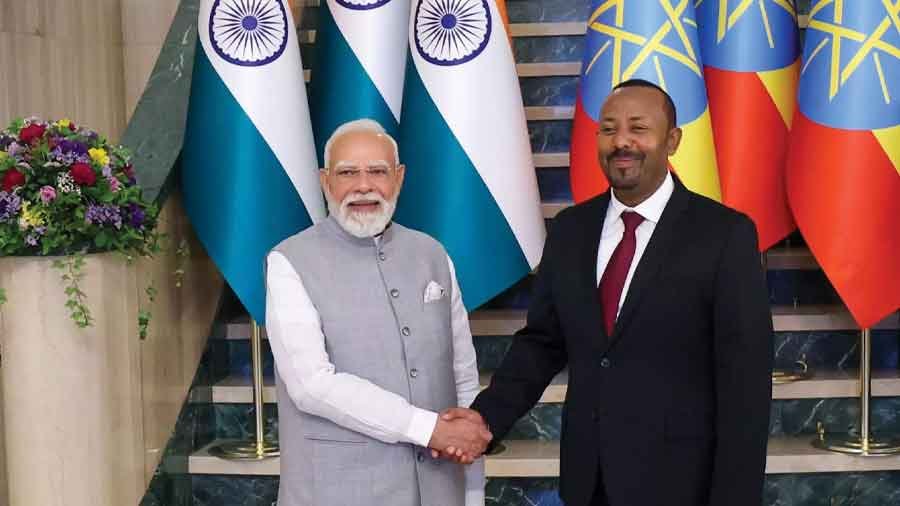
The relationship between India and Ethiopia represents one of the oldest continuous engagements between the Indian subcontinent and Africa. The recent decision by India and Ethiopia to elevate their bilateral relations to the level of a Strategic Partnership following comprehensive discussions between Prime Minister Narendra Modi and Prime Minister Abiy Ahmed Ali signifies a qualitative transformation in their engagement. This development not only strengthens bilateral ties but also reinforces India’s broader strategic outreach to Africa.
Prime Minister Modi’s ceremonial reception at the National Palace in Addis Ababa symbolised the growing political trust and diplomatic convergence between the two countries. As democratic states committed to peace, development, and multilateralism, India and Ethiopia share a common vision for the Global South and an inclusive international order.
Historical Foundations of India–Ethiopia Relations
Scholarly literature traces India–Ethiopia relations back nearly two millennia to the period of the Aksumite Kingdom. The Red Sea port of Adulis functioned as a crucial maritime hub linking the Horn of Africa with the Indian Ocean trading system. Indian spices and textiles were exchanged for Ethiopian gold, ivory, and other commodities, laying the foundations of enduring transregional economic and cultural interactions.
During the late fifteenth and early sixteenth centuries, European maritime expansion intensified Afro-Asian trade. Portuguese intermediaries facilitated the movement of Indian artisans and technicians to Ethiopia, contributing to architecture, craftsmanship, and religious institutions. By the late nineteenth century, Indian teachers and traders had begun settling in Ethiopia, reinforcing people-to-people linkages. Today, approximately 8,000 persons of Indian origin reside in Ethiopia, reflecting the continuity of these historical ties.
Shared Anti-Colonial Experiences and Global Solidarity
India and Ethiopia share a distinctive anti-colonial legacy. While India experienced prolonged British colonial rule, Ethiopia successfully resisted Italian colonisation in the late nineteenth century, preserving its sovereignty. These shared historical experiences shaped their solidarity in international forums.Both countries played significant roles at the 1955 Bandung Conference, which laid the ideological foundations of Afro-Asian cooperation and non-alignment. As founding members of the Non-Aligned Movement (NAM), India and Ethiopia contributed to shaping global discourse on sovereignty, decolonisation, and strategic autonomy during the Cold War period.
Institutionalisation of Diplomatic Relations
Formal diplomatic relations between India and Ethiopia commenced in 1948 and were institutionalised in 1950. Ethiopia became the first African country to establish an embassy in New Delhi, appointing Ato Amanuel Abraham as its first ambassador. India reciprocated by appointing Sardar Sant Singh as its ambassador to Ethiopia. Bilateral relations flourished during the reign of Emperor Haile Selassie, who actively encouraged Indian educators to serve in Ethiopia, particularly in rural areas. These initiatives significantly contributed to Ethiopia’s literacy and human resource development. High-level exchanges—including visits by Emperor Haile Selassie, President Sarvepalli Radhakrishnan, Prime Minister Manmohan Singh, and Ethiopian leaders—have sustained political engagement across decades. Ethiopia’s role as host of the 2011 India–Africa Forum Summit further underscored its diplomatic importance.
Contemporary Strategic Cooperation
Prime Minister Modi’s recent visit to Ethiopia resulted in the signing of eight major agreements and understandings, formally elevating bilateral relations to a Strategic Partnership. Areas of cooperation include customs administration, digital infrastructure, UN peacekeeping training, debt restructuring under the G20 framework, expansion of ICCR scholarships, artificial intelligence training, and maternal and newborn healthcare. Prime Minister Modi highlighted Ethiopia’s strategic significance as the headquarters of the African Union, emphasising its central role in continental diplomacy. He recalled India’s initiative during its 2023 G20 presidency to grant permanent G20 membership to the African Union, reinforcing India’s commitment to inclusive global governance.
Trade, Investment, and Development Cooperation
Economic cooperation constitutes a core pillar of India–Ethiopia relations. India is the largest source of foreign direct investment in Ethiopia, with over 615 Indian companies operating across sectors such as manufacturing, pharmaceuticals, agriculture, and services. Bilateral trade during the 2023–24 financial year stood at USD 571.52 million, with a significant trade surplus in India’s favour. India has extended lines of credit exceeding USD 1 billion to Ethiopia, supporting projects in rural electrification, sugar production, and railway infrastructure. These initiatives are complemented by grants, technical assistance, and capacity-building programs aligned with Ethiopia’s development priorities. A robust framework of bilateral agreements—including trade, taxation, aviation, science and technology, and irrigation cooperation—underpins this engagement.
Education, Culture, and Renewable Energy Cooperation
Educational cooperation has been institutionalised through the Educational Exchange Programme (2007), facilitating student mobility and academic collaboration. Cultural diplomacy has further strengthened people-to-people ties, with Indian dance troupes performing in Ethiopia and the establishment of the Ethiopian Cultural Centre in New Delhi in 2013. Renewable energy cooperation, particularly under the International Solar Alliance (ISA), represents an emerging area of strategic engagement. Planned initiatives include solar rooftop systems, off-grid electrification, and solar-powered irrigation pumps, aimed at enhancing energy access and supporting sustainable development.
Conclusion
Prime Minister Modi’s conferment with Ethiopia’s highest civilian honour, The Great Honour of the Order of Ethiopia, symbolises the depth and maturity of bilateral relations. The visit to Friendship Park and Friendship Square further reinforced symbolic and emotional bonds between the two nations. The India–Ethiopia Strategic Partnership reflects both historical continuity and forward-looking cooperation. As India deepens its engagement with Africa through development partnerships, multilateral diplomacy, and people-to-people exchanges, Ethiopia will continue to serve as a pivotal partner in advancing India–Africa relations in the twenty-first century.
References
Government of India, Ministry of External Affairs. (2024). India–Ethiopia Bilateral Relations. New Delhi: MEA.
Government of India, Department of Commerce. (2024). Export–Import Data Bank. New Delhi.
Legesse, A. (2001). Ethiopia and the Horn of Africa. Trenton, NJ: Red Sea Press.
Melakou, T. (2019). India–Ethiopia relations: Historical continuity and emerging cooperation. African Journal of International Affairs, 12(2), 45–62.
Ministry of External Affairs. (2015). India–Africa Forum Summit: Framework for Cooperation. New Delhi.
Nyerere, J. (1968). Freedom and Unity: Uhuru na Umoja. London: Oxford University Press.
Southall, R. (2010). Liberation Movements in Power: Party and State in Southern Africa. Pietermaritzburg: University of KwaZulu-Natal Press.


Leave a Reply