

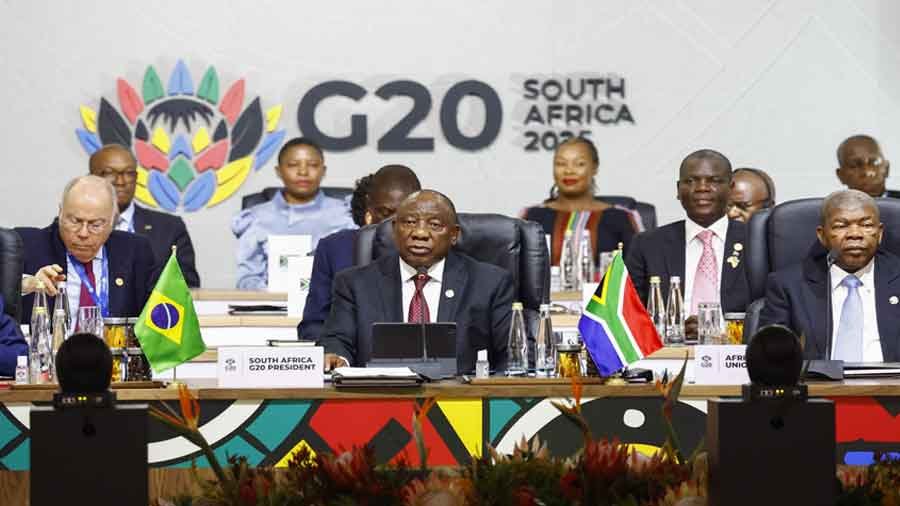
The 2025 G20 Summit, held in Johannesburg, South Africa, and based on the theme “Solidarity, Equality and Sustainability,” brought a new dawn in terms of South-South cooperation. The Summit not only highlights the growing significance of Africa as an important actor from the Global South, but it also showcases the norm-making role of Global South players, particularly in the economic domain. While the 2023 G20 Summit marked the inclusion of Africa in global governance, the 2025 Summit highlights the agential role of Africa in shaping crucial norms and values for Global South countries. It reflected a pluralistic approach when it comes to economic discussions in the crucial areas of infrastructure, development, and finance for South-South partnership. As a result, by setting the agenda for 2025 and institutionalising the priorities of the Global South, Africa aimed to strengthen coalition-building among Global South countries, thereby reinforcing their role as vital norm negotiators within the global governance architecture.
Roots of South-South Economic Cooperation
The historical roots of South-South cooperation can be traced back to the Non-Aligned Movement. The Bandung Conference of 1955 in Indonesia, where newly decolonised countries comprising Asian and African nations convened, laid the groundwork for the framework of the Non-Aligned Movement (NAM) in 1961 during the Cold War. These countries shared common historical battles against imperialism and colonialism and held a shared vision of creating a peaceful world order devoid of colonial domination.
As a result, these countries emphasised the “Ten Principles of Bandung,” established on the values of non-interference, sovereignty, opposition to apartheid, territorial integrity, and cooperation based on their newfound independence. Hence, these decolonised countries came together to defend their common interests and demonstrate a strong commitment to peace by remaining “non-aligned” with both the United States and the Soviet Union during the Cold War period. This movement marked the onset of a structural transformation in international politics, as it laid the foundation for Global South solidarity and collective identity formation, highlighting shared objectives and ideological goals. It manifested the role of the Global South as a crucial normative participant on the global platform.
While the Global South initially focused on political cooperation in the context of NAM, by the 1970s this solidarity expanded into the realm of economic justice and equality, leading to the birth of the New International Economic Order (NIEO) under the aegis of the United Nations General Assembly Declaration of 1974. The Global South, primarily comprising ‘developing’ economies, demanded restructuring of the global economic system due to persistent inequalities between the Global North and the Global South. These developing economies sought fairer trade practices, regulation of investments, and reforms in financial institutions such as the World Bank and the International Monetary Fund (IMF). The NIEO and its economic debates paved the way for the rising prominence of Global South countries in the post-Cold War world order, further advancing their discourse of solidarity amid shifting contours of global governance.
Johannesburg Redefining Norms in Economic Cooperation
The Global South has gradually moved away from the margins of the international political and economic system and is now exerting its agential, norm-making role within the global order. Emerging powers from Asia, Africa, and Latin America have strengthened South-South ties by reconfiguring institutional frameworks independent of Western dominance, particularly through platforms such as the G20. In contrast to the NIEO, which primarily focused on redistribution and structural reforms, the G20 represents a more institutionalised platform that enables Global South countries to bargain, negotiate interests, set agendas, and influence the shaping of global governance structures.
The G20 Summit 2025 in Africa further advances the priorities of South-South cooperation in this direction. Rooted in the philosophy of Ubuntu, meaning “I am because we are,” the G20 2025 encapsulates the significance of interdependence and the moral ethos of shared responsibility among Global South members. The Summit focused on four key economic priorities:
The G20 Summit provided an opportunity to articulate the economic priorities of the Global South and strengthen cohesion in a multipolar world order across multiple sectors. In these discussions, Global South concerns—such as development finance and debt relief—were foregrounded as central to fostering collective bargaining among member states. Additionally, by emphasising inclusive growth, climate finance, and climate justice as core pillars of its economic agenda, Africa aligned itself with mutually beneficial economic partnerships across Global South countries.
Moreover, Africa’s G20 Presidency placed significant emphasis on digital public infrastructure (DPI) and development-driven digitalisation. This reflects a move beyond technological dependency on the West towards South-South knowledge exchange, enabling Global South countries to emerge as vital norm entrepreneurs in the global digital economy.
The Johannesburg G20 Summit therefore aimed to redefine the normative contours of global economic governance. First, building upon India’s initiatives related to Multilateral Development Banks (MDBs), which outline pathways to expand development lending, South Africa consolidated and promoted these measures as part of a long-term transformative agenda. Second, digital technologies—particularly DPI—were identified as essential for inclusive progress, with Africa championing connectivity and MSME-led digital innovation. Third, in the realm of climate action, South Africa advocated for expanded climate finance. Overall, the G20 deliberations reaffirmed leaders’ commitments to inclusive economic growth, reduced inequalities, innovative practices, and sustainable development financing.
Therefore, the continuation of G20 Summits under African leadership reveals the norm-making and agential role of South-South partners in shaping the global development agenda and advancing equitable global governance. It signifies that the Global South is no longer merely a norm-taker but is actively rewriting the rules to pursue inclusive and holistic economic development. Hence, the G20 Summit in 2025 effectively carried forward the legacy of “inclusive multilateralism” first articulated at the 2023 Summit, particularly in the domains of financial and economic architecture, and further strengthened through the diverse areas of cooperation highlighted at the 2025 G20 meeting, reinforcing South-South economic partnerships.


Leave a Reply