

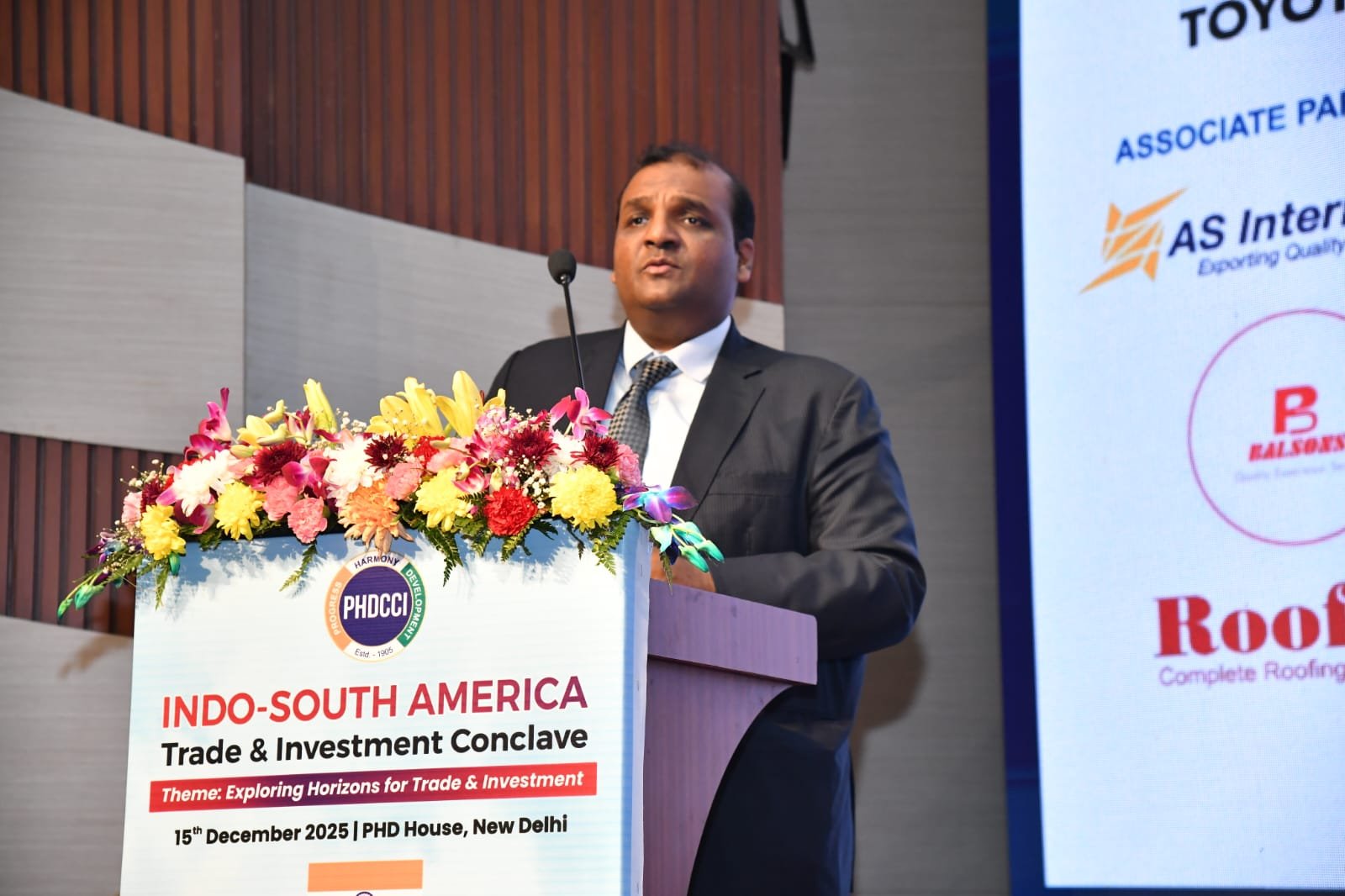
The Indo–South America Trade and Investment Conclave, held on 15 December at PHD House, New Delhi, underscored the growing strategic and economic convergence between India and the South American region. Addressing diplomats, policymakers, and industry leaders, Mr. Nishant Berlia, Chair, International Committee for the Americas, PHD Chamber of Commerce and Industry, outlined a forward-looking vision for deepening engagement across trade, investment, and knowledge partnerships.
Welcoming the diplomatic community and industry representatives, Mr. Berlia emphasised that the Chamber’s focus on South America has evolved organically, driven by sustained interest from Indian businesses. “The PHD Chamber has been working on strengthening the Indo–South America dialogue for quite some time now,” he noted, adding that the initiative reflects “the growing interest expressed by many of our members who see significant potential in deeper engagement with the South American region.”
Natural Complementarities, Strategic Opportunities
Highlighting South America’s economic profile, Mr. Berlia pointed to the region’s natural complementarities with India. Despite geographical distance, South America offers a compelling economic landscape, with a population exceeding 430 million and a combined GDP of nearly USD 4 trillion. Sectors such as aerospace, natural resources, innovation ecosystems, and advanced manufacturing present strong opportunities for Indian enterprises.
“While geographically distant, South America represents an attractive economic landscape for Indian businesses,” he observed, noting the already visible presence of Indian companies in the region and the growing interest of South American firms in the Indian market.
Placing this engagement within India’s broader economic trajectory, Mr. Berlia highlighted India’s emergence as a major global economic force. “India is fast emerging as a USD 2 trillion export economy and is effectively among the world’s largest economies today,” he said, aligning the Chamber’s work with the Prime Minister’s vision of a USD 30 trillion economy by 2047.
Beyond Trade: Investment and Long-Term Partnerships
While trade remains a key pillar, Mr. Berlia stressed that the relationship must evolve beyond transactional exchanges. Investment-led partnerships, he argued, are becoming increasingly central to sustainable economic ties. “It is important to emphasise that this engagement is not limited to trade alone. Investment-led partnerships are becoming increasingly significant,” he remarked, pointing to the growing global footprint of Indian multinational enterprises, including in South America.
Looking ahead, he highlighted India’s future role as a major commodity importer as it transitions into a middle-income economy. “India could well become one of the world’s largest, if not the largest, commodity importers,” he said, identifying a natural convergence of interests with resource-rich South American economies. At the same time, evolving global supply chains and the expanding role of services call for closer coordination and strategic foresight.
Three Priority Pillars for Cooperation
Drawing from extensive consultations with industry members, Mr. Berlia outlined three priority areas that could shape Indo–South America cooperation in the coming years.
The first is trade facilitation and improved market access, including progress on preferential trade agreements and free trade agreements. “As a Chamber, we would be keen to collaborate closely with the Excellencies and with the Government to provide constructive, industry-driven inputs into these processes,” he said, noting strong industry support for such frameworks.
The second pillar is investment-led partnerships, recognising that long-term economic engagement is strengthened through two-way investments. The third is knowledge and innovation cooperation, an area Mr. Berlia described as often underestimated. “There is sometimes a perception that innovation is concentrated in a few advanced economies, but in reality, many countries possess deep, specialised expertise,” he observed, citing sectors such as agriculture, aerospace, mining, sustainability, and niche technologies.


Leave a Reply