

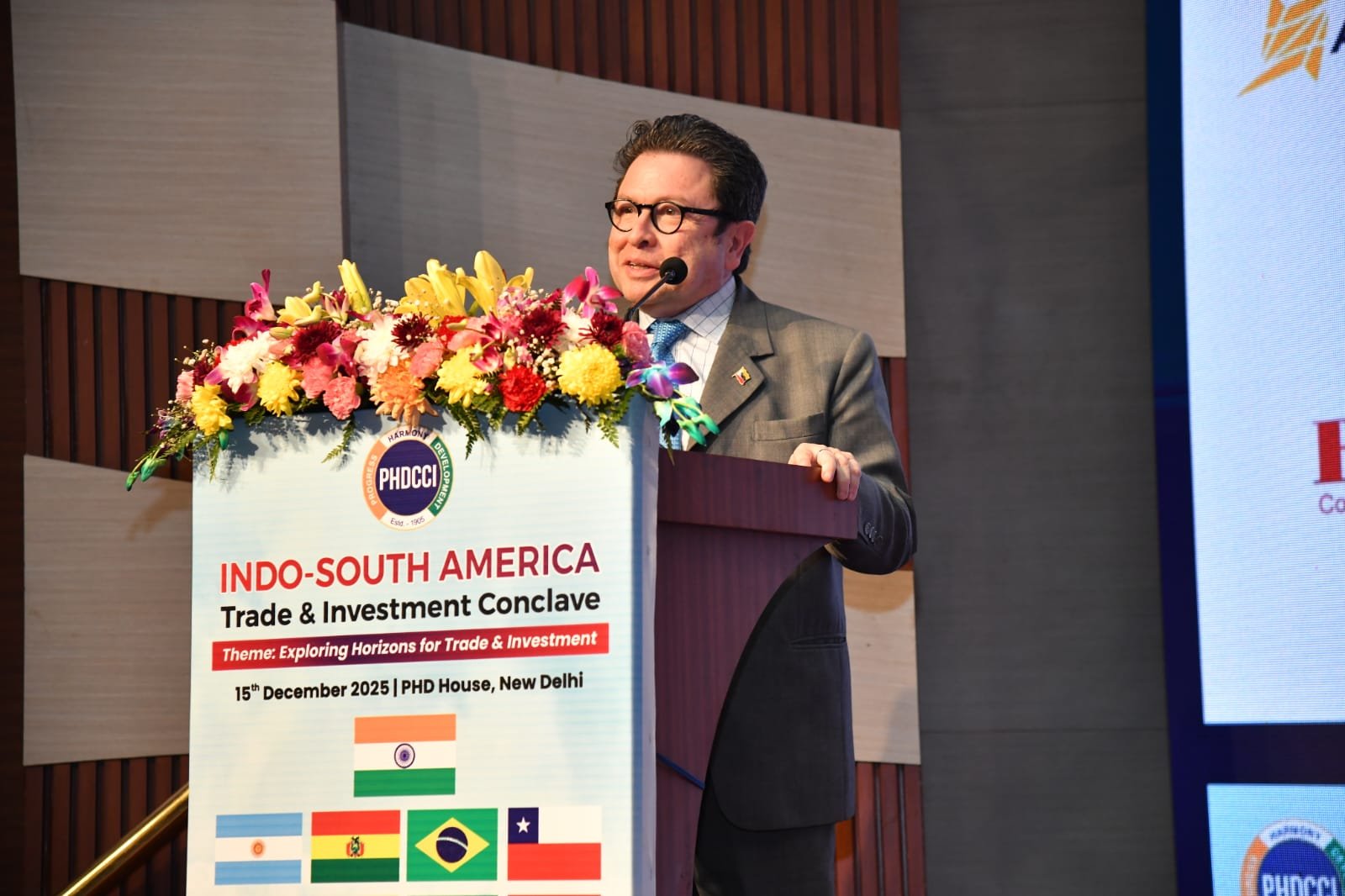
Highlighting Venezuela’s renewed outreach to global markets and its intent to diversify beyond hydrocarbons, Mr Juan Goldnick, Minister Counsellor, Embassy of the Bolivarian Republic of Venezuela in India, outlined the country’s vast trade and investment potential at the Indo–South America Trade & Investment Conclave.
Speaking on behalf of H.E. Ambassador Capaya Rodríguez González, who could not attend due to health reasons, the diplomat emphasised Venezuela’s readiness to engage international partners—particularly India—in energy, mining, manufacturing and non-oil exports.
“Venezuela offers many opportunities to international trade, both for the export of goods and services and for the development of productive activities,” he said, pointing to the country’s favourable climate, abundant natural resources and expanding industrial zones.
A Resource-Rich Economy with Strategic Potential
Spread across approximately 916,445 square kilometres, including mainland and island territories, Venezuela possesses extensive multipurpose land suitable for agriculture, mining, energy production and industrial development. According to the speaker, the country’s economic potential spans food production, hydrocarbons, chemicals, automotive assembly, textiles, plastics, technology and tourism.
“Venezuela is a country of great potential for primary production, mining, oil and transformative industries,” Mr Goldnick noted, underscoring the government’s focus on attracting investors with a productive, long-term vision.
Shared Vision Between India and Venezuela
The diplomat highlighted the convergence of Indian and Venezuelan perspectives on global economic stability, dialogue and cooperation.
“The Bolivarian Republic of Venezuela and the Republic of India share a global vision and a common commitment to dialogue, innovation and balanced cooperation,” he said, adding that such alignment is crucial in navigating today’s rapidly reconfiguring global order.
India and Venezuela share over 66 years of diplomatic relations, marked by energy cooperation and complementarities between India’s demand-driven economy and Venezuela’s resource base.
Energy Powerhouse with Global Relevance
Venezuela remains a key player in the global energy landscape. The country holds the world’s largest proven crude oil reserves, estimated at over 300 billion barrels, and ranks among the top ten countries globally in proven natural gas reserves.
“Venezuela is positioning itself as an important energy supplier to meet global demand, particularly that of India,” Mr Goldnick stated.
In response to global energy market volatility, Venezuela is also working to rebalance its economy, using mining and non-oil sectors as complementary growth engines.
Mining, Strategic Minerals and Energy Transition
Beyond hydrocarbons, Venezuela is endowed with significant mineral wealth, including gold and a wide range of strategic and critical minerals essential for modern industries and the global energy transition.
The diplomat noted that Venezuela possesses certified deposits of over 40 strategic minerals, including metallic, non-metallic and rare earth elements. These resources position the country as a relevant participant in global mining supply chains, particularly for technologies linked to renewable energy, electronics and advanced manufacturing.
“In the mining sector, Venezuela is emerging as an alternative productive engine, with emphasis on gold, coltan, bauxite and diamonds,” he said, stressing the government’s intent to attract responsible international investment.
Export Basket and Trade Facilitation
Venezuela is actively promoting non-oil exports as part of its economic diversification strategy. Key exportable products include:
· Fish and seafood
· Cocoa and green coffee beans
· Cereals, seeds and pulses
· Fertilisers such as urea and methanol
· Wood, steel and petrochemical derivatives
To facilitate trade, Venezuela has introduced tariff preferences and streamlined customs procedures, including a single-window foreign trade system aimed at reducing transaction costs for exporters and importers.
Special Economic Zones and Global Integration
A central pillar of Venezuela’s investment strategy is the development of Special Economic Zones (SEZs)—designated areas offering fiscal incentives and regulatory facilitation. These zones are open to international investors, including companies from BRICS countries, across sectors such as manufacturing, logistics, energy and agro-industry.
“Our goal is to promote commercial and productive integration with global markets and expand the international reach of Venezuelan production,” the diplomat said.
He also pointed to Venezuela’s efforts to strengthen bilateral business mechanisms, including business roundtables and sector-specific engagements, to build durable commercial bridges.
Looking Ahead
Addressing current economic challenges, the diplomat reaffirmed Venezuela’s confidence in overcoming external constraints through diversification, innovation and international cooperation.
“The Bolivarian government continues to promote the transformation of our economy and is prepared to receive investment with a clear plan for directing resources, technology and efforts,” Mr Goldnick stated.
Concluding his remarks, he reaffirmed Venezuela’s commitment to deepening ties with India.
“We reiterate our commitment to new initiatives and industrial projects for the growth and development of both our countries—India and Venezuela—in unity, solidarity and complementarity,” he said.


Leave a Reply