

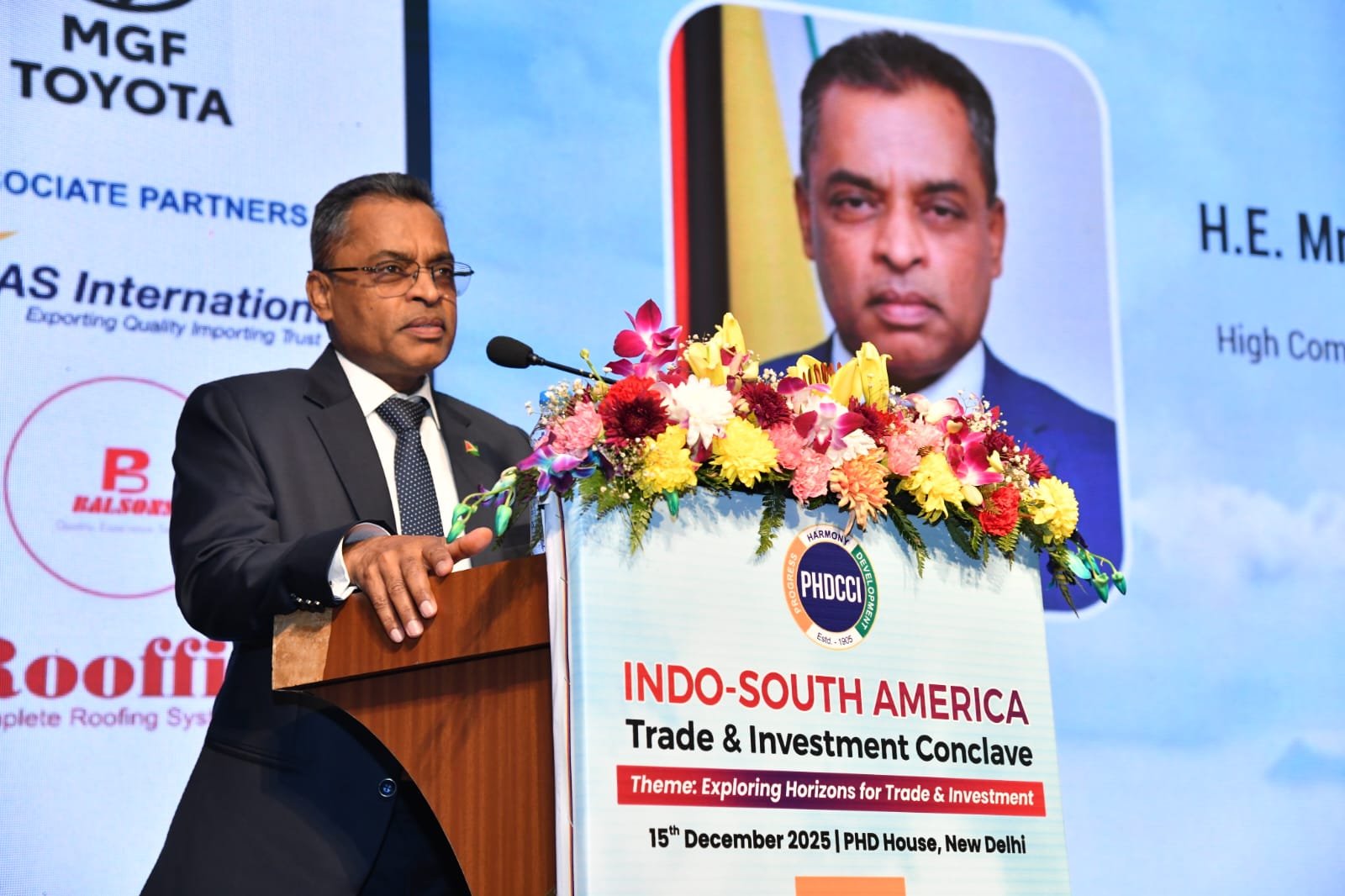
Guyana, one of South America’s smallest nations by population, is today scripting one of the most compelling growth stories in the Global South. Speaking at the Indo–South America Trade and Investment Summit organised by the PHD Chamber of Commerce and Industry, H.E. Mr. Dharamkumar Seeraj, High Commissioner of Guyana to India, presented a candid and forward-looking overview of his country’s economic transformation and its expanding partnership ambitions with India.
Opening his remarks with characteristic humility, the High Commissioner noted that Guyana may be small in size, but it is large in ambition. “We are a very small country in South America, with a population of just about 800,000 people—but with big ambitions,” he said, adding that scale must always be viewed in context, especially when engaging with a country like India.
From Agriculture to Energy-Led Growth
Historically, Guyana’s economy was anchored in agriculture, with sugar and rice exports forming its backbone, alongside seafood, fruits, vegetables, gold, diamonds, and bauxite. The country’s strong Indian diaspora—today constituting around 37 percent of the population—has its roots in the indentured labour brought to Guyana nearly two centuries ago to work on sugar plantations.
The economic landscape, however, has changed dramatically since the discovery of oil in 2015 and the commencement of production in 2019. “In 2019, our economy stood at just over USD 5 billion,” the High Commissioner noted. “Today, we have grown to nearly USD 25 billion.” Growth figures underscore this transformation, with Guyana recording some of the highest GDP growth rates globally—43.5 per cent in 2020, 63.3 per cent in 2022, and over 43 per cent in 2023. The country is projected to sustain growth of around 15 per cent annually over the next five years.
Oil production has risen from zero in 2019 to approximately 700,000 barrels per day, with projections of reaching 1.7 million barrels per day by 2030. This unprecedented expansion, he explained, is enabling transformative investments in infrastructure, human capital, and economic diversification.
Development Anchored in Climate Responsibility
Despite becoming a major oil producer, Guyana has placed sustainability at the heart of its development strategy. The High Commissioner highlighted Guyana’s long-standing Low Carbon Development Strategy, which prioritises food security, energy security, and climate security.
“We consider ourselves a leader not only in energy security, but also in climate security,” he said, pointing to the country’s unique position as one of the world’s most forest-rich nations. With nearly 87 per cent forest cover and 23 hectares of forest per capita, Guyana plays a critical role in global climate mitigation.
Guyana’s environmental stewardship has also been recognised internationally. Norway, he noted, has already paid Guyana USD 177 million under a forest conservation agreement, effectively compensating the country for preserving its forests. Building on this, President Dr. Mohamed Irfaan Ali recently launched the Global Biodiversity Alliance, inviting governments and companies to partner with Guyana in protecting forests and biodiversity while pursuing responsible development.
Food Security and Agro-Industrial Opportunity
Another major pillar of Guyana’s development agenda is food security, both nationally and regionally. As Chair of food security initiatives within CARICOM, Guyana aims to reduce the Caribbean’s food import bill—currently estimated at USD 6 billion—by 25 per cent by 2030.
“This is an ambitious programme,” the High Commissioner acknowledged, “but it creates enormous opportunities in agriculture, agro-processing, manufacturing, and logistics.” Investments are being sought in large-scale corn and soya production, climate-smart agriculture, drainage and irrigation systems, and improved regional supply chains.
Lower energy costs, driven by natural gas and renewables, are expected to unlock Guyana’s manufacturing potential, which was previously constrained by some of the highest electricity costs in the Caribbean and Latin America.
Infrastructure, Connectivity and the Digital Push
Guyana is also positioning itself as a regional connectivity and logistics hub. Plans are underway to develop a deep-water harbour on the Atlantic coast, offering parts of northern Brazil a shorter and more efficient export route through Guyana.
In parallel, digital transformation features prominently in Guyana’s future roadmap. The High Commissioner outlined plans for e-ID systems, digital health, digital education, and the adoption of digital public infrastructure. “Guyana is leaning towards India for obvious reasons,” he remarked, underlining India’s leadership in scalable digital governance solutions.
India–Guyana Collaboration on Energy and Renewables
India already has a visible presence in Guyana’s energy transition. Indian companies are upgrading transmission infrastructure, executing solar projects, and developing renewable energy hubs. Recently, an Indian firm signed a contract to power Guyana’s international airport entirely with solar energy. “Our objective over the next five years is to develop 100 megawatts of renewable energy, primarily solar,” the High Commissioner said.
Guyana also aims to become a technology and services hub for the Caribbean, supported by STEM education, innovation clusters, and affordable energy. “Our President wants Guyana to become the tech hub of the Caribbean,” he noted, adding that India’s partnership will be central to achieving this vision.
Health, Tourism and People-to-People Ties
Healthcare and tourism form another area of opportunity. Guyana has commissioned seven hospitals this year alone and is actively exploring collaboration with India in healthcare delivery, traditional medicine, and medical education. The country also seeks to position itself as a destination for health tourism and sports tourism, with several world-class hotels currently under construction.
While Guyana may not offer the white-sand beaches typical of other Caribbean destinations, it is promoting eco-tourism rooted in its rainforests, rivers, and biodiversity. Branding this experience as “rain, rivers and rum,” the High Commissioner highlighted Guyana’s unique tourism proposition, including its globally recognised El Dorado rum.
Concluding his address, H.E. Mr. Seeraj described Guyana as “ripe for investment,” particularly in agriculture, energy, manufacturing, infrastructure, technology, and tourism. “Because we are at a relatively early stage of development, we want to move at a speed and scale that is unmatched,” he said.
Guyana already imports nearly 80 per cent of its pharmaceuticals from India and maintains strong trade ties in textiles, electronics, and machinery. Drawing on personal anecdotes, the High Commissioner recalled the durability of Indian motorcycles he once used as an agricultural extension officer—an example, he said, of the reliability and adaptability that Guyana associates with Indian technology.
“We are open for investment at all times,” he concluded, inviting Indian businesses to become long-term partners in Guyana’s transformation journey—one that seeks inclusive growth, climate responsibility, and shared prosperity across the Global South.


Leave a Reply