

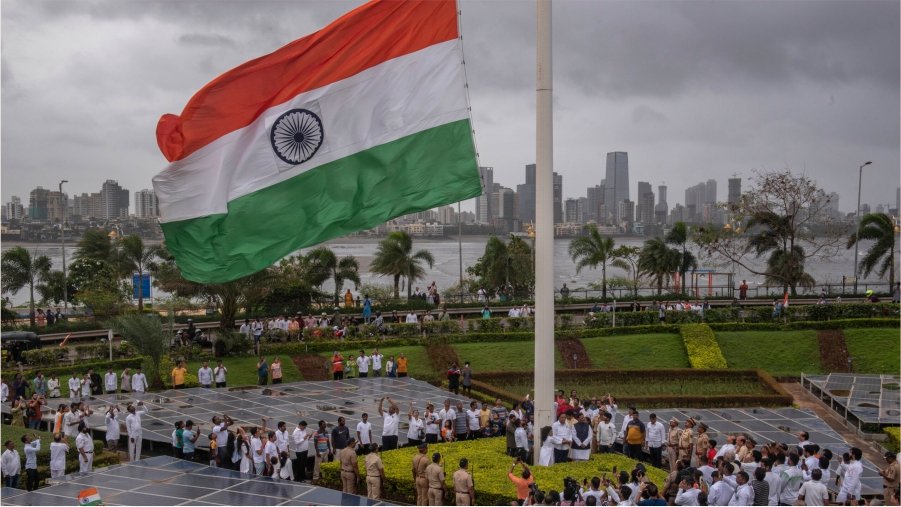
After the clarion call of Viksit Bharat (Developed India) by 2047 given by Prime Minister Narendra Modi, there is a growing sense in the corridors of global powers that India’s time has come. Long regarded as a rising power on the verge of arrival, India today stands as a critical pillar of the 21st-century global order, and there are ample reasons for this.
India is already the fourth-largest economy in the world and is poised to overtake Japan by 2027 to become the third-largest. It has also become the most populous country, surpassing China, but India’s real strength lies not in its total population, but in its demographic composition. More than 68% of its population falls within the working-age group (15–59 years), and the median age is just 28.8 years. India’s demographic strength, digital revolution, and diplomatic assertiveness are no longer aspirational talking points; they are active levers of global influence. The question before the world is no longer whether India will shape the new century — but how.
A New Geography of Power
Much of the 20th century was dominated first by the transatlantic alliance and later by the rise of China. The 21st, however, is witnessing the emergence of a multilateral world — with the United States, China, and India as its defining anchors. India’s geopolitical positions, straddling the Indo-Pacific, connected to the Middle East, and respected across the Global South, have made it indispensable to the balance of power.
India’s diplomacy has evolved from cautious non-alignment to strategic multi-alignment. It is a member of the QUAD, partnering with major democracies to secure the Indo-Pacific; it leads the Global South through forums such as the G20 and BRICS; maintains a strategic relationship with Russia; advances its Act East Policy; and fosters strong ties with Europe through FTAs. Few nations have managed to walk this tightrope with such finesse — though some of these relationships have faced pressure, particularly due to protectionist trade policies in the West.
India’s G20 Presidency in 2023 marked a turning point. By championing the African Union’s inclusion as a permanent member and emphasising global equity and digital inclusion, India positioned itself as a bridge — not merely between East and West, but between the developed and the developing world. In doing so, it recast multilateralism in moral and inclusive terms.
The Economic Engine
India’s rise in the 21st century is equally reflected in its economic transformation. With GDP growth averaging over 6.5% in the past decade, India has become the fourth-largest economy, on track to surpass Japan within the next few years and thus becoming 3rd third-largest economy of the world. These achievements are even more remarkable given that they followed the COVID-19 pandemic, a period when many economies struggled to recover — yet India not only revived but thrived.
In one of the most remarkable achievements of recent years, 171 million people have been lifted out of extreme poverty. According to the World Bank, the share of people living on less than USD 2.15 a day — the global benchmark for extreme poverty — fell sharply from 16.2% in 2011–12 to just 2.3% in 2022–23.
Credit for this transformation largely goes to the twin policy initiatives of the government — Atmanirbhar Bharat (Self-Reliant India) and Digital India — which together represent a hybrid model of globalisation and domestic capability-building. Unlike some nations that have retreated from global integration, India is redefining globalisation in its own image, where domestic strength complements global engagement.
The Digital Public Infrastructure (DPI) — comprising Aadhaar, UPI, and the India Stack — has revolutionised inclusion. Over 500 million people have gained access to formal banking through Jan Dhan accounts, and UPI now processes over 12 billion transactions monthly, making India the global leader in digital payments. These are not merely technological achievements but social equalisers on a national scale.
Simultaneously, the Make in India 2.0 and Production-Linked Incentive (PLI) schemes are attracting global supply chains seeking alternatives to China — the so-called “China + 1” strategy — especially in the post-COVID world. Apple now assembles 14% of its iPhones in India, while sectors like semiconductors, green hydrogen, and electric mobility are emerging as new frontiers.
For decades, India was known as an IT services superpower. Today, it hosts over 1,700 Global Capability Centres (GCCs) employing 1.9 million professionals and generating USD 64.6 billion in revenue (as of 2024). By 2030, the sector is expected to grow to USD 105 billion with 2,400 GCCs employing 2.8 million people. India’s ambition is clear — to be not just the world’s back office, but its workshop and innovation lab.
Demography and Democracy
With a median age of 28, India has the youngest workforce among major economies. In the age of AI, 16% of India’s workforce already possesses AI-related skills, positioning the country well for an AI-led economy. By 2030, India will contribute over 22% of global workforce growth. Yet, demography alone is not destiny — it must be matched with skills and purpose. The National Education Policy (NEP) 2020, with its emphasis on vocational education and global partnerships in higher education, is aligning India’s demographic dividend with its digital and economic future.
What makes India’s rise distinctive is its democratic character. In an era when authoritarian models of development are ascendant, India represents a unique combination of scale and democracy. Its ability to manage linguistic, religious, and regional diversity within a constitutional framework offers an alternative model to the world — that growth and freedom can coexist.
India’s democracy may be messy, argumentative, and imperfect, but it remains resilient and effective. In a world marked by wars, misinformation, and political polarisation, the scale and credibility of India’s electoral process provide legitimacy to its global leadership claims in a way few others can match.
India and the Global South
If the West views India as a strategic partner and Asia sees it as a regional power, the Global South regards it as a moral voice. From vaccine diplomacy during the pandemic to climate negotiations and debt relief advocacy, India’s outreach has been guided by empathy and equity.
The Voice of the Global South Summit, convened by India in early 2023, exemplified this shift. Bringing together representatives from over 120 developing nations, it gave a platform to those often excluded from global decision-making. During its G20 Presidency, India’s initiative to integrate the African Union as a full member of the G20 symbolised its inclusive vision. In doing so, India not only demonstrated moral leadership but also institutional stewardship.
India’s responsible conduct on the global stage was further evident at the COP26 Summit in Glasgow, where Prime Minister Modi announced major climate commitments, including the goal of achieving net-zero emissions by 2070 and raising non-fossil fuel energy capacity targets from 450 GW to 500 GW by 2030. Although still a developing economy, India has shown notable climate leadership, pursuing growth and sustainability in tandem.
Challenges Ahead
Despite its achievements, India’s path to becoming a responsible global power is not without challenges. The widening income gap, uneven regional development, and persistent social issues — such as caste and class tensions, the north–south divide, and linguistic rivalries — could constrain its potential. Diplomatically, managing complex relations with China while balancing ties with the U.S. and Russia will require agility. Recent trade policy shifts in the West have further complicated this balancing act.
To sustain its global credibility, India must strengthen institutional capacity — from judicial efficiency to policy implementation — ensuring its execution matches its ambition. The world already respects India’s ideas; it now expects results.
The Future
The story of 21st-century India is one of civilizational renewal and confidence. For centuries, India served as a moral and cultural compass for Asia — a source of philosophy, science, and commerce. Colonialism disrupted that arc, but globalisation is restoring it. This time, however, India’s influence extends beyond culture — it is shaping technology, diplomacy, and development models.
As global power becomes increasingly diffuse and multipolar, India’s strength lies in its ability to mediate rather than dominate — evident in its balanced approach to the Russia–Ukraine and Israel–Hamas conflicts. In both cases, India emerged as one of the few nations trusted by all parties to facilitate dialogue and promote peace.
India today stands as a bridge between worlds — between the established West and the emerging Global South, between technology and ethics, between economic ambition and social inclusion. The 21st century may not belong to any single nation, but it will be defined by those who can build bridges in an increasingly fragmented world. India, with its democratic ethos and development potential, is poised to do precisely that.


Leave a Reply