

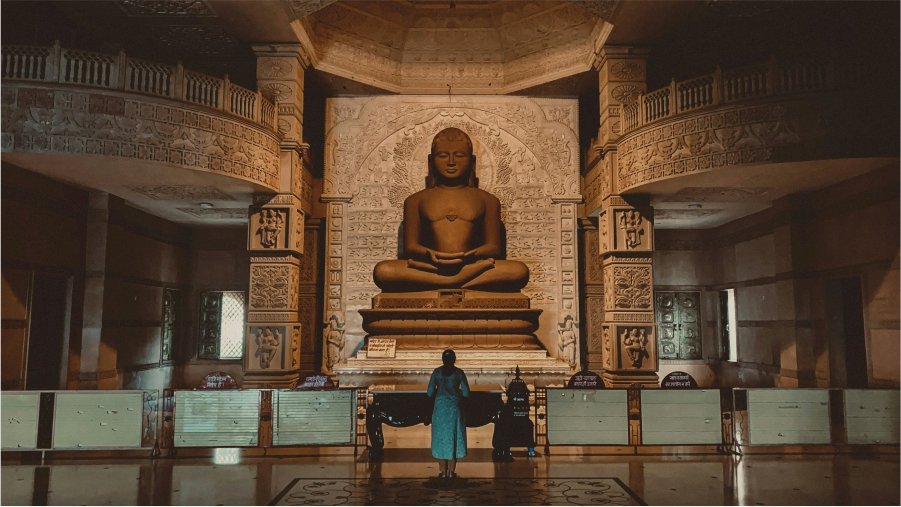
Indian history, which goes back thousands of years, is mainly surrounded by the development of spirituality in all Indian religions, including Sanatana Dharma, Jainism, Buddhism, and Sikhism. These religions have affected our ways of thinking, feeling, and acting. Among all, Jainism is considered one of the oldest religions of the world that has been propagated by twenty-four Tirthankaras (Gods) – Lord Rsabhadeva as the first, and Lord Mahaveer as the last. The main source of Jain philosophy is “Tattvartha Sutra”, a text written by Acharya Umaswami approximately 2000 years ago. This is the first Jain text written in the Sanskrit language. It contains ten chapters and 357 sutras. The motto of Jain religion, “Parasparopagraho Jivanam” (परस्परोपग्रहो जीवानाम्), is borrowed from this text. It means that it is the duty or religion of the living beings to help each other, whether human beings, plants or animals. We are interdependent in nature. There are the following fundamental pillars of Jainism: (1) The principle of Non-Absolutism (Anekantavada-reality has many sides), (2) The principle of Non-Violence (Ahimsa) and (3) The principle of Non-Possession (Aparigraha).
Jainism has popularised a pluralistic perspective to understand reality and truth (non-absolutism-Anekantavada) and proposed a state of living wherein we all can live peacefully despite our inner differences in thoughts and actions as human beings. Jainism propagates that each entity in nature has its own significance and nothing is useless. In any object, many contradictory characteristics can coexist. There are a very popular story of four blind men and an elephant. These blind men were holding different parts of the elephant and considered them equal to the whole elephant. Anekantavada postulates that the elephant is not the sum of its parts but rather is much bigger. Similarly, any society or organisation is made up of diverse entities or functions and each one of them has its own significance, and nobody is superior or inferior.
The principle of non-possessiveness discards the idea of control over wealth and power over others and suggests that wealth and power are a kind of responsibility given to you. Otherwise, the feeling of possession over wealth and power can likely ruin your mental capability to look at everything in a pluralistic manner. It is an illusion that power and money belong to only us; rather, we should see ourselves as trustees of such wealth and power and use it for the benefit of all. The feeling of possessiveness has made us a “tough competitor”; although we earn enough to live a good life, but still strive for more, and others should remain deprived (a feeling of jealousy and hatred). To adopt anekantavada, one should control a craving for the possessiveness of materialistic objects or too much accumulation of wealth.
The principle of ahimsa connects us with all living creatures and helps regulate negative emotions. The Jain principle of ahimsa is an ecological ethic. It is the highest point of the development of human civilisation and culture. Himsa (violence) is inextricably intertwined with human life, but it is not considered a part of its development, and it is defined as taking life away out of passion.
Furthermore, these principles are related to the concept of triple bottom line (Planet, People and Profit). Anekantvada teaches us that planet Earth belongs to all living and non-living creatures, so one should not destroy it. Aparigrah nurtures the tendency of non-possession and sharing wealth with others, thus inculcating the idea of profit sharing. Ahimsa is a feeling of respect towards all living creatures in the form of peaceful coexistence.
In Jainism, the combination of aparigraha (non-possessiveness) and ahiṃsā (non-violence) can lead to a more peaceful coexistence with all living beings, fostering a civilisation characterised by empathy, compassion, and humility. Embracing Aparigraha promotes conscious choices that minimise waste and resource utilisation, hence preserving the ecological equilibrium of the planet. Most modern economies rely on growth fueled by consumption, which contradicts the fundamental principles of Aparigraha. To effectively incorporate non-possessiveness into society, it is necessary to transition towards fairer and more sustainable economic systems that prioritise long-term welfare beyond the pursuit of immediate financial gains.
Triple Bottom Line (TBL) agenda, directed at companies, emphasises the economic, societal, and environmental contributions made by these enterprises by prioritising and harmonising the 3Ps – Profits, People, and Planet. Implementing the fundamental principles of Jainism can assist firms in achieving and exceeding their triple bottom-line objectives. The figure illustrates the correlation between the trilogy of Jainism and sustainable development objectives, utilising the notion of the triple bottom line.
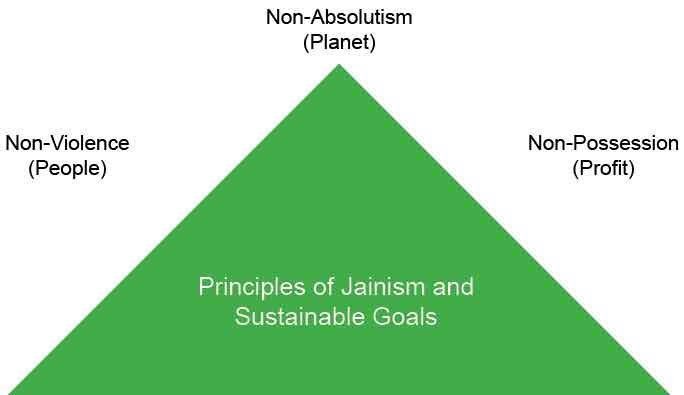
Principles of Jainism and Triple Bottom Line
Scholars have also examined Jainism’s fundamental scripture to gain a deeper understanding of the religion’s perspective on ecological philosophy. Jains believe that the honeybee (Madhukarāyate, मधुकरायते) is the most exemplary demonstration of sustainability in nature. The bee diligently collects nectar from each flower, extracting a small quantity without excessive depletion of any individual flower. Subsequently, the bees transform the nectar into honey – a delicious food that possesses healing properties. If humans were to learn from and emulate the honeybee, we would simply extract a small amount from nature, turn it into something useful, and be satisfied. Therefore, Jainism asserts that human necessities need to be diminished and cravings should be minimised, but levels of consumption should be maintained within rational limits.
Rsabhadev and Mahavira are cited among the pioneers who showed the world how to live life in accordance with the core principles of sustainable development. Their followers were famously instructed to: (1) restrict their consumption; (2) refrain from consuming meat; (3) prepare fruits and vegetables properly (such as removing seeds from foods that contain multiple seeds and keeping them for replanting and regeneration); (4) save sufficient seeds for personal use and also scatter seeds on the ground for wildlife; (5) avoid exploiting animals; and (6) show reverence towards the fundamental elements of nature – water, fire, earth, and air. As a result, Jains believe that the most important duty in life is to adhere to non-violence (Ahiṃsā paramo dharmaḥ, अहिंसा परमो धर्मः), and they also emphasise the need to actively support all sentient beings.
The findings of modern psychology suggest that “power damages the human brain” and thereby loses the ability to understand things from various perspectives. This is what goes wrong with several people when they reach the top positions, as they are not taught how to handle a power position in the larger interest of society. Modern workplaces are suffering from issues related to bullying, abusive supervision, toxic leadership, etc., due to a lack of control over negative emotions. Therefore, lord Mahaveer has always taught a lesson of “niyama” (self-discipline) and “sanyam” (self-control) so that others should not control your emotions and behaviour. According to Jainism, these three principles are a means to attain infinite bliss, infinite knowledge, and infinite perception. Such a soul is called a Siddha and is revered in Jainism. In Jainism, moksha is the highest and noblest objective that a soul should strive to achieve. Moksha means living a life with equanimity (samatvam or upekkhā) towards all living creatures, plants and animals.



Leave a Reply