

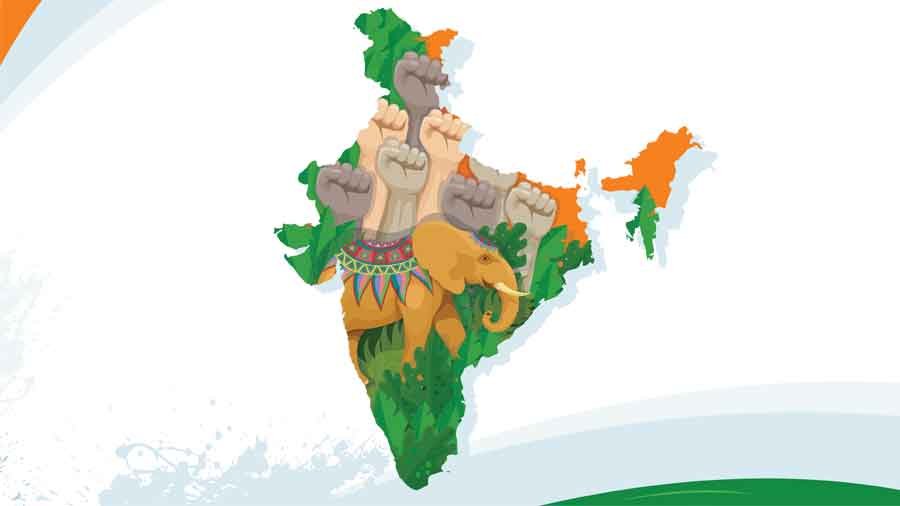
India in the 21st century has emerged as one of the world’s fastest-growing large economies, a pivotal geopolitical actor, and a hub for digital public infrastructure, while navigating complex challenges in jobs, urbanisation, climate resilience, public health, and federal governance. The period has seen major structural reforms and rising global influence through strategic partnerships and leadership in multilateral forums. Besides, India is a powerful country with a rich culture and heritage and the world’s largest democracy, with a population of over 1.4 billion people. The country’s integration into the global economy has been accompanied by economic growth during the last decade, raising its prominence as a global player. As its influence continues to grow, India will positively play an ever-more important role in shaping the 21st-century global order.
However, the contemporary world order is highly fluid and rife with uncertainties. Geopolitically, the world has undergone a massive metamorphosis. The old bipolar world order has given way to a new multipolar world order. The East-West conflict has paved the way for a new North-South conflict.
At the same time, there is a perceptible shift from geopolitics to geoeconomics. Due to changing global circumstances, India has aligned itself with Western groupings like the Quadrilateral Security Dialogue, or the Quad, whose member countries are the US, Australia, Japan, and India (Lahiry, 2024). As the new world order slowly emerges, humanity stands at a pivotal crossroads. This period of transition presents a rare opportunity for rising nations like India to play a decisive role and make a global impact. Global impact refers to the extensive and far-reaching consequences of actions, innovations, or events that affect countries, societies, and economies around the world.
For example,Ford, the American auto giant that exited India in 2021, has made a dramatic comeback, announcing a ₹3,250 crore investment to revamp its Chennai plant and officially roll out production by 2029. But this isn’t just a corporate comeback, it’s a statement. A global message that India isn’t just assembling cars anymore, it’s driving the future of mobility. Ford’s exit had left car enthusiasts heartbroken. But the return signals renewed confidence in India’s booming manufacturing ecosystem.
From skilled engineers to expanding EV infrastructure, Ford clearly sees India not as a market to test, but as a market to trust. This investment is more than metal and machinery, it’s about momentum. Global automakers are waking up to a new reality: India is no longer the world’s workshop; it’s the world’s growth engine. With Make in India accelerating, EV manufacturing picking up pace, and India’s automotive exports record high, Ford’s return could spark a new wave of auto innovation — one that blends international expertise with Indian ingenuity. This is India from factory floor to global powerhouse.
India in the Present World
Political:India has always been a peaceful country, striving for mutual respect and cooperation with all nations. India is one of the founding members of the Non-Aligned Movement (NAM) and played an important role in its establishment. India has also been a strong supporter of the United Nations and has worked to promote peace and security around the world. In recent years, India has become an increasingly important player on the global stage. India is now the world’s second-most populous country with over one billion people, and it is also one of the world’s fastest-growing economies. India is also a nuclear power and has a large military force. India has been able to use its growing economic and political clout to expand its influence around the world. For example, India has been working to strengthen ties with East Africa in order to counter China’s growing influence in the region. India has also been working to expand its economic ties with Latin America and Southeast Asia.
Economic:The economic role of India is significant, as it is currently the world’s fastest-growing major economy, with an annual growth rate of around seven per cent. In recent years, India has been a key driver of global economic growth, accounting for about 15 per cent of the world’s total economic output. India is also home to a large and rapidly growing middle class. Currently, there are around 300 million middle-class consumers in India, and this number is expected to grow to 600 million by 2030. This growing middle class is increasingly playing a role in global consumption patterns, with Indian consumers becoming an important market for a wide range of products and services. In addition to its economic role.
Military: India is also a major military power. The country is the world’s second-largest contributor to United Nations peacekeeping operations and is a nuclear-armed state with one of the largest militaries in the world.
Significant Roles Played by India
India is also a member of a number of important international organisations, including the United Nations, the World Trade Organisation, and the G20. Against this backdrop, India has taken certain steps in the security arena to build closer relations with the West through the Quadrilateral Initiative, defence collaboration and weapons purchases from the US, Israel and France and military exercises with ASEAN.
India also has close cooperation with Central Asia against Terrorism and has joined Asian Security organisations such as the Shanghai Cooperation Organisation. On the economic and cultural front, India continued to intensify its relations with friendly developing nations through the sharing of its resources, best practices and its economic cooperation programme for them. India indicated its readiness to continue to intensify its cooperation with its neighbours, its continental neighbour Africa and strengthen its Act East Policy. All of these aspects make India a significant player on the global stage.
Conclusion
India’s global impact is principally due its size and diversity. While on one hand, the challenges of development that India is addressing in the areas of health, education and infrastructure are similar to those faced by other developing countries, its democratic credentials, its soft power, its expertise in science and technology, software engineering and space technology, and its skilled manpower resources are at par with other developed countries. India’s contributions to the international multilateral institutions have been pivotal in ensuring the creation of platforms in these institutions for furthering the interests of developing countries.
The global pandemic has been one of the most disruptive challenges of this century, and India, through its Vande Bharat and Vaccine Maitri Programmes, was able to reinforce its position as a friend in need to other countries by facilitating air travel for their citizens stranded during lockdown and providing the much-needed vaccine for their population. India’s 21st-century journey is defined by technical and financial innovations, scale, speed, and systems, building world-class digital infrastructure, expanding physical infrastructure, repositioning in global supply chains, and striving for inclusive, sustainable growth.
The future lies in converting demographic potential into widespread prosperity through job-rich industrialisation, resilient cities, climate-smart development, high-quality public services, and strong institutions, so that India’s rise is globally far-reaching.
Reference
Lahiry, S. (2024). India and the Contemporary World Order: Retrospect and Prospect. The Review of International Affairs, 75(1190), 139-163.



Leave a Reply