

I joined the British Diplomatic Service 23 years ago. Many things have changed in that time. But one thing has remained constant: the diplomat’s penchant for sloganeering and jumping on the latest bandwagon.
When I arrived in Gujarat in March 2023, an oft-repeated phrase was “the living bridge.” Having a somewhat cynical edge after five overseas postings and numerous home assignments, I took this to be another overused cliché and even used it myself in the occasional speech.
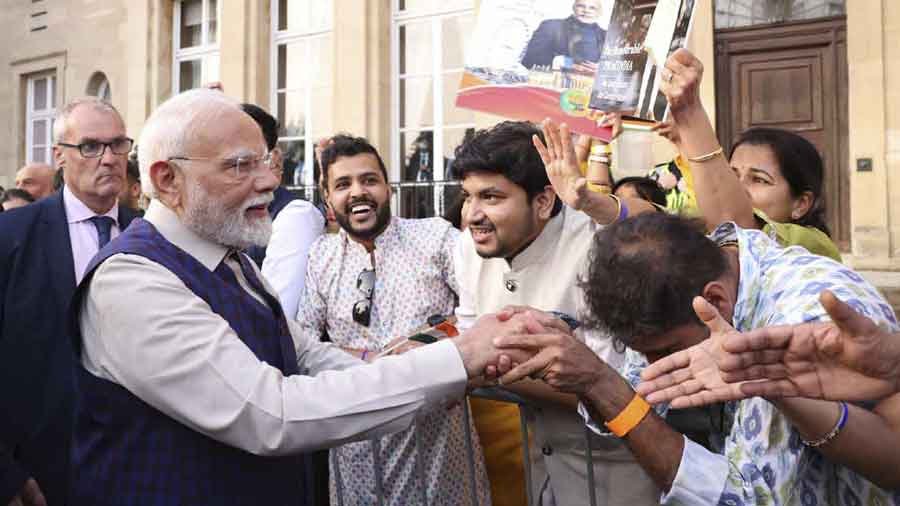
But I have come to realise how mistaken I was. It’s a real thing. PM Modi was absolutely right to coin the phrase. As the only foreign diplomat currently serving in Gujarat, I feel I’ve built a unique perspective on this underutilised asset.
The Indian diaspora in the United Kingdom numbers nearly two million, of which 45% have Gujarati roots. From post-war migration, in many cases via East Africa, to contemporary global mobility in education and business, the Indian community in Britain has transformed from a migrant population into an influential community shaping politics, business, and culture.
The living bridge helps build economic connections between our countries and regions in an increasingly turbulent geopolitical era. Diaspora-led business has become an important driver of UK-India trade, playing a significant role in investment flows, start-up ventures, and technology in areas such as fintech and digital infrastructure.
The living bridge gives the UK a unique lens through which to grasp opportunities to partner with Indian business. As Lord Karan Bilimoria, an exemplar of the living bridge, put it, “India is no longer looked upon as an outsourcing destination. We can partner with India, which is very advanced, and work together. India is actually ahead of the game.”
Lord Karan Bilimoria’s observation couldn’t be more true. As I’ve seen in my time in Gujarat, British companies are investing in India because of its skills base, advanced manufacturing economy, and business-friendly policies, while Indian companies tap into British research and innovation, tech expertise, and manufacturing heritage. Whether it’s the big names like JCB manufacturing in India, and Royal Enfield and TVS investing in motorcycle manufacturing and design in Britain, or the small family-run businesses, the partnerships and cooperation run deep.
On my visits to the UK, I can see for myself how the living bridge offers us a lens through which to see the relationship beyond capitals, offering unsurpassed depth and granularity. Gujarati families running manufacturing businesses in the English Midlands have a unique view of Britain and India which we should harness. The diaspora has a role in educating India about the incredible Britain beyond London and educating Britain about the vast India that lies beyond Delhi. This lends a wonderful context to our bilateral relationship.
It’s not all about business. The diaspora brings something else. During the pandemic, while India provided manufacturing clout for UK-developed vaccines, diaspora-led initiatives mobilised aid, oxygen supplies, and medical support for India. These acts of solidarity highlight perfectly the emotional depth of the living bridge which responds to human need.
I saw it again after the tragic crash of Air India flight 171 in Ahmedabad in June. We quickly set up our response to include a reception centre for the families of British victims, many of whom were of Indian and Gujarati origin. Seeing Indian-origin members of our consular response teams assisting diaspora families to navigate the tragedy was deeply moving and hammered home to me the reality of the living bridge.
Education is a key driver of the living bridge. Indian students have for some time been the largest cohort of overseas students studying at universities in the United Kingdom. Bilateral educational ties between India and the United Kingdom have entered a new phase. One of the privileges of my role in Gujarat has been to see the development of transnational education here. The future demand for university places in India is mind-boggling: enrolment by 2035 could reach 90 million annually. Of the nine UK universities that have plans to establish branch campuses across India, I have been proud to support three that have chosen to locate at GIFT City near Ahmedabad: Queen’s University Belfast, Surrey University, and Coventry University. These new campuses will reinforce the dynamism of the living bridge and supercharge collaboration on research and innovation, potential commercial spin-offs, and of course open the chance of British higher education to an even greater number of Indian students.
This year, Prime Minister Modi and Prime Minister Starmer launched Vision 2035, a comprehensive roadmap to guide our bilateral relationship into the future. It will expand ambition and deepen partnership between our countries, responding to global challenges and delivering tangible benefits to all of our people on trade and investment, technology and innovation, clean energy, and education. Our living bridge will be front and centre as we plot a vibrant new course together.
As India’s role in the 21st-century global order develops, and the UK redefines itself as an independent actor, the living bridge offers us a unique advantage. In a world of uncertainty, we have the chance to forge a people-focused future to the benefit of all, drawing on the opportunities offered by our recently announced UK–India Free Trade Agreement.
I was wrong about the living bridge. It is real, and very special. It is not static, but dynamic. It will evolve and develop, expand and enrich as our ties develop, and bring a level of understanding between India and the United Kingdom that no policy framework could ever possibly achieve.



Leave a Reply