

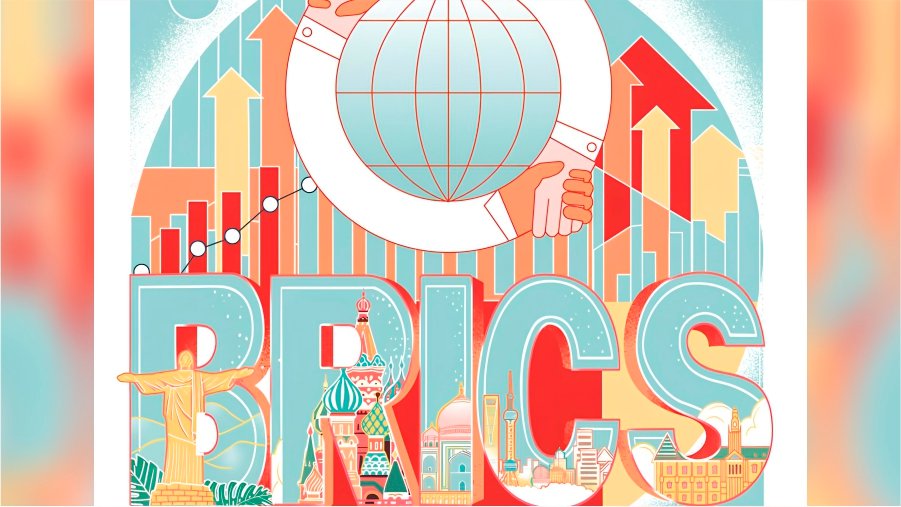
The group of seven (G7) most industrialised countries originated in 1975, with Canada, France, West Germany, Italy, Japan, the United Kingdom, and the United States as members. The group started with the summit of six countries (1975), and Canada joined in 1976. BRICS (an acronym for Brazil, Russia, India, China, and South Africa), is an economic bloc of countries. This followed the creation of the term “BRIC” in 2001 by Jim O’Neill, a Goldman Sachs economist. The “S” was added when South Africa joined in 2010 (Chen, 2025). The bloc became BRICS Plus (BRICS +) in 2024 and 2025, when Egypt, Ethiopia, Indonesia, Iran, Saudi Arabia and the United Arab Emirates officially joined. Also, the bloc introduced a category of “partner countries” at its 2024 summit. They are Belarus, Bolivia, Cuba, Kazakhstan, Malaysia, Nigeria, Thailand, Uganda, and Uzbekistan (Ferragamo, 2025).
BRICS Plus and the G7
The G7 countries, along with the European Union as a participant, are composed of large economies which have shaped the post-Second World War international order, “coordinating policies on macroeconomics, security, and global crises.” Their influence extends through the Bretton Woods institutions, established in 1944, like the International Monetary Fund and the International Bank for Reconstruction (International Monetary Fund, 2025). The International Bank for Reconstruction, otherwise called the World Bank (WB) and the IMF, have dominated the global economy for over 80 years, with “conditionalities” which have been criticised to have perpetuating poverty in developing countries.
In contrast, the BRICS Plus countriescame into force as a counterbalance to Western global influence. The group aims to challenge the dominance of Western powers and institutions, like the G7, by presenting a unified position for emerging economies on issues of global trade, finance, and international politics. The BRICS + group has become a major political and economic force over two decades, strengthening its goal to create an alternative to Western-led liberal internationalism. The group’s expansions in 2024 and 2025 demonstrated its growing weight and acceptability among developing countries. Brazil’s 2025 leadership of the BRICS + bloc aims to focus on better cooperation among the Global South (the developing countries of the world).
Clearly, the G7 and BRICS Plus nations do appear diametrically opposed in their operational methodology in addressing global issues such as the economy, politics and human rights. However, in an increasingly multipolar world, there is a need for partnership and interdependence for sustainable development, peace and security. Differences do exist, but no country, developed or developing, can ill-afford to mortgage its economic well-being and security. Therefore, it is imperative for the multipolar world—the international community—to build a strong architectural masterpiece of interdependent states. These are states that should be free from poverty, insecurity and environmental cataclysm, threatening international peace and security, today.
BRICS Plus and the G7 in a Multipolar World: The Case for the Developing World
Since the end of the Cold War in 1991, ending bipolarity and a brief period of unipolarity, multipolarity has been on the rise.Many countries of the Global South believe that those Bretton Woods institutions, especially the WB and the IMF, are failing to meet the needs of poverty-stricken nations, particularly in areas such as technology transfer and climate financing. As the United Nations Chief Scribe, António Guterres, has argued: “This system (Bretton Woods) was created by rich countries to benefit rich countries.” He emphasised that, “Practically no African country was sitting at the table of the Bretton Woods Agreement.” (Ferragamo, 2025).
Therefore, in a world of multipolarity, the BRICS+ +, and not solely the G7, holds promise to adequately address the developing countries’ challenges. The group has created an alternative finance system— the New Development Bank (NDB) and the Contingent Reserve Arrangement (CRA). Both are meant to provide an alternative to the WB and IMF, respectively. BRICS + states hope that alternative lending institutions can invigorate South-South cooperation and reduce dependence on traditional funding sources. Since 2014, the NDB has made a significant stride towards providing funding for infrastructure and sustainable development projects in emerging economies, and the CRA has functioned as a safety net, bolstering the financial stability of member countries (Punchng.com/…, 23 August 2023).
However, BRICS + and G7 nations need not be entangled in an unnecessary ideological rivalry. Despite differences in perspectives, synergies are possible between the WB/IMF and NDB/CRA. These primarily lie in joint-financing opportunities, scientific and technological sharing, and all-encompassingshared goals of global economic stability and development. Currently, the most developed BRICS + member states are notably Russia, China and India, while all G7 states are most developed. In this instance, many of the Global South developing countries swing between the most developed BRICS and G7 capitals, particularly African states. Thus, the African region is hopping between the two blocs, trying to strike a diplomatic balance to accelerate its development quest. Africa’s development needs to be conscientiously and concertedly addressed by African leadership in collaboration with global partners like the G7, BRICS + and the Group of Twenty (G20) advanced economies. Incidentally, all member states of G7 and seven BRICS + are in the G20, hoping they would pay attention to Africa. If not, the 21st Century may be another lost century for Africa. The African Union must leverage its opportunity in the G20 to leapfrog its development.
All the member states of BRICS Plus are the original 5: Brazil, Russia, India, China, and South Africa, plus 6 new members: Egypt, Ethiopia, Indonesia, Iran, Saudi Arabia, and the United Arab Emirates, admitted in 2024-2025. Also, there are other countries categorised as “partner countries,” namely, Belarus, Bolivia, Cuba, Kazakhstan, Malaysia, Nigeria, Thailand, Uganda, and Uzbekistan. Altogether, the number of member states can be put at 21, of which only 5 are African states, namely South Africa, Egypt, Ethiopia, Nigeria and Uganda. This is just 5 of 54 African countries. Of the 5 countries, only South Africa is considered to be the most developed, followed by Egypt, leaving the others struggling to leapfrog to development.
African states need to learn from China that transformed its society from ‘an overwhelmingly rural, impoverished, and technologically backward nation to a technological superpower, with cutting-edge technology companies, world-beating EV makers, an enviably extensive network of high-speed rail lines, and an expanding influence across the Global South in the course of only 40 years?’ (weforum.org/…, Jun 19, 2025). Currently, Africa is struggling with its ‘Agenda 2063: The Africa We Want’ (au.int/en/…, December 14, 2025 ). The Agenda 2063 is just 38 years away, but the agenda declaration began in 2013. The achievability of this development goal largely depends on the seriousness of African leadership and its development partners.
Conclusion
The G7 countries are composed of advanced world economies which have shaped the post-World War 2 international order. Their influence extends through the Bretton Woods institutions, like the WB and IMF, that have dominated the global economy, which have been criticised to have perpetuating poverty in developing countries. In contrast, the BRICS Plus countriesconstitute an alternative to Western global influence with a unified position for emerging economies on issues of global trade, finance, and inclusivity. The BRICS+ + group has become a major political and economic force in a multipolar world, especially increasing the influence of Global South developing countries.
References
au.int/en/…, December 14. (2025 , December 14). “Agenda 2063: The Africa We Want”. Retrieved from au.int/en/…: https://au.int/en/agenda2063/overview. Accessed November 8, 2025.
Chen, J. (2025, October 2). “Understanding BRICS: Brazil, Russia, India, China, South Africa & Beyond”. Retrieved from investopedia.com: https://www.investopedia.com/terms/b/brics.asp. Accessed November 7, 2025.
Ferragamo, M. (2025, June 26). “What Is the BRICS Group and Why Is It Expanding?”. Retrieved from cfr.org: https://www.cfr.org/backgrounder/what-brics-group-and-why-it-expanding. Accessed November 7, 2025.
International Monetary Fund. (2025). “THE IMF AND THE WORLD BANK”. Retrieved from imf.org/…: https://www.imf.org/en/About/Factsheets/Sheets/2022/IMF-World-Bank-New. Accessed November 8, 2025.
Punchng.com/…, 23 August. (2023, August 23). “BRICS Explained: All to know about emerging economies”. Retrieved from punchng.com/…: https://punchng.com/brics-explained-all-to-know-about-emerging-economies/. Accessed November 8, 2025
weforum.org/…, Jun 19. ( 2025, June 19). “How China got rich: a deep dive into China’s 40-year history of economic transformation”. Retrieved from weforum.org/…: https://www.weforum.org/stories/2025/06/how-china-got-rich-40-year-history-of-economic-transformation/. Accessed November 8, 2025.


Leave a Reply