

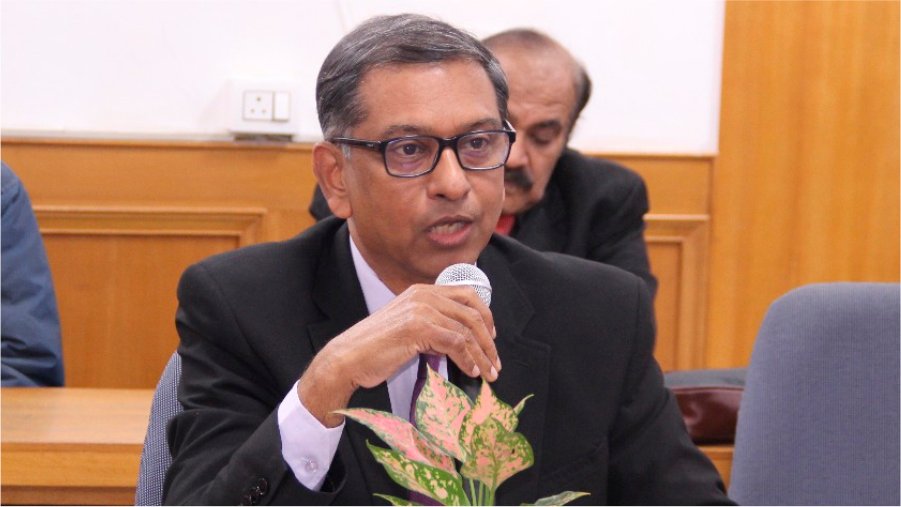
At a panel discussion hosted by the Indian Institute of Foreign Trade (IIFT), “Navigating Diplomacy Through Turbulent Times,” jointly with Diplomatist Magazine as part of the prelude series to Diplomatic Nite, Dr. Jones Mathew — Principal, Great Lakes Institute of Management, Gurgaon — brought a refreshing and deeply human lens to the evolving landscape of global diplomacy. While other speakers focused on geopolitics, conflict, and power realignments, Dr. Mathew redirected attention to a softer, yet profoundly influential, dimension of diplomacy: food, travel, and cultural exchange.
A World Shifting at Breakneck Speed
Reflecting on the global order, Dr. Mathew underscored how unpredictable the world has become — politically, economically, and socially. He invoked Bob Dylan to describe the moment we are living in. “When I see the title of today’s panel — The Times They Are A-Changin’ — I feel we’ve come full circle. The world shifts, sometimes violently, often unpredictably, yet inevitably.”
He didn’t mince words about the volatility of contemporary diplomacy: “Global decisions today are made at breakneck speed. Policies swing dramatically, alliances change overnight. Even the world’s most powerful nations have found themselves reconsidering decisions taken only months earlier.”
In a humorous aside that drew smiles from the audience, he referred to the acronym “TACO” — Trump Always Chickens Out — to illustrate the unpredictable nature of global leadership.
India’s Diplomatic Journey: From Non-Alignment to Balance
Dr. Mathew spoke of India’s shifting diplomatic posture: “For decades we navigated the world through non-alignment; then we recognised its limitations and recalibrated toward what we now call a ‘multilateral balanced’ strategy — a far more demanding diplomatic posture.”
This shift, he emphasised, has earned India credibility as a nation capable of problem-solving in an increasingly polarised world.
Soft Power: Where Real Bridges Are Built
Transitioning to the theme of his article for the Diplomatist Annual Edition, Dr. Mathew elaborated on the power of culinary and tourism diplomacy — two domains often sidelined in high-level discussions.
“Cuisine is landscape in a pot,” he said, capturing the imagination of the room. “When people taste a cuisine, they taste a history, a climate, a philosophy.”
He reminded the audience that India has a cultural depth that can shape global imaginations far more effectively than speeches or press releases. Revisiting the Incredible India campaign, he reflected: “It was our structured attempt to reintroduce India to the world — not as a land of snake charmers but as a civilisation of beauty and diversity.”
Yet, he pointed out that a great deal remains untapped: “India has 42 UNESCO World Heritage Sites — the same number as France — and yet the Eiffel Tower receives more annual visitors than all 42 combined. Our packaging, our storytelling, our outreach… they need to be sharper.”
A Call to Strengthen Global Institutions, Not Abandon Them
Dr. Mathew urged the global community to re-examine the role of international organisations. “Instead of assuming global agencies have outlived their relevance, perhaps we should focus on strengthening them,” he said. “Their failures were structural, not philosophical.”
He also flagged the need for new diplomatic frameworks in emerging frontiers — oceans, space, mineral security, and artificial intelligence.
A Humbling Reminder from the Universe
One of the most poignant moments of his talk was when he invoked Carl Sagan’s Pale Blue Dot: “It humbles us — reminding us that Earth is a tiny speck suspended in a cosmic dark. And yet we have fought for centuries over borders and pride.”
Musk may dream of Mars, he joked, “but until that becomes real, we must safeguard Plan A: diplomacy, dialogue, and coexistence.”
The Final Message: Diplomacy Must Be Human
Dr. Mathew concluded with a thought that lingered long after the panel ended:
“In navigating turbulent times, diplomacy must be both hard and soft — assertive yet sensitive, strategic yet human. Sometimes, the road to peace begins not in conference halls, but at dining tables, through shared meals and shared experiences.”
His reflections offered not just analysis, but perspective — reminding us that in a fractured world, sometimes the simplest human gestures of culture, cuisine, and conversation can do what the grandest geopolitical strategies cannot.


Leave a Reply