

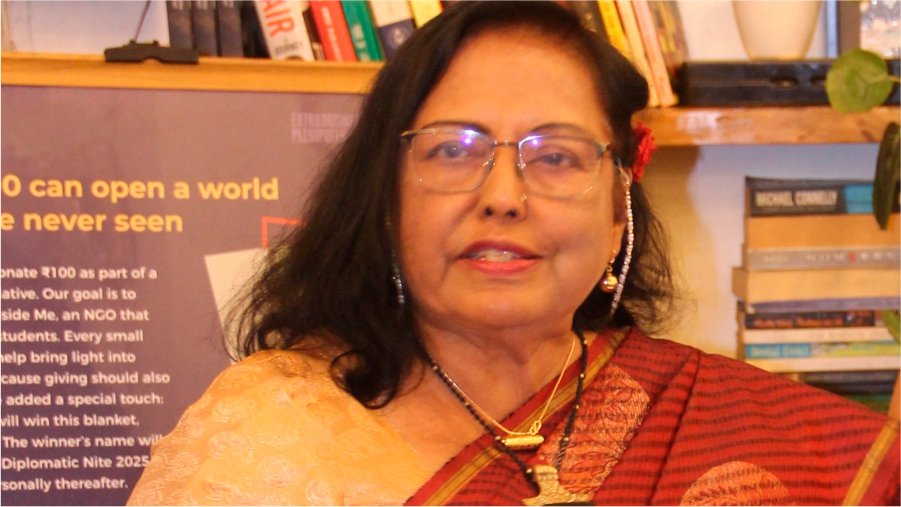
At a luminous literary evening organised by Diplomatist Magazine, Amb. Banashri Bose Harrison, former Ambassador of India to Sweden, elegantly brought to life the rich emotional landscapes of Heart Lamp, the 2025 International Booker Prize–winning collection by Banu Mushtaq (translated from Kannada by Deepa Bhasthi).
She quoted a wry mentor who once called her “a distinguished diplomat, now an extinguished diploma” — a line that drew smiles, but underscored her lifelong love for surprising narration.
She began by grounding her reading in a tribute to Rabindranath Tagore, reciting his famous poem: Where the mind is without fear and the head is held high…
For Amb. Harrison, the lines resonated deeply with Mushtaq’s own bold literary voice. She noted the historical parallel: just as Tagore broke new ground, Banu Mushtaq is breaking barriers — her Heart Lamp is the first Kannada collection (and first collection of short stories) to win the International Booker Prize.
Amb. Harrison chose to read from “Stone Slabs for Shaista Mahal”, the opening story in the collection. In this piece, Maroon’s voice emerges as she struggles to define her identity within her marriage. She wrestles with language — what to call her husband, what to call herself — rejecting labels that reduce her to servitude. In Mushtaq’s words (via the English translation), Maroon reflects: “If I use the term yajamana and call him ‘owner,’ then I become the servant, as if I am an animal or a dog… I have earned a degree. I do not like these owner–servant roles.”
When her husband, Mujahid, takes a second wife, Maroon returns to her parents’ home. Amb. Harrison’s voice softened as she read the heartbreaking conclusion: Maroon pours kerosene on herself, convinced no one cares — then her daughter, Salma, rushes out, calling “Ami, Ami, don’t leave,” hugging her mother until she whispers, “Forgive me, my darling.” The scene reverberated through the room, underscoring Mushtaq’s power to convey desperation, love, and dignity in a single, devastating gesture.
In conversation with Shibani Seth, Amb. Harrison reflected on why she chose Heart Lamp.
“I was drawn by the ‘firsts’ — the first Kannada book to win, the radical translation, the stories of women whose everyday lives demand audacity in silence,” she said. She described Mushtaq’s characters as quietly rebellious: not loud revolutionaries, but women who bend the system from within: “They don’t shout from podiums,” Amb. Harrison observed. “They stay within their society’s boundaries but push those boundaries with their very existence. That, to me, is more powerful than overt protest.”
Shibani asked which story struck her most. Amb. Harrison didn’t hesitate: “The first story. Shaista Mahal’s voice. Her refusal to be defined as a wife. Her pain. Her dignity. That’s universal — it’s not just one religion or culture. It’s about human respect.”
She added that Mushtaq’s writing felt deeply personal: “The legal background, the activism, the protest literature — it’s grounded in lived experience. Reading this, you feel you are standing within the homes she describes, hearing the quiet ache, seeing the small acts of courage.”
Turning to the audience, Amb. Harrison made a heartfelt appeal:
“If you want your worldview to expand — if you wish to understand hidden realities, to meet women who carry both pain and fierce hope — read Heart Lamp. This is not distant or exotic. These are stories of everyday lives shaped by injustice, faith, love, and resistance.”
She said she believed in the power of literature to humanise; to connect us with experiences we might never live but can deeply empathise with. “Women who change their world don’t always raise banners. Sometimes, they change it with the strength of their hearts and the clarity of their thoughts. Heart Lamp shows us how.”


Leave a Reply