

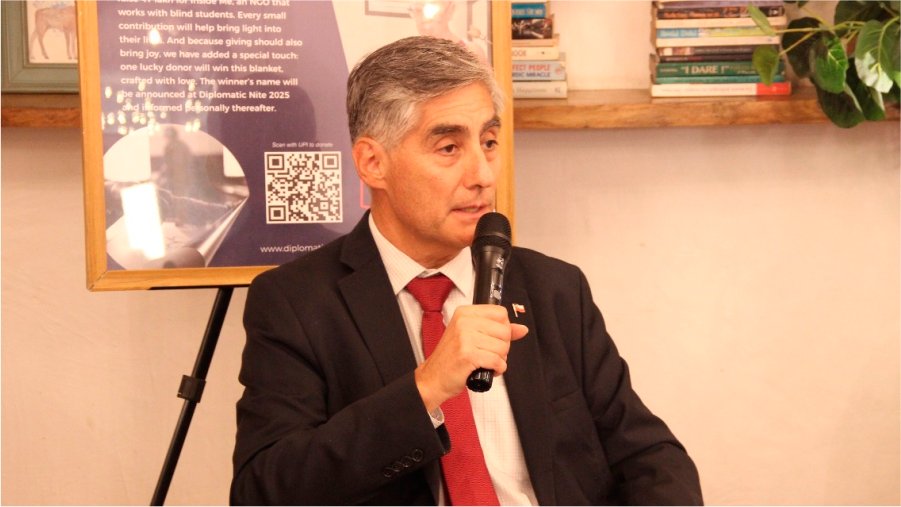
There are moments in literary gatherings when the atmosphere subtly shifts—when an ambassador, usually known for sharp diplomacy and policy depth, reveals a gentler landscape within: one shaped by poets, memory, and the instinctive human longing to express. Such a moment unfolded when H.E. Juan Angulo M, Ambassador of Chile to India, took the stage for the Literary Evening with the Ambassador, organised by Diplomatist Magazine on 18th November 2025.
Ambassador Angulo reminded the audience that Chile holds a remarkable distinction: two Nobel Prizes in Literature, both awarded to poets—Gabriela Mistral and Pablo Neruda—who were not just literary giants, but diplomats.
He recalled how several Chilean diplomats continue this tradition today, publishing poetry even as they serve in postings around the world, including India. Some of his predecessors in New Delhi have also written books inspired by their time here.
“When I received the invitation,” he shared, “I immediately connected with our history of diplomatic writers.”
It was a perfect doorway into the two poets he chose to read—two voices radically different, yet bound by the same Chilean soil and a fierce emotional honesty.
Before reading, he spoke gently about Gabriela Mistral, the first Latin American to win the Nobel Prize in 1945. A teacher, a traveller, a social reformer, and an advocate for indigenous rights, she wrote with a voice that was both intimate and societal.
“She gave a voice to the voiceless,” he said.
He then read her poem kanc in English translation—a piece both tender and aching. It tells the story of four young girls who dream of growing up to be queens but instead meet the realities life often delivers: limitations, losses, and unfulfilled desires.
As he narrated the lives of Rosalia, Soledad, Herminia and Lucilla, the room fell still. You could feel the sadness, the beauty, the truth in Mistral’s line—that dreams and destinies do not always align, but the power of dreaming must never leave us.
When he finished, the audience paused before applause—allowing the weight of the poem to settle.
From Mistral’s quiet strength, he transitioned to the fire and longing of Pablo Neruda, Chile’s second Nobel Laureate (1971). A poet, diplomat, politician, and Marxist, Neruda was a writer of passion—of love, injustice, memory, and revolution.
Ambassador Angulo chose Neruda’s iconic Poem No. 20 from “Twenty Love Poems and a Song of Despair.” He reminded the audience that Neruda wrote it at just 19, yet it remains one of the most beloved poems in the Spanish-speaking world.
He read lines filled with aching remembrance:
“I can write the saddest verses tonight…
To think that I do not have her.
To feel that I have lost her.”
His slow, deliberate rendering—first in Spanish, then in English—brought the raw essence of Neruda alive. For a moment, it felt like the Chilean night sky had spilled into the room.
Conversation Host Shibani Seth then began a thoughtful and fluid dialogue with the ambassador. Her first question captured the essence of the evening: “Why do you think these poems continue to feel timeless?”
H.E. Angulo responded with clarity: “Because they speak of human characteristics. We have loved since the beginning, and we will love for millions of years to come, I suppose. Poetry like Neruda’s helps us express what many cannot say.”
He added that love poetry is universal—it transcends cultures, religions, and eras.
“Feelings will always exist,” he said. “These authors remind us that we are all human.”
Shibani then asked what moved him most about Neruda.
His answer wove together literature, politics, and history. Neruda, he explained, was a writer deeply connected to social realities—from inequality in Chile to the freedom struggle in India. Having visited India three times, Neruda maintained ideological closeness with the Indian independence movement.
“There are links between our countries,” he reflected, noting that Neruda’s poetry is particularly loved in Bengal.
The discussion turned back to Gabriela Mistral. Shibani asked what stayed with him most about her work. He described her deep connection with children and with rural Chilean life. But he also touched on something profoundly human: the hidden dimensions of her identity.
Mistral, he explained delicately, was in love with a woman at a time when such love was forbidden. Her yearning, unfulfilled desires, and social constraints fed her creativity.
“Imagine someone with this need to express herself who cannot,” he said.
“Perhaps that is why her poetry carries such intensity.”
It was a rare, honest, human insight—offered with sensitivity.
Smiling, Shibani posed the most difficult question: “Whom should the audience read first—Mistral or Neruda?” He laughed softly before answering.
Mistral is profound, he said, but Neruda is more universal—his works spanning love, war, landscapes, travel, and revolutionary ideals. He wrote about Asia, about Machu Picchu, about Spain. His experiences and passions were global.
Still, he chose Mistral to read that evening because she too represents Chile’s soul—and because both were diplomats, mirroring the spirit of the event.
If diplomacy is often seen as structured and strategic, this evening revealed its more intimate side—the diplomat as storyteller, as reader, as custodian of culture. Ambassador Angulo’s presence reminded everyone that poetry is not a luxury of leisure—it is a mirror to history, to pain, to love, to the unfinished business of being human.
As he said toward the end: “Dreams may not always unfold as we imagine, but we must keep dreaming. Life is an open canvas—it is up to us to choose the colours.”
And for a literary evening, nothing could have been more fitting.


Leave a Reply