

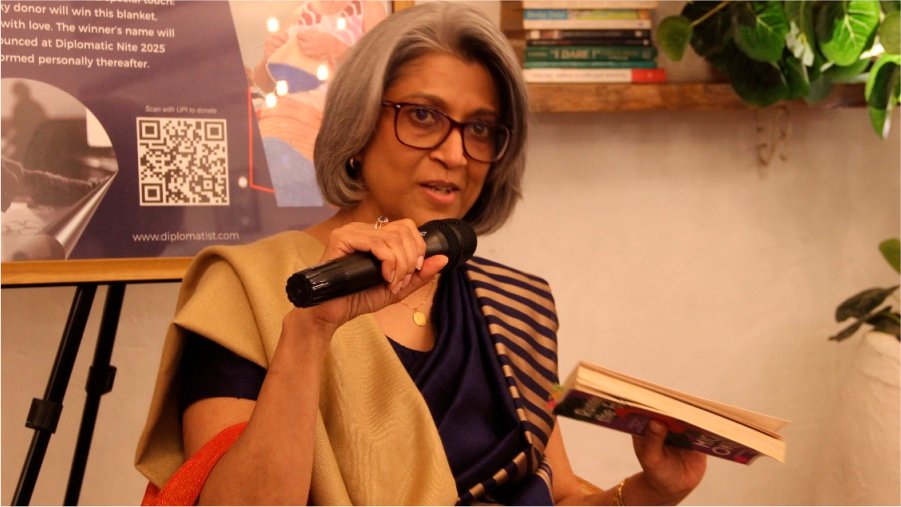
The fourth event of the Diplomatist Prelude Series unfolded in the soft warmth of The Tea Room by Blossom Kochhar—an evening scented with tea, conversation, and the rustle of turning pages. Amid this intimate setting, H.E. Mahishini Colonne, High Commissioner of Sri Lanka to India, took the audience on a journey across memory, myth, and imagination through Michael Ondaatje’s Running in the Family.
The moment she began speaking, the room settled into an attentive hush. Her connection with the text was palpable—not simply as a literary admirer but as someone who recognised, instinctively, the emotional geography of the book.
Introducing Ondaatje’s work, H.E. Colonne described it as a book that “refuses to fit into a single shelf.” It is, she said, “a river of images”—unpredictable, poetic, unsentimental yet affectionate, much like the way we remember our own families. Though Ondaatje is known globally for The English Patient, this book occupies a different space: deeply personal, playful, reflective, and woven with the textures of Sri Lanka.
“It captures the essence of Sri Lanka in a way that is intimate yet universal.” And with that, she began reading.
Her first chosen excerpt transported the audience from a cold Canadian winter night into the humid breath of Sri Lanka. Ondaatje’s fevered dream—of chases, jungle animals, dogs circling his father—unfolded in her voice with a cinematic swiftness.
As she read, it felt as if winter and tropics were colliding within the walls of the Tea Room.
Her second reading shifted from dreamscape to cartographic imagination. She read with steady clarity the ancient names of Sri Lanka—Serendib, Taprobane, Zeylan, Island of Dreams—each name a relic of traders, sailors, storytellers, and conquerors.
The final offering, “Sweet Like a Crow,” filled the room with bright laughter. Every outrageous comparison—“like a crow swimming in milk,” “like Air Pakistan carrying a burning typewriter”—landed with delight. It was Sri Lanka rendered through mischief and music.
After the reading, Conversation Host Shibani Seth guided the High Commissioner into an exchange that felt more like two people rediscovering a shared love for stories.
Shibani began by asking what aspect of Running in the Family felt closest to her heart. The High Commissioner paused, then smiled gently.
It wasn’t one character or one moment, she said, but the way the book evokes feeling.
“When we think of home, we don’t think of any single thing. It may be the smell of rain, a childhood street, a half-remembered story. Ondaatje captures that beautifully.”
In that moment, it became clear that this was not just a diplomatic reading—it was an emotional homecoming.
Shibani then asked which character lingered with her long after reading. The High Commissioner answered instantly: his father.
Not as a neat biographical figure, she clarified, but as a constellation of stories—contradictory, affectionate, sometimes absurd.
“The father appears in fragments—warmth in one story, chaos in another. That, to me, is the truth of family. And that is why he remains unforgettable.”
Her articulation drew a thoughtful nod across the room.
When asked why she gravitated toward this particular text, the High Commissioner’s response was deeply relatable. “Perhaps it is only in our late 30s or 40s that we truly begin to look back at our childhood, our history.”
She explained that Ondaatje’s exploration of exile and return—of leaving home to understand it better—mirrors the experiences familiar to diplomats, migrants, and anyone who has lived between worlds.
Shibani’s final question—“Why this book for our audience?”—brought an answer that felt like a gentle invitation.
“There is something for everyone—poetry, humour, history, tenderness. And the language alone is worth the journey.”
The applause that followed was warm, knowing, and thoroughly deserved.


Leave a Reply