

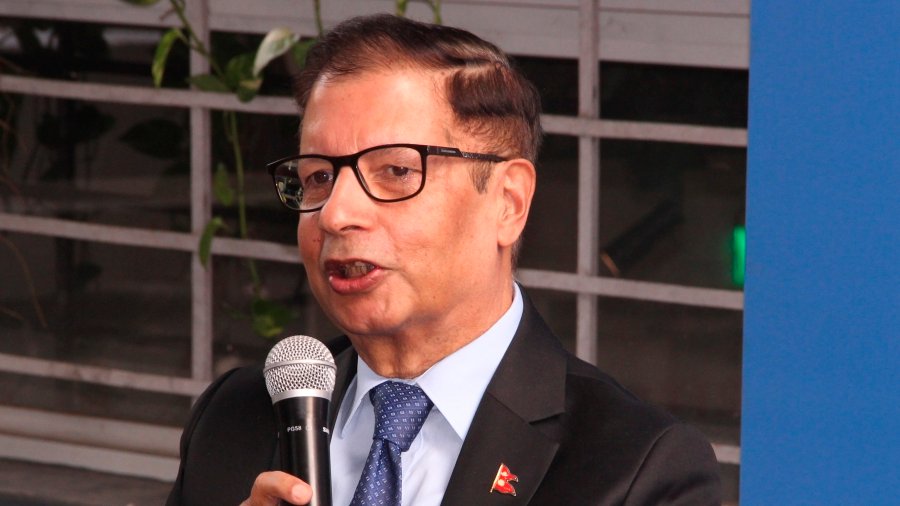
On 14 November 2025, at an engaging gathering at Triveni Kala Sangam, Diplomatist Magazine hosted a panel discussion and photo exhibition, Frames of Heritage and Echoes Beyond Borders – An Artistic Dialogue, bringing together diplomats, artists, and cultural leaders. Among the distinguished speakers was H.E. Dr. Shankar Prasad Sharma, Ambassador of Nepal to India, who emphasised the deep civilisational bond shared by Nepal and India.
A Bond Rooted in Civilisation
H.E. Dr. Sharma articulated the exceptional nature of Nepal–India ties, describing them as a relationship “rooted in geography, culture, tradition, and religion.” These layers, he noted, form the basis of a bond that stands apart in South Asia. Yet, he argued that the present moment calls for renewed imagination: “The key question now is how we collectively use this soft power—how we strengthen our economic ties, how we leverage our shared cultural heritage, and how we further enhance people-to-people relations for mutual social and economic benefit.”
Kathmandu Valley: A World Heritage Mosaic
H.E. Dr. Sharma led the audience through a thoughtful and vivid portrayal of Nepal’s unique cultural treasures. Within just 110 square kilometres of Kathmandu Valley lie seven UNESCO World Heritage Sites—a density unmatched anywhere globally.
“You may find many historical sites in Rome, Athens, or Cambodia,” he noted, “but they are generally clustered under single heritage groups. Kathmandu Valley, however, houses seven distinct UNESCO sites within a compact area, each with its own cultural and historical identity.”
Among them are the iconic Durbar Squares of Kathmandu, Patan (Lalitpur), and Bhaktapur, preserved through contributions from Austria, Germany, the United States, India, and others. These, H.E. Dr. Sharma emphasised, are not just remarkable structures—they are living testimonies to centuries of Indo–Nepal cultural interconnectedness.
Historical Ties Woven Across Generations
The Ambassador traced these ties back to the Licchavi dynasty’s longstanding links with Vaishali in Bihar, followed by the Malla rulers’ deep association with the Maithili cultural sphere. “Even today,” he observed, “Maithili bhajans and cultural expressions are widely seen in Kathmandu.”
He also highlighted the marital ties of Nepal’s Rana and Shah families with Indian royal lineages—connections that spanned regions and reinforced cross-border social and cultural bonds over centuries.
Shared Spirituality: The Footsteps of Buddha and Shankar
H.E. Dr. Sharma turned to Buddhism as a powerful shared heritage. Lumbini, the birthplace of Lord Buddha, and the ancient stupas of Swayambhu and Boudhanath in Kathmandu Valley form a sacred circuit linked intrinsically with India’s spiritual centres of Sarnath, Bodh Gaya, and Kushinagar. This makes the jointly promoted Buddhist Circuit a cornerstone of religious tourism diplomacy between the two countries.
Similarly, the Pashupatinath Temple, one of Hinduism’s holiest shrines, is an emblem of Indo–Nepal religious synergy. The ambassador noted a unique tradition: “A unique aspect of this temple is that its priests must come from South India—this is mandatory.” Just as Indian priests serve in Pashupatinath, Nepali priests serve at the Kashi Vishwanath Temple in Varanasi and the Ram Mandir in Ayodhya.
The seventh UNESCO site, Changu Narayan, one of the oldest Vishnu temples dating back to the 4th or 5th century, further reinforces the shared scriptural and spiritual lineage of the two countries.
Cultural Routes as Pathways to Prosperity
Beyond UNESCO-recognised treasures, H.E. Dr. Sharma highlighted Janakpur’s Janaki Mandir, Ramayana-related sites, and other culturally significant locations forming the Ramayana Circuit and additional heritage routes now being developed jointly by Nepal and India.
These, he emphasised, are not mere repositories of the past—they are dynamic avenues for future cooperation. “Our cultural heritage is not only about preserving the past; it is also about creating opportunities for the future,” he said.
Every year, hundreds of thousands of pilgrims travel between the two countries, weaving threads of connectivity—spiritual, cultural, and economic. These exchanges, he said, reinforce the “people-to-people ties, deepen cultural bonds, and generate economic benefits for both countries.”
Heritage as an Engine of Diplomacy and Development
H.E. Dr. Sharma concluded with a compelling reminder: “Heritage, therefore, is both a cultural connector and an engine of economic development. It is our collective responsibility to preserve these treasures and find innovative ways to harness their full potential for our shared prosperity.”
His remarks at Triveni Kala Sangam beautifully captured the essence of the evening—where art, memory, and diplomacy came together to remind us that cultural heritage is not merely inherited; it is activated, celebrated, and strategically nurtured.


Leave a Reply