

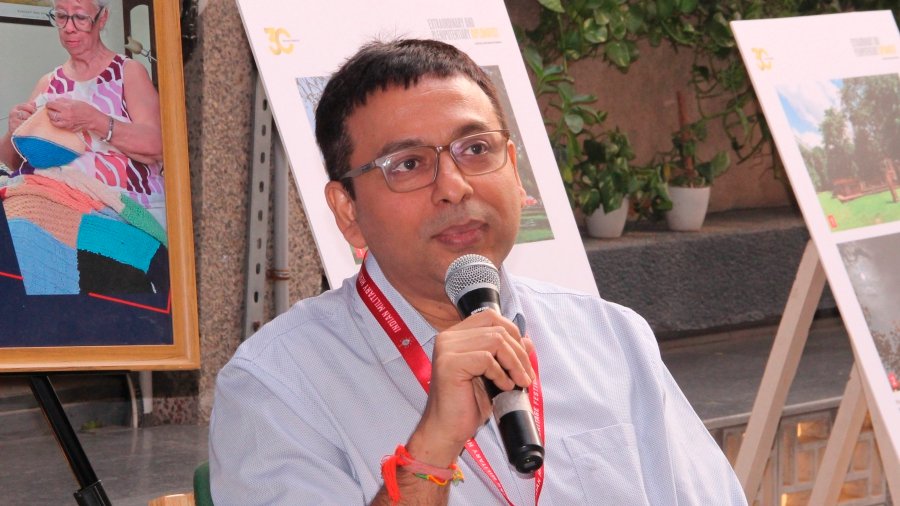
At Frames of Heritage: A Photo Exhibition and Echoes Beyond Borders – An Artistic Dialogue, held on 14 November at Triveni Kala Sangam, Kallol Bhattacharjee, senior journalist with The Hindu, offered a compelling perspective on photography—one that straddles history, diplomacy, and the media.
“Everyone here has talked about photography and heritage from their point of view, mainly diplomatic. I, being a media person, would like to speak about photography and images as we encounter them in our day-to-day professional lives, contextualised within Indian history,” Bhattacharjee began, setting the tone for a discussion that was as much about memory and documentation as it was about cultural dialogue.
Reflecting on India’s freedom struggle and the evolution of its diplomacy, he noted, “For me, when I look back at India’s freedom struggle and our diplomacy—which is what I write about daily—what stands out is how deeply both are rooted in photographic memory. Mahatma Gandhi, for example, was immortalised by the great American photographer Margaret Bourke-White. Her images of India’s freedom struggle, of Gandhi and Nehru, are iconic. Nehru himself built the Indian Foreign Service by including people from diverse backgrounds—radio, television, cultural professions—laying the foundations of India’s cultural diplomacy.”
Bhattacharjee highlighted the continuing relevance of photography in the contemporary media landscape. “In today’s world, amid the cacophony of social media and the tensions between legacy media and digital platforms, photography remains a medium where communication is pristine, direct, and clear. Despite the toxicity that sometimes surrounds online discourse, photographs carry a distinct authenticity that transcends these challenges.”
He elaborated on the dual nature of photography—its aesthetic appeal and its critical, documentary function. “Of course, there is the aesthetic dimension of photography—evident in the beautiful images displayed here today—but there is also critical photography. Some photographs remind us of the world we inhabit, the conflicts we confront, and the histories we navigate. I recently attended a photography awards event in Dubai, where Arab Gulf countries, cautious about developments in Gaza, awarded the highest honours to photographers from Gaza and Syria. Without words, these images communicated volumes about their stance on violence in their neighbourhood.”
Bhattacharjee underscored the diplomatic significance of photography. “Photography allows civil discourse on global issues. It enables us to witness and comprehend events from afar. For instance, images from Nepal this September or from Bangladesh last year revealed the significance of developments that might otherwise have gone unnoticed. Photographs help us track, understand, and engage with events, even in regions where our attention may have lagged. They are vital for constructing peaceful narratives in an increasingly complex world.”
He also spoke of photography’s expanding frontiers. “Still photography has immense potential, but innovations in drone photography, underwater photography, scientific photography, and astrophotography are expanding the medium’s scope. Each of these adds to our shared heritage, providing diverse ways to document and interpret the world.”
Concluding his address, Bhattacharjee praised the efforts of the organisers. “From a professional standpoint, this is an area worth promoting. I congratulate Diplomatist Magazine for taking the initiative to highlight photography as more than just picturesque imagery. It is a reflection of the times, a lens into our collective mindscape, and it has a promising future ahead.


Leave a Reply