

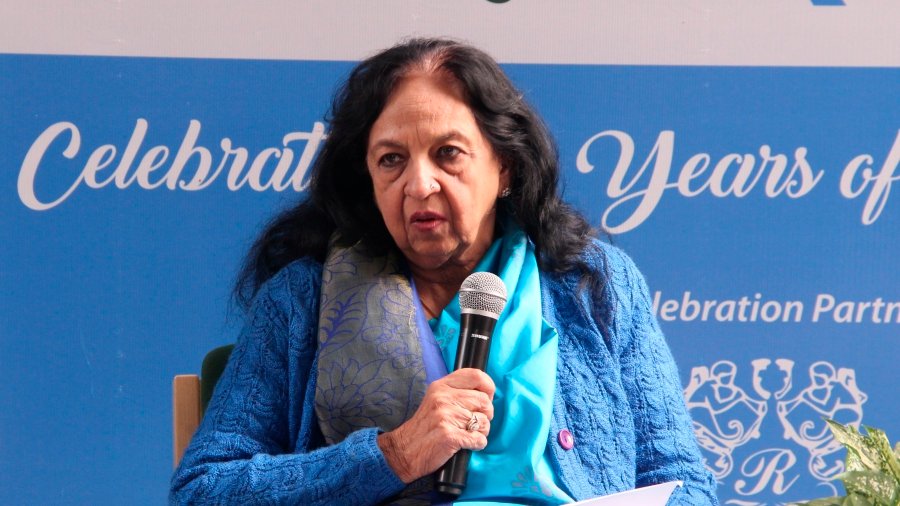
At Frames of Heritage: A Photo Exhibition and Echoes Beyond Borders – An Artistic Dialogue, organised by Diplomatist Magazine on 14th November 2025 at Triveni Kala Sangam, Dr. Kavita A. Sharma, former President of South Asian University, took the audience on a thoughtful journey into the power of culture in bridging communities and nations. She reflected on the subtle yet transformative influence of cultural diplomacy in our interconnected world.
“When we speak of echoes beyond borders… we are essentially talking about cultural diplomacy—the role culture plays in shaping relations, first among people, and then between nations,” Dr. Sharma said, setting the tone for a discussion that wove together history, education, and human connection. She reminded the audience that culture is far more than art or tradition—it is the very fabric of society. Quoting UNESCO, she described it as “the whole complex of distinctive spiritual, material, intellectual, and emotional features that characterise a society or social group. It includes the arts, literature, modes of life, fundamental human rights, value systems, traditions, and beliefs.”
Dr. Sharma emphasised the importance of educational institutions and civil society in nurturing these connections. Drawing from her experience at South Asian University, she explained, “We do all this to spread ideas, and ideas are very powerful and very persuasive. They lead to people-to-people interactions, forming communities that often collaborate with governments or create influence that governments cannot ignore.” For her, cultural exchange is not a lofty concept—it is a practical and essential part of building trust and collaboration across borders.
She also spoke about the concept of soft power, famously articulated by Joseph Nye, though she preferred to frame it in collaborative terms rather than as “power.” “I personally don’t like to use the word ‘power’ because it can sound coercive. The essence is collaboration,” she said. Dr. Sharma pointed out how the 9/11 attacks underscored Nye’s idea: even the most powerful governments cannot achieve their goals if they neglect cultural influence and people-to-people engagement.
The conversation then turned to the modern world, where technology and migration have made cultural diplomacy more immediate and visible. The Indian diaspora provides a vivid example of this. “The older diaspora, such as those in Suriname, has risen to positions of leadership because of the support of local communities. Today, clusters of people of Indian origin in Canada, the USA, Australia, and elsewhere voice opinions, share cuisine, clothing, and culture, and influence international perceptions of India,” she noted. Technology amplifies this reach: “With technology, people can share ideas and opinions globally at the click of a button. This makes people-to-people contact and cultural interaction more important than ever for fostering understanding and cooperation.”
Dr. Sharma also drew parallels with other countries, highlighting the influence of the Chinese government and its global diaspora in advancing technology, research, and STEM collaborations, illustrating how cultural networks can shape knowledge and innovation on a global scale.
Closing her address, Dr. Sharma reflected on India’s long-standing role in cultural diplomacy. India is no stranger to cultural diplomacy. The influence of ancient Indian civilisation on Southeast Asia—Laos, Cambodia, Thailand, Indonesia, Malaysia, Singapore—and through China, on Japan and Tibet, is profound. The Silk Road not only carried trade; it also carried ideas. Buddhist scholars travelled back and forth, enriching both India and China. Similarly, Indian civilisation has absorbed influences from Persia, Africa, and beyond, in cuisine, dress, arts, and craft. Culture is both a bridge and a bond.”
She concluded with a call for active participation: “In today’s globalised world, where travel and virtual communication create communities across borders, fostering these interactions is essential. For societies to hope for harmony and peace, cultural engagement and people-to-people contact must be cultivated and sustained by all of us.”


Leave a Reply