

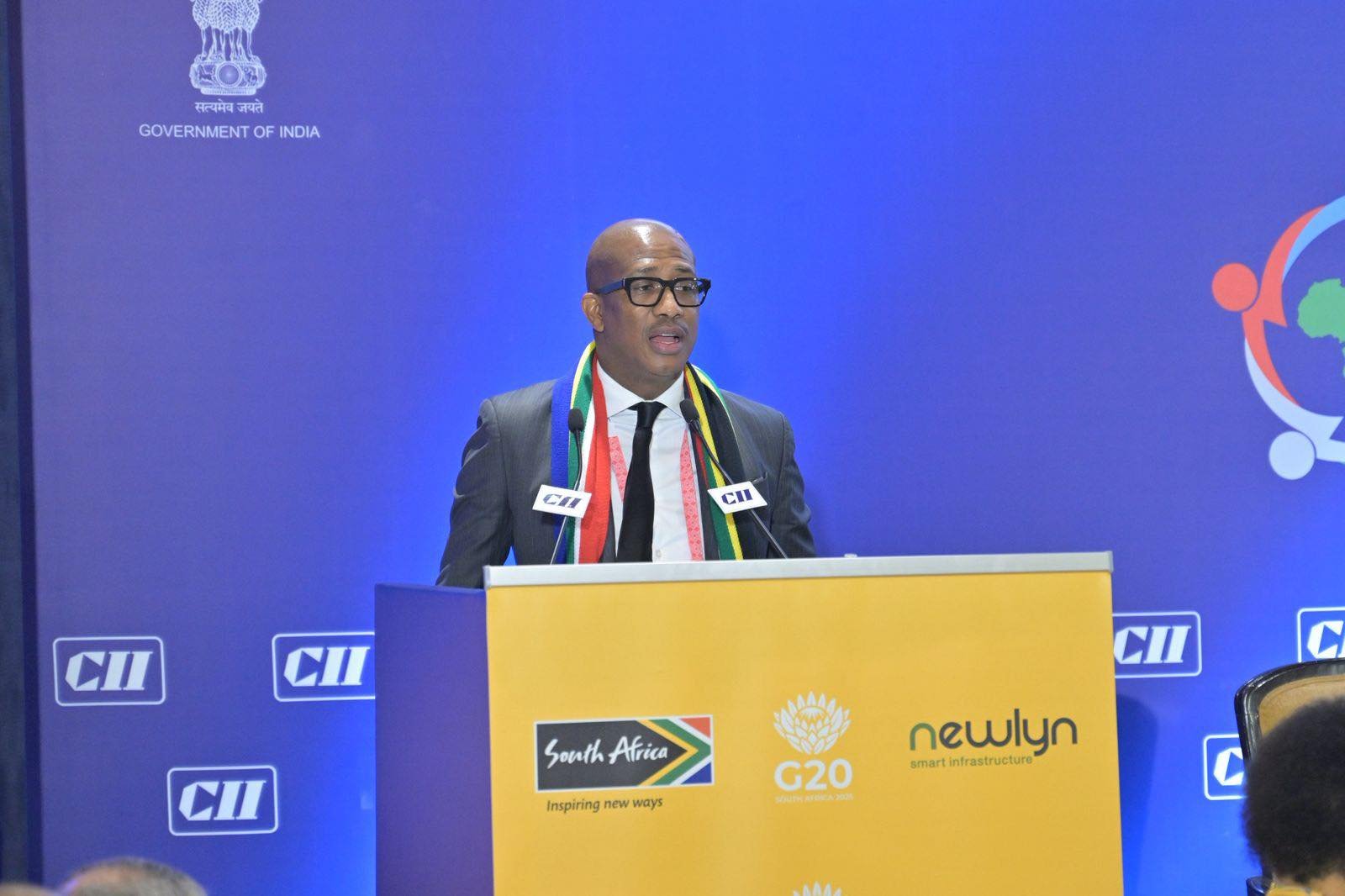
At the 20th CII India–Africa Business Conclave, Mr. Kenneth Morolong, Deputy Minister in the Presidency of the Republic of South Africa, spoke about the enduring and evolving partnership between South Africa and India. Speaking at the session on “Deepening the South Africa–India Strategic Partnership,” Mr. Morolong highlighted the unique political history, strong economic ties, and future opportunities that bind the two nations.
“We meet at a pivotal moment for the global economy—an era defined by geopolitical tensions, shifting trade routes, and weakening multilateral systems,” he remarked. “In this uncertain environment, the partnership between South Africa and India stands as a beacon of hope, resilience, trust, and shared prosperity.”
A Relationship Beyond Diplomacy
Mr. Morolong emphasised that the South Africa–India relationship is deeply rooted in shared historical struggles. “Our two nations share a profound and unique political history, deeply intertwined through our struggles against colonialism and apartheid. This bond transcends diplomacy—it is rooted in shared experiences of oppression and our parallel fights for freedom, dignity, and equality,” he said.
At the same time, he stressed that the partnership is not confined to the past but is firmly anchored in the present and future. “Today, our relationship is not only about the past; it is firmly anchored in the present and future, as a strategic alliance to harness new opportunities for growth and cooperation.”
South Africa’s Economic Strengths
Positioning South Africa as a gateway for Indian investment into Africa, Mr. Morolong drew attention to the country’s industrial and economic might. “South Africa today stands as the most industrialised and diversified economy on the African continent, contributing nearly a fifth of Africa’s GDP. We are Africa’s largest automotive producer, exporting more than 600,000 vehicles annually,” he noted.
He further underscored the strength of the Johannesburg Stock Exchange, describing it as “the largest in Africa, providing governance, liquidity, and access to capital comparable to the world’s best exchanges.”
South Africa’s research and innovation ecosystem, he added, is among the most advanced in the developing world. “Landmark projects such as the Square Kilometre Array, the world’s largest radio telescope, are pushing the frontiers of science, data, and artificial intelligence.” With thriving start-ups in fintech, agritech, and health tech, the country offers fertile ground for collaboration with India’s globally recognised technological expertise.
Mr. Morolong set out the defining features of the partnership’s future trajectory. He pointed first to South Africa’s G20 Presidency under the theme Solidarity, Equality, and Sustainable Development. “We invite our Indian partners—public and private—to collaborate with us in shaping equitable economic policies, addressing socio-economic fragmentation, and tackling global challenges with shared resolve,” he said.
He also underlined the maturity of the economic relationship, noting that bilateral trade has reached USD 19.25 billion in 2023–24. “Over 150 Indian companies, including Tata, Mahindra, Vedanta, and Wipro, are established in South Africa, employing more than 22,000 South Africans and investing nearly USD 10 billion,” he stated. In turn, South African companies such as Naspers, FirstRand, and Old Mutual have made important contributions to India’s growth story, reflecting the balance and resilience of this two-way engagement.
Looking ahead, Mr. Morolong called for an expansion of trade and investment into higher-value sectors such as pharmaceuticals, green energy, automotive, and digital services. “South Africa’s Special Economic Zones provide Indian firms with strategic entry points to access the African market under the AfCFTA,” he explained.
Equally important is the shared commitment to the green transition. Highlighting South Africa’s position as a custodian of critical minerals, he said: “Our nation holds 90% of global platinum reserves and remains a dominant producer of manganese, vanadium, and chromium, essential for EV batteries, hydrogen fuel cells, and advanced electronics. With India as one of the world’s largest consumers, our partnership is key to building sustainable supply chains for the future.”
Concluding his address, Mr. Morolong underscored the broader vision that underpins this partnership. “The South Africa–India partnership is a powerful testament to the potential of South–South cooperation. It is built on solidarity, driven by a shared commitment to sustainable development, and focused on creating equitable and inclusive growth for our people,” he said.
He ended with a call to action, inviting Indian partners to deepen their engagement: “By working together, we can bridge global divides, pioneer new solutions, and contribute to a more stable, secure, and prosperous world. We invite our Indian partners to join us on this journey of resilience, opportunity, and shared destiny.”


Leave a Reply