

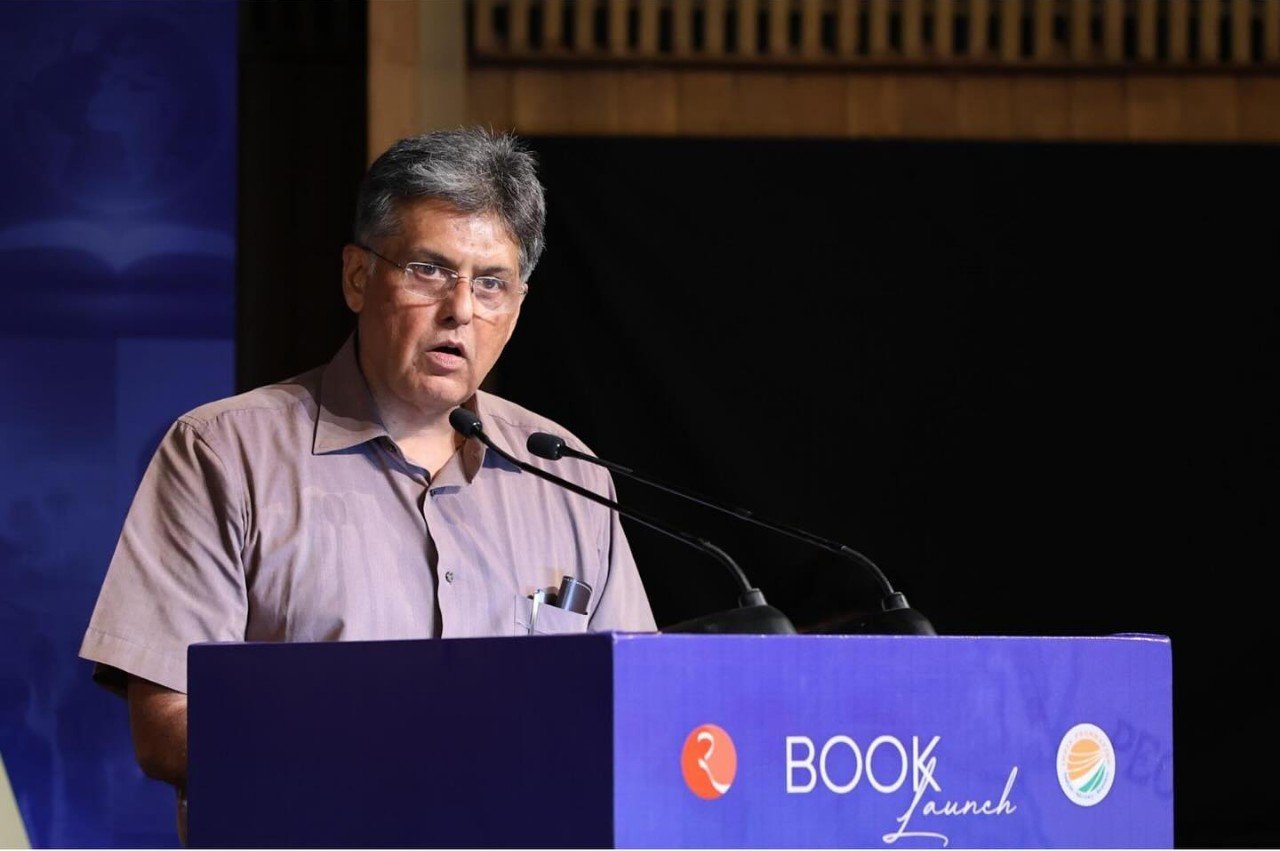
On 23rd June, India Foundation hosted a thought-provoking book launch at the India Habitat Centre, New Delhi, unveiling The New World, the latest work by Shri Ram Madhav—author, thinker, and public intellectual. Among the distinguished speakers at the event was Shri Manish Tewari, Member of Parliament (Lok Sabha), who offered a deeply reflective and historically grounded response to the book’s central themes.
Tewari began by congratulating Shri Ram Madhav on a “work that is both expansive in its exposition and incisive in its analysis,” noting the book’s intellectual range—from the early evolution of human society to contemporary political fault lines such as conservatism and wokeism.
Tewari lauded the spirit of intellectual rigour embedded in the book and reflected, “As with all well-prepared menus—and so it is with serious books—there are always portions that one savours more than others. But that is the nature of robust discourse: to provoke, to challenge, and to invite the reader to engage, agree, or even disagree—but always with rigour.”
Building on the book’s premise that the liberal international order—crafted in the aftermath of the Second World War—is in decline, Tewari posed an incisive question: Are we truly witnessing the birth of a new global order, or are we regressing into a revival of the realist, power-driven world of the 17th and 18th centuries?
Quoting the Italian Marxist theorist Antonio Gramsci, he asked: “Is the old world dying, the new yet to be born—and are we therefore living through an age of monsters?” He noted that the answer may lie in the persistence of raison d’état—the principle that nations act primarily in their self-interest—and the enduring logic of strategic alliances.
He cited a range of recent global events to support this thesis: the trade tensions triggered by U.S. President Donald Trump’s reshaping of economic frameworks, the Russia-Ukraine war, the multi-layered Israel–Iran conflict, and the intensifying rivalry with China. The India-Pakistan standoff—“arguably the most serious since the Kargil War”—and recent U.S. military actions in Iran further highlighted the unravelling of post-WWII multilateralism.
Tewari explored the historical underpinnings of global strategic thought, tracing them back to the European colonial and intellectual experience. He recalled how the Peace of Westphalia in 1648 institutionalised the concept of the sovereign nation-state and how Cardinal Richelieu’s doctrine of raison d’état shaped international conduct.
He reflected on the rise of the balance of power doctrine and its operationalisation by William of Orange, leading to the Concert of Vienna in 1815, which ensured relative peace for nearly a century.
Drawing on military theory, he cited a memorandum from 1892, where General Nikolai Obruchev argued that modern warfare would no longer be determined by who fired first but “who mobilised first,” calling mobilisation “the most decisive act of war.” This idea was tragically confirmed during World War I, following the assassination of Archduke Franz Ferdinand in 1914.
The Second World War, Tewari noted, was a result of failed alliance management, and the Cold War extended the same strategic logic, albeit through ideological contestation. The collapse of the Soviet Union in 1991 did little to erase the core principles of power balancing and self-interest.
Addressing the erosion of multilateral institutions, Tewari stated: “When confronted with existential threats, nations have not turned to multilateralism. They have acted unilaterally, pursuing what they perceive as their own survival imperatives.” This, he argued, is the great paradox of our times—the very powers that built the liberal order have been the first to discard it when it no longer serves their core interests.
Amidst this global disorder, India has shown remarkable consistency, said Tewari. He noted that India’s foreign policy has always balanced two imperatives: sovereignty through independent decision-making (raison d’état) and an adaptive engagement with the world, which began as non-alignment and has now evolved into multi-alignment.
Referring to India’s diplomatic continuity, he remarked: “There is thus a deep continuity in India’s external engagement, stretching over seven and a half decades.”
Shri Tewari praised The New World for documenting the shifts and continuities in India’s foreign policy and for offering a thoughtful framework to understand an increasingly volatile world.
He described the book as “a timely reflection on the state of global affairs, and a rigorous documentation of how India has navigated continuity and change amidst global uncertainty.” For students and scholars of international relations, he said, it is “a must-read.”


Leave a Reply