

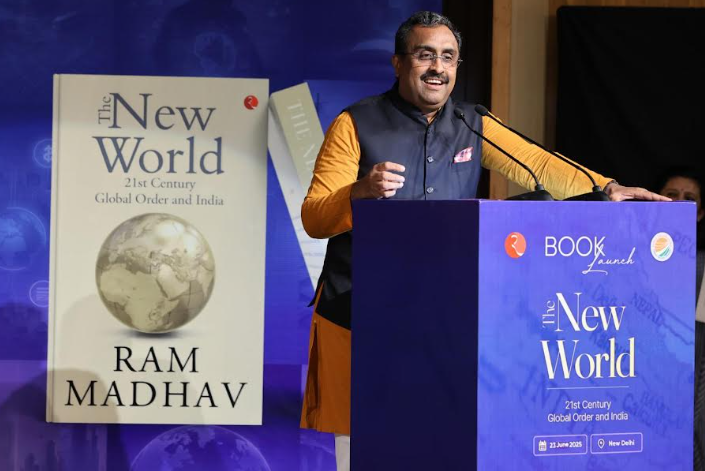
In an intellectually charged evening at the India Habitat Centre on June 23, 2025, Ram Madhav, political thinker, author, and public intellectual, unveiled his latest book, The New World: 21st-Century Global Order and India, at a special event hosted by the India Foundation. The occasion was graced by the presence of the Hon’ble Vice President of India, Shri Jagdeep Dhankhar, along with several prominent dignitaries, scholars, and members of the strategic affairs community.
Speaking at the release function, Ram Madhav addressed the audience with a mix of humour, humility, and sharp insight into the evolving global dynamics. He acknowledged the enthusiastic turnout, expressing gratitude to the Vice President and others on the dais for taking time to attend the ceremony.
While naturally tempted to dive deeply into the substance of his book, the author jokingly restrained himself. “As the author, I would, of course, love to speak at length about the book,” he said, “but my publisher has gently warned me not to give too much away! After all, if I share everything now, you may not feel the need to read it yourselves.”
At the heart of Madhav’s remarks was a call for introspection on a concept that has become ubiquitous yet often remains ill-defined: the new world order. “Today, we often hear the phrase ‘new world order’ in public discourse,” he noted. “It’s a term that gets thrown around with increasing frequency—yet, how many of us actually pause to ask: What does it truly mean?”
His book, he explained, is an attempt to answer that very question. Structured in two parts, The New World identifies ten defining characteristics that are likely to shape the 21st-century global order and then offers ten strategic suggestions for India to assert itself effectively in that changing landscape. “This book is somewhat futuristic in its approach,” he said. “It is about us—about what lies ahead for our generation and for the children of our nation.”
The motivation for writing, he revealed, was deeply rooted in a sense of responsibility towards national awakening. “To understand where we are heading, and to prepare our country for that journey, is, in my view, a patriotic duty,” Madhav stated firmly.
Responding to a colleague who asked what the book offers from an ideological perspective, Madhav stressed that the book transcends ideological lines. “When I say ‘us’, I mean everyone—from the grey-haired elders in this room to the youngest IR enthusiast in our country. This new world is going to be in front of us very soon,” he said, underscoring the urgency of future preparedness.
He reminded the audience that civilizational pride must be coupled with a clear vision for the future. “We often talk about Bharat, about our civilizational vision, about Rashtra and national destiny. But we must also ask ourselves: What is the destination? Where do we see India in this changing world?”
While the book spans over 480 pages, Madhav described it as a “framework,” not a doctrine—an invitation for further reflection and debate. “The ten points and ten suggestions I have offered are by no means exhaustive. It could be twelve points or fifteen suggestions—this is merely a contribution to a much larger national and global conversation.”
In a lighter moment, Madhav shared a personal anecdote about his affection for books and his “book-sabha”—his personal library at home. “Inside it hangs two signs,” he smiled. “One says: ‘Please don’t ask to borrow a book from this library.’ And the other, borrowed from a European writer, reads: ‘He who lends a book is a fool; he who returns it is a greater fool.’” The message was clear: value books, own them, and most importantly, read them.
He concluded by urging the audience to engage with The New World not just as readers, but as thinkers and stakeholders in India’s global journey. “Don’t borrow this book. Buy it, read it, and reflect on it,” he said with a laugh, “because the future that this book speaks about is no longer far away. It is upon us.”


Leave a Reply