

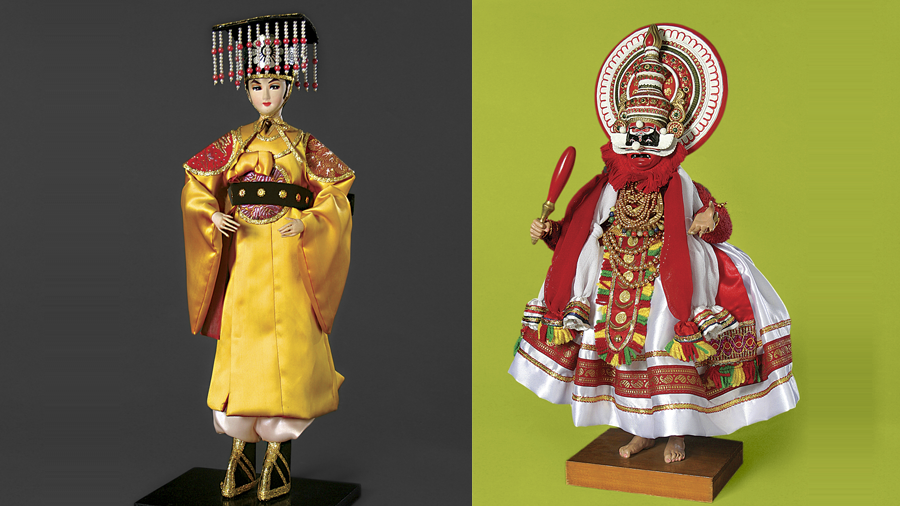
‘Dreamland’. ‘Fairyland’. ‘Mini United Nations’. The epithets used to describe the Shankar’s International Dolls Museum (SIDM) are as varied as the multitudes who flock to see it. Truth to tell the museum is a bit of all these and more. It is the culmination of a dream—the vision and foresight of one man.
That man was Shankar (K. Shankar Pillai) doyen of political cartoonists in India, whose magazine Shankar’s Weekly had not just held the attention of world political leaders for its witty and intelligent look at politics, but had endeared itself to children as well through its annual international competition in Painting and Writing, in addition to holding annually the great New Delhi festival of colours for children—the Shankar’s On-the-Spot Painting Competition.
It was this wholehearted involvement with children and their activities that triggered off Shankar’s lifelong passion of collecting and exhibiting costume dolls from around the world.
The first doll of the Museum was special. She was a gift from the Hungarian ambassador. A pleasant young woman wearing the traditional peasant’s dress…sitting and gazing fondly at the corn cob she holds in her hands.
The costume, the benign expression, the story the figure told of the lifestyle of a nation, moved Shankar so deeply, his immediate thought was: ‘If dolls like her could be collected from every country, it would open up a veritable window to the world for children.’
From then on Shankar began collecting costume dolls from every country he visited as part of the Prime Minister’s entourage. Moved by his passion and single-minded pursuit of his goal, ambassadors and heads of state deemed it a privilege to be able to gift to Shankar costume dolls, representative of their countries.
Soon Shankar had a staggering 500 dolls in his collection. He began exhibiting them all over India along with the paintings sent in by children for the Shankar’s International Children’s Competition. But the constant packing and unpacking, travelling and exhibiting lead to considerable wear and tear of the delicate dolls. Alarmed by the rapid damage to his beloved collection, Shankar voiced his concern for them to the then Prime Minister, Shri Jawaharlal Nehru, at an exhibition in New Delhi. Smt. Indira Gandhi, who had accompanied her father to the exhibition promptly suggested having a permanent ‘dolls house’ for them.
The International Dolls Museum opened on November 30, 1965, in its grand premises on Bahadur Shah Zafar Marg, New Delhi. The colourful mosaic folk figure patterns on its façade immediately made it stand out to the visitors who came to see this new wonderland.
The present strength of dolls on display at the SIDM numbers 7000 from over 85 countries and are divided into three broad categories–costume dolls, traditional dolls, and group dolls. While there are dolls wearing traditional attire, there are also dolls wearing ‘contemporary’ clothes that make a statement about the so-called ‘modern’ trends. Some dolls in the UK section are replicas from the Queen’s own collection and are costumed as William Shakespeare, Henry VIII, and have characters from nursery rhymes and all-time favourite stories like Alice in Wonderland.
Attached to the International Dolls Museum is a Dolls Designing and Production Centre (Dolls Workshop). The workshop was set up primarily to make, for exchange purposes, Indian dolls in authentic Indian dress. It is to the Workshop’s credit that it has over 200 types of authentic Indian Costume Dolls—unique among them being the man and woman from all States, the brides of India series and the hugely popular dance and drama series. Each doll is handcrafted after meticulous research into the physical features of the region it represents. The same care in detail is shown while tailoring the dress, assembling the jewellery, in adorning the doll and embellishing it to become the true replica of the person or region it represents. Little wonder then the dolls were awarded the Golden Peacock Feather at the Dolls Biennale held in Cracow, Poland in 1980.



Leave a Reply