

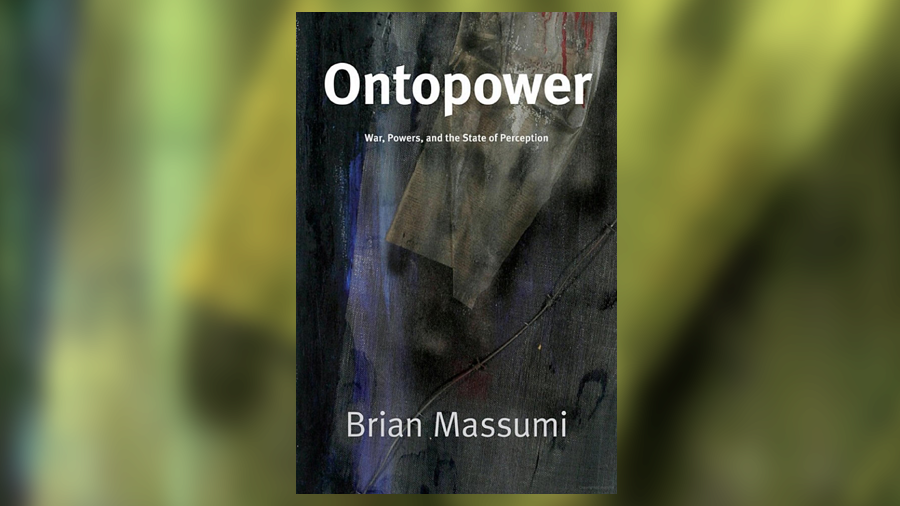
Brian Massumi’sOntopower: War, Powers, and the State of Perception is a sophisticated and compelling exploration of power in its most pervasive and insidious form. Building upon his earlier works on effect, perception, and politics, Massumi introduces the concept of “Ontopower,” a mode of governance that operates preemptively and shapes the very conditions of existence. Written in his signature dense and abstract style, the book is a critical intervention in contemporary political theory and offers profound insights into how modern systems of power structure life at ontological levels.
Structurally the book is divided into three parts consisting of seven Chapters exclusive of Preface and Afterword. The main Arguments of the book include Ontopower as a form of power that exceeds the disciplinary and biopolitical paradigms identified by thinkers like Michel Foucault. Unlike these frameworks, which rely on regulating populations or disciplining individual bodies, Ontopower works preemptively, before events materialize. It operates in anticipation of threats, taking action to modulate potentialities rather than responding to actualities.
This shift has profound implications for governance, particularly in the context of global security and military strategy.One of the book’s key contributions is its discussion of how Ontopower operates through affect and perception. Massumi argues that governance under Ontopower seeks to modulate the feelings and perceptions of populations, creating an atmosphere of constant vigilance and insecurity. This management of affective states ensures compliance and consent, not through overt coercion but by shaping how people experience and anticipate the world.Massumi grounds his theoretical exploration in the context of the War on Terror, arguing that it exemplifies Ontopower in action. The preemptive logic of counterterrorism, in which threats are neutralized before they fully emerge, exemplifies how Ontopower operates. The endless and indeterminate nature of the “threat” transforms war into an ontological condition rather than a discrete event. Building on thinkers like Deleuze, Massumi emphasizes that Ontopower is more diffuse than traditional disciplinary mechanisms. It infiltrates life through control societies, where technologies of surveillance and prediction enable power to govern indirectly. This form of power is more dynamic and adaptive, aligning with the unpredictability of modern life and global risks.
As a Conceptual Innovation, Massumi’s development of the concept of Ontopower is groundbreaking. It extends existing theories of power into new domains, offering a framework for understanding the unique challenges of contemporary governance.The book synthesizes insights from philosophy, political theory, affect studies, and security studies, making it a rich and multifaceted analysis.By focusing on the War on Terror and other contemporary phenomena, Massumi demonstrates the immediate relevance of his ideas to understanding modern geopolitics, and statecraft.The introduction sets the stage by situating ontopower within the evolution of modern governance and power. Massumi highlights the shift from biopolitics (Foucault) and control societies (Deleuze) to a new mode of power that operates preemptively, before events take place.Massumi frames the book in terms of contemporary military and security practices, particularly the War on Terror, as the paradigmatic example of ontopower in action.To introduce how preemptive logics redefine governance and expands beyond conventional power frameworks define the purpose of the book.
Part one of the book illustrates that the Primacy of Pre-emption lays out the foundational concept of pre-emption as central to Ontopower. Pre-emptive action is not about reacting to threats but neutralizing them before they arise, based on probabilities and possibilities. The Operative Logic convinced that Pre-emptive power engages with “potentialities” rather than concrete realities. He exemplified the War on Terror as a case study to illustrate how pre-emption functions in security strategies.Which gives an Insight that Pre-emption represents a fundamental shift in governance, blurring the line between war and peace by treating threats as continuous and omnipresent.
Part Two Ontopower of Perception explores how Ontopower shapes perception and governs affect. It focuses on how environments of fear and vigilance are cultivated to keep populations compliant. He intensely reflected on how Perception as a Weapon used by state authorities and Ontopower operates through the modulation of how individuals perceive reality, creating an atmosphere of uncertainty and anxiety. Drawing from affect theory, Massumi explains how emotions are targeted to prime individuals for pre-emptive compliance.For example, The heightened fear of terrorism post-9/11 and its normalization through media and political narratives.
This part alsoexamines how pre-emption works in concrete practices, such as drone warfare, counterterrorism operations, and predictive analytics.Ontopower relies heavily on technological systems (e.g., surveillance and big data) to predict and neutralize threats.Preemption is inherently speculative, operating in a space of uncertainty and possibility.Massumi critiques the ethical and political consequences of a system that acts on incomplete information and potential risks, often with devastating consequences.
Part three includesreturning to the theme of affect, this part dives deeper into how Ontopower shapes collective emotional states. The state of fear is cultivated and sustained to justify pre-emptive actions and limit dissent.Ontopower doesn’t just act on individuals but creates environments that modulate collective emotions.Massumi uses examples from media portrayals of terrorism and the rhetoric of global insecurity to show how fear becomes embedded in daily life.The book focuses exclusively on the War on Terror as a manifestation of Ontopower. The War on Terror epitomizes onto power’s logic of perpetual preemption, where there is no clear beginning or end to the conflict. Preemptive actions have redefined international relations, sovereignty, and the very concept of war. Massumi raises questions about the ethical implications of preemptive governance, especially its impact on civilian populations and human rights.
Massumi explores the political dimensions of Ontopower, particularly its implications for democracy and individual freedom.Ontopower undermines traditional democratic principles by centralizing decision-making in the name of security.By shaping perception and affect, Ontopower creates a population that feels free but is deeply constrained.Massumi critiques how preemptive power erodes public trust and accountability.
The conclusion reflects on the broader implications of Ontopower for governance, ethics, and resistance. Ontopower is pervasive and adaptive, making it difficult to resist through traditional means. Resistance must begin at the ontological level, challenging the very conditions under which preemptive governance operates. Massumi calls for a rethinking of politics and governance to address the challenges posed by Ontopower.
Massumi extends Foucault and Deleuze’s ideas into a novel framework for understanding contemporary power. His integration of affect theory with political analysis is innovative and insightful. The book offers a powerful critique of post-9/11 governance and its global implications. This includes Limited case studies beyond the War on Terror. Insufficient engagement with grassroots resistance or alternative modes of governance. A dense theoretical style may limit accessibility for broader audiences.
Massumi’s dense, jargon-heavy style can alienate readers unfamiliar with his theoretical influences, such as Deleuze and Guattari. This limits the accessibility of his arguments, potentially excluding broader audiences who could benefit from his insights. While Massumi’s theoretical framework is compelling, the book lacks extensive empirical evidence to substantiate its claims. His reliance on abstract concepts and limited case studies (primarily the War on Terror) leaves room for skepticism about the broader applicability of ontopower across diverse contexts. Massumi is deeply critical of preemptive governance and the ontological manipulation of perception, but the book offers little in terms of resistance or alternatives to this form of power. How can individuals or societies counteract power’s pervasive influence? Ontopower offers valuable insights into effect and perception but misses a critical opportunity to explore their intersection with systemic inequalities like race, gender, and class. This oversight limits the analysis’s depth and its relevance to broader social justice concerns.
Ontopower is a groundbreaking contribution to political theory, offering a powerful lens for understanding the preemptive logics that define contemporary governance. Massumi’s work challenges readers to rethink the relationship between power, perception, and reality, providing a framework that is both provocative and urgent. However, the book’s dense theoretical style and limited empirical grounding may alienate some readers, and its lack of attention to resistance and intersectional issues leaves important questions unanswered.
Despite these gaps, Ontopower is essential reading for scholars of political theory, affect studies, and security studies. It is a critical text for understanding the evolving nature of power in the 21st century, even as it invites further inquiry into the possibilities of resistance and alternative forms of governance.



Leave a Reply