

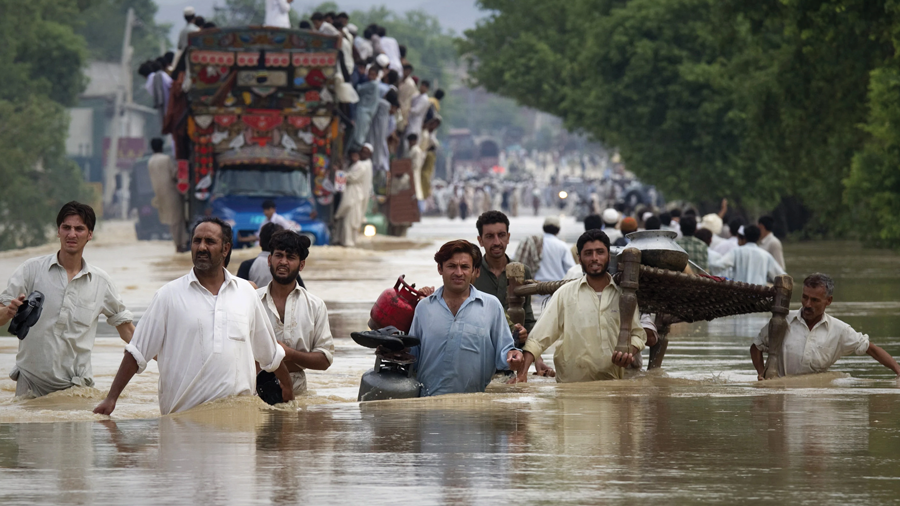
One of the most difficult issues facing the world amid the polycrisis is climate change. The lives and livelihoods of communities and areas vulnerable to climate-sensitive resources are being impacted by environmental deterioration combined with the unpredictable effects of climate change, such as water stress, droughts, forest fires, floods, and sea level rise. 2024 turned out to year of breaking records of being the warmest year in terms of exceeding the threshold of global greenhouse gas emissions, a rise in temperature of 15.100C ; 0.120C higher annual value than in 2023. The combined average temperature of the year 2023-24 was 1.540C more than the limit set by the Paris Agreement of 1.50 C above pre-industrial level. The Intergovernmental Panel on Climate Change (IPCC) notes the nexus of climate change and human migration. The International Organization on Migration (IOM) assessment reveals displacement of around 25 million to 1 billion people at a global level due to environmental degradation and climate change. IOM, defines climate migrants as “individuals or groups of persons who, predominantly for reasons of sudden or progressive changes in the environment that adversely affect their lives or living conditions, are obliged to leave their habitual homes, or choose to do so, either temporarily or permanently, and who move either within their country or abroad”.
One of the regions most at risk from environmental hazards is South Asia. Around 45 million people in India alone are expected to be displaced by climate-related disasters by 2050, according to the Climate Action Network South Asia (CANSA). The Global Report on Internal Displacement (GRID-2024) states that 3.6 million internal displacements occurred in South Asia as a result of disaster-related incidents. The most significant disaster displacements occurred in Chattogram, Bangladesh’s Cox Bazar district as a result of Cyclones Mocha and Hamoon, which formed in the Bay of Bengal and affected the already vulnerable Rohingya refugee minority from Myanmar. On the Indian subcontinent, 105,00 people were displaced as Cyclone Biparjoy, which formed in the Arabian Sea, caused flooding in Gujarat and Rajasthan. In Pakistan, Biparjoy caused displacement, resulting in 85,000 evacuees. El Nino circumstances in the middle of 2023 caused the continent of South Asia to become drier. Due to the unpredictable climate shift, it caused 647,000 displacements in the eastern provinces of Punjab, Balochistan, and Khyber Pakhtunkhwa. In the Afghan province of Herat, earthquakes accounted for 380,000 internal displacements in October 2023, making them the second most common cause of disaster-related displacements. The economic needs of humans are impacted by both immediate and gradual environmental dangers and they are forced to migrate as a result of their diminished capacity for adaptation and the effects on their means of subsistence.
According to the Global Climate Risk Index, most South Asian states are vulnerable to climate change. As a result of human displacement brought on by climate change, a number of socioeconomic and political issues arise. Migration brought on by climate change makes the humanitarian issue over a few resources worse and potentially endangers regional stability. Displacement also has varying effects on people and groups, with women, the poor, and the disadvantaged bearing the brunt of the cost. The majority of migrations brought on by climate change are leaving low-lying coastal areas and places that are under unproductive agricultural stress, either domestically or externally. Socioeconomic hardships have a profound effect on communities whose livelihoods depend on climate-sensitive resources, livestock, agriculture, and fisheries. In addition to economic hardships, migrants face health risks, such as physical and mental health issues, as well as a profound sense of loss and displacement. The gendered impact of disasters cannot be disregarded, as women are subjected to gender-based violence, and have limited access to resources, and stakeholder capacity in decision-making.
Globally and nationally, climate-induced migration has gotten scant attention, which has kept them out of the protection measures. The glaring legal framework vacuum is highlighted by the International Conventions on Refugees’ failure to recognize climate-induced displacement. Because there are no policy restrictions in place, undocumented migrants lead to fundamental human rights breaches. Internal and cross-border displacements in response to climate-related harms are not recognised by international legal instruments. The 1951 and 1967 Convention on Refugees offers protection to those fleeing from well-founded fear of persecution under categories of religion, nationality, race, ethnicity or political opinion However, by extending protections to internally displaced persons, the regional Kampala Convention broadens the traditional definition of refugees. A regional agreement is necessary to handle climate migration in a way that is appropriate for the particular circumstances of South Asia, as a one-size-fits-all strategy would not be sufficient to address the requirements of climate-induced displacement effectively.
South Asia has taken several steps to lessen the effects of climate change. For example, Bangladesh’s National Adaptation Plan and Mujib Climate Prosperity Plan, India’s National Action Plan on Climate Change, and the Maldives’ National Adaptation Plan all seek to increase the region’s resilience and adaptability. However, there is a lack of institutional response to protect environmental migrants, and the current frameworks are insufficient to handle displacements brought on by climate change. Due to their vulnerability to climate change and frequent disasters, South Asian states need a legal framework that may help mitigate the effects of climate change and displacement. It is necessary to comprehend the socio-political situation of each region and adjust policy at the regional and national levels accordingly. initiatives such as developing a proactive strategy to deal with migration and displacement, enhancing technology capabilities and weather-related knowledge sharing, concentrating on developing sustainable resilience strategies with government support, incorporating local stakeholders in decision-making, advocating for gender-sensitive policies, and, finally, fostering regional collaboration.
The challenges of climate change cooperation stem from geopolitical tensions and security agendas. South Asia has a unique chance to close the legal loopholes pertaining to climate migrants’ protection because there is no international framework on climate-induced migration. Effectively addressing the issues of climate change and displacements requires regional deliberation and cooperation. In order to strengthen regional collaboration and build the ability to counteract migration brought on by climate change, SAARC must resurrect its climate action plan.



Leave a Reply