

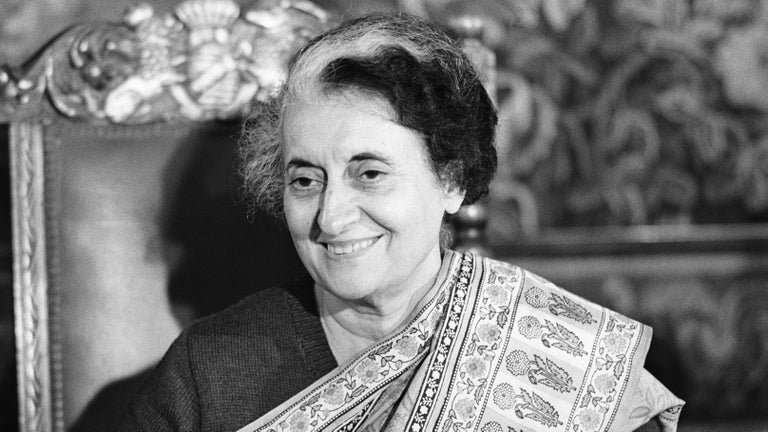
As the world watches whether the United States (US) will finally vote a woman into power, here’s what the world had to say when India got its own.
Women in power are always under watch. Some people watch in awe, and some watch to blame it all on her being a woman. Some people watch to objectify, some with an academic microscope, and others watch with sympathy even bordering on pity. Some watch on tenterhooks – she cannot be messing up or the misogynists will come at us. Some watch with absolutely no room for error, and yet others offer constant over-compensation. Some are interested in watching others react to women in power.
So, this is an exciting time- watching fellow Americans fret over electing a woman of colour into power.
But the US is late to the party of electing women to head their state. This isn’t the first time a woman of colour is in power. The first woman to make it to the top seat was in Sri Lanka in 1960- Sirimavo Bandaranaike.
Six years later (1966), the headlines went to India, when Indira Gandhi became the Prime Minister capturing international discourse.
Colonial narratives viewed Indian women as oppressed and subjugated. The West considered itself superior in its treatment of women, and in trying to justify imperialism, it failed to look at the gender-based inequality that existed in their own cultures.
So, in 1966 when Indira Gandhi came to power at a time when no North American and European country had achieved this, the Western world was visibly perplexed.
Their reportage of her Prime Minister-ship were actually existential questions for themselves. The Boston Globe asked- “Can it happen: A woman in the Prime Minister’s palace, why not in the White House?” It stated – “For women, East grants them and West talks equal rights…while the West preaches acceptance of women in public life, India practices it.”
These questions didn’t emerge in isolation. In the 1960s, in the US, the second-wave feminist movement was ongoing. This was propelled by a book, ‘The Feminine Mystique’ by Betty Friedan. The book questioned the public/private sphere dichotomy, identifying the “malaise” experienced by women who were restricted in their role as housewives while the men enjoyed active social, economic and political rights. The book has sold over three million copies since its publication in 1963 and fuelled the feminist movement urging full and equal participation of women in public, political, economic and social life.
Indira Gandhi’s power acquisition only highlighted the limited space for women in power in their own country. The Time Magazine pointed this out by writing- “ The idea of the woman Prime Minister strikes the outsiders as more curious than it does most Indians.”
Such was the curiosity that Betty Frieden herself travelled to India to study the “most powerful woman in the world”. She was commissioned by the Ladies Home Journal, a leading women’s magazine in the US.
In her article ‘How Mrs. Gandhi Shattered The Feminine Mystique’, Friedan wrote: I had come to India with questions we all had in America, where the thought of a woman President is still so inconceivable that its very mention is a joke. How is it possible for a woman to be elected Prime Minister of India, where enforced seclusion of women in purdah, child marriage and Sati…outraged Christian missionaries less than a century ago?”
Indira Gandhi attributed it to women’s participation in the Indian struggle for independence and to the leadership of Mahatma Gandhi. She told Friedan: “Gandhi felt the struggle for independence had to involve women as much as men, not only because they were half the population, but if you ask a man to go to prison, face the firing squad and his wife said no, it would be much harder. So, he (Mahatma Gandhi) appealed directly to the women and gave them the hardest work…Women rose to it and they did things that they never believed they could do.”
What was a pragmatic choice on Mahatma Gandhi and other prominent leaders’ part to strengthen the people’s movement for Indian independence, actually opened doors for women in India, unlike the imperial part of the world.
While the West now called India a “woman’s castle” hence proved by Indira Gandhi’s ascent, prominent author and public figure, Khushwant Singh, analysed if this was true for all women in India. He verified that India did have a significant presence of women in political-public spaces as compared to other countries in the West, but these women were mostly anglicized, upper-class women. Since the anglicized, upper-class gentry of India held positions as civil servants, international representatives, politicians and opinion makers, it seemed that women in India could “get to the very top” easily. However, the majority of women in India coming from the working classes did not have the same ease and access as the elite, upper-class women. This was reflected in having “no working-class woman leader in India.”
Indira Gandhi’s Prime Minister-ship created debates within India too. Khushwant Singh wrote of this in the New York Times. Her win became a family debate. The patriarch of the house declared his displeasure. “How can a woman rule this country? The country will be ruined!” A debate ensued where each male candidate who could have been elected instead of her was discussed. It was finally concluded that Indira Gandhi was indeed the best choice of all, but the patriarch concluded by saying- “We are heading towards a disaster…no woman can possibly rule a country like India.”
The nervousness of a woman leading a populous and complicated country like India was reflected on the cover of Time Magazine on January 28, 1966. An illustrated picture of a grim-looking Indira Gandhi holding a wilting red rose made the cover and the tagline read “Troubled India in a woman’s hands.”
But why such interest in her? Even though Sirimavo Bandaranaike came to power before Indira Gandhi, she did not make as much news. Why Indira Gandhi then?
The answer lies in the international context of that period. From the 1940s onwards the world entered a phase of geopolitical tension between two superpowers: the US and its allies, representing Western democracies and capitalism, and the Soviet Union and its allies, representing Eastern bloc countries and communism. This race for global domination characterized by ideological warfare and indirect conflicts was called the Cold War.
At this point, the world was also going through processes of decolonization, where European colonies, including India, resisted colonialism and sought independence.
India attained independence in the first phase of decolonization and Jawaharlal Nehru its first Prime Minister. He was quick to identify the potential dangers that lay ahead for the newly independent, third world nations in the context of the Cold War. The Western and Eastern alliances saw the newly emergent nations as battlegrounds for choosing between their corresponding ideologies to adopt in their own countries.
To Nehru, this would mean enslavement, yet again, to either of the blocs. To prevent this and to create an alternate pathway for these nations, he along with leaders of other decolonizing nations of Yugoslavia, Egypt, Ghana and Indonesia, established the Non-Aligned Movement (NAM). The nations in NAM would remain non-aligned- and not have to join one of the two blocs. It intended to create a safe space to build solidarity and not let their voices and needs go unheard in the battle between the two superpowers.
Nehru’s charismatic personality, distinct voice for peaceful coexistence and self-determination for colonized nations and leadership of the non-aligned movement made him stand out in the international scene.
The choices India made under Nehru’s leadership also made him stand out. Instead of adopting either the democratic or the communist-socialist pathway, India adopted a mixed model. While India chose to be a political democracy, it adopted centralized economic planning inspired by the Soviet Union. As a result, both superpowers watched India closely to gauge which side it tilted. As the second most populous country in the world, India also came to be known as the largest democracy – which added to why it was closely watched by all.
Through all this, Indira Gandhi worked with her father, Nehru, as the Official Hostess of India – travelling internationally, representing India, discussing intel and being his sounding board. Indira Gandhi was already a part of international discourse, high-strategy meetings between heads of state and a public life alongside and independent of her father much before she became the Prime Minister. She was already well-covered by international media, being called a “world citizen” and the “most powerful woman in India.” It was then only natural for her to be covered widely when she acquired the Prime Minister-ship of a country like India and the legacy of Jawaharlal Nehru.
Her connection to Nehru raised questions about her election – was Indira Gandhi elected Prime Minister only because she was Nehru’s daughter? Betty Friedan raised this question in her interviews.
Her interviewees clarified that a decade earlier, it would have been unthinkable for Indira Gandhi to become the Prime Minister. Her initial importance was only as Nehru’s official hostess. But over the years, she had put in work to carve out a “political identity of her own.” Respondents told Friedan “Nehru himself would not have thought of his daughter in the present post.” Indira stated: “My father didn’t think I could, but I have.”
Indira Gandhi’s Prime Minister-ship was very eventful and stormy with positive and negative peaks. As a result, she was always under watch. Such was her presence that while on one side, due to her pivotal role in Bangladeshi independence, she was abused on tape by the President of the US, Richard Nixon as an “old witch” and more offensive terminology, she still lives on in the erstwhile Soviet Union with statues to commemorate her, and women named after her.
Now, Kamala Harris is running for office in the US and is aware that all eyes are on her. The internet is all out, projecting how different the two are- Kamala Harris as a woman of colour and Trump as the ultimate white, male supremacist. Just a reading of the top few articles on Kamala Harris’s candidature shows how central her identity as a woman of colour is in the discourse. For instance, references made to her as a “childless cat lady miserable at her own life” by the Republican Vice-Presidential candidate Vance, have resurfaced. Kamala Harris highlights her identity as a role model for young girls. Further, given Donald Trump’s deeply sexist treatment of women and view on immigrants, she stands in complete contrast to him based on her identity.
Some say that Kamala Harris will only be the same or a more radical version of Joe Biden, others hope she turns out different. One thing is for sure, her coming to power will, even if only in name, shake up male and white supremacists. Meanwhile, a comment on Twitter reads – “Don’t deny it, Kamala Harris gives off very strong Indira Gandhi vibes.”



Leave a Reply