

Introduction
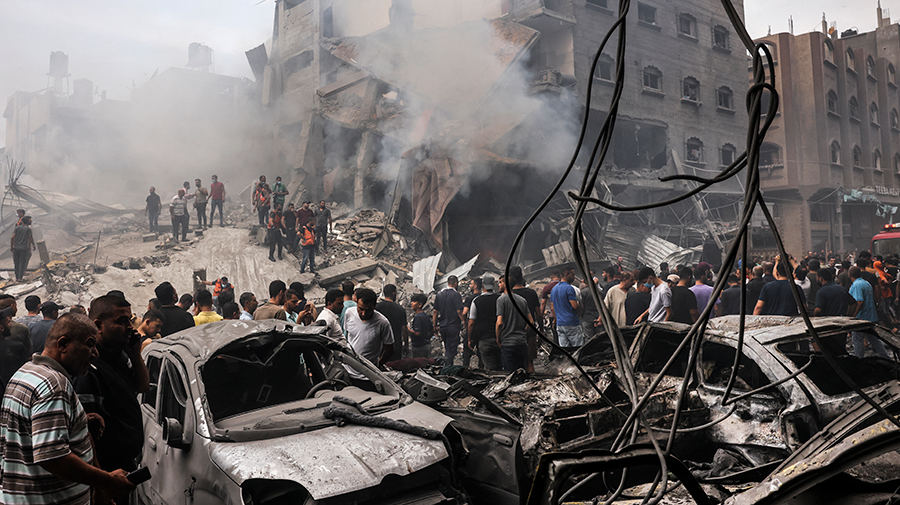
The Gaza conflict, which reignited the question of Palestinian statehood and provoked the regionalization of conflict in the West Asia region on October 7, 2023, has drawn significant global attention. India’s significant interests are at stake in this conflict, spanning from defence, strategy, infrastructure (India-Middle East-Europe Corridor Project), energy, economics, and diaspora. Therefore, India has navigated this conflict through its nuanced and balanced approach. This article delves into India’s response to the conflict, exploring its historical relations with Israel and Palestine, the principles guiding its foreign policy, and the strategic imperatives that shape its position on the conflict. India’s response is analysed within the broader context of its evolving foreign policy, domestic political considerations, and its aspirations on the global stage.
Historical Context: India’s Relations with Israel and Palestine
India’s relationship with Israel and Palestine has been historically complex. At the time of its independence in 1947, India adopted a firm stance in favour of Palestinians’ self-determination for its statehood. The country voted against the United Nations partition plan for Palestine in 1947, which proposed the creation of a separate Jewish state. India’s support for Palestine was rooted in its anti-colonial ethos and its desire to build solidarity with other newly independent nations. However, India recognized Israel in 1950 but did not establish diplomatic relations until 1992. For decades, India’s foreign policy was characterized by a strong pro-Arab, pro-Palestinian stance, primarily driven by its desire to maintain good relations with the Arab world, which was seen as vital for India’s energy security and the welfare of its sizeable expatriate workforce in the Gulf region.
However, India’s foreign policy shifted in the late 1980s and early 1990s. The end of the Cold War, the collapse of the Soviet Union, and India’s economic liberalization led to a reassessment of its global alliances. India established full diplomatic relations with Israel in 1992, and since then, the relationship has grown significantly, particularly in defence, security, and technology. At the same time, India has continued to support the Palestinian cause, advocating for a two-state solution and maintaining diplomatic relations with the Palestinian Authority. This dual approach reflects India’s attempt to balance its historical support for Palestine with its strategic relationship with Israel.
India’s Official Response to the October 7 Conflict
When the Gaza conflict escalated on October 7, 2023, the international community closely watched India’s response. India’s official position was intended to end this conflict, and it called for restraint from both sides and advocated for a peaceful resolution through dialogue. The Ministry of External Affairs (MEA) issued a statement expressing concern over the loss of civilian lives and the escalating violence. The statement reiterated India’s long-standing support for a two-state solution, emphasizing the need for both Israel and Palestine to live in peace and security.
India’s response also highlighted the importance of protecting civilians and respecting international humanitarian law. The MEA’s statement avoided taking sides and reflected India’s careful diplomatic balancing act. While it expressed solidarity with Israel’s “right to defend” itself against ‘terrorism,’ it also called for restraint to prevent further escalation of violence and suffering. However, India has criticized the ‘terrorist’ attack that killed 1200 people by Hamas and reflected on the humanitarian efforts and permanent ceasefire. India has not made any comment on the ongoing ‘disproportionate’ response of Israel that led to the large-scale catastrophic humanitarian crisis.
Strategic Considerations in India’s Response
Several strategic considerations, both regional and global, shape India’s response to the Gaza conflict. Firstly, India’s relationship with Israel has become increasingly important in recent years. The two countries have deepened their cooperation in defence, cybersecurity, agriculture, and water management. Israel has become a key supplier of military technology to India, and the two countries have developed strong security ties. These factors influence India’s cautious approach to the Gaza conflict as it seeks to avoid straining its relationship with Israel.
Another strategic consideration is India’s relationship with the Arab world. India has significant economic and strategic interests in West Asia, particularly in the Gulf region, home to millions of Indian expatriates and a significant source of energy imports. India’s close ties with countries like Saudi Arabia, the United Arab Emirates, and Iran require it to maintain a balanced approach to the Israel-Palestine conflict. Any perceived tilt towards Israel could strain relations with these important partners, which could have severe economic and geopolitical repercussions for India.
India’s Role in International Diplomacy
India’s response to the Gaza conflict also reflects its broader aspirations on the global stage. As a rising power and a member of the G20, India seeks to play a more prominent role in international diplomacy. Its approach to the Gaza conflict is consistent with its broader foreign policy objectives, which include promoting dialogue, conflict resolution, and respect for international law. India’s emphasis on a two-state solution aligns with its advocacy for a rules-based international order and its support for multilateralism.
Moreover, India’s response to the Gaza conflict is shaped by its bid for a permanent seat on the United Nations Security Council (UNSC). India has long sought to reform the UNSC to make it more representative and reflective of contemporary global realities. Its measured response to the Gaza conflict is part of its broader strategy to position itself as a responsible global actor that can contribute to peace and stability in West Asia and beyond.
The Role of Public Opinion in Shaping India’s Response to the Gaza Conflict
Public opinion in India has also played a significant role in shaping the government’s response to the Gaza conflict. The Indian public is deeply divided on the issue, with strong sentiments on both sides. Pro-Palestinian demonstrations have taken place in several cities across India, with participants calling for an end to Israeli military actions in Gaza and expressing solidarity with the Palestinian people. At the same time, there has been significant support for Israel, particularly among right-wing groups and supporters of the BJP, who view Israel as a critical ally in the fight against terrorism.
The Indian government has been mindful of these diverse public sentiments in crafting its response to the Gaza conflict. The government’s measured and balanced approach reflects its desire to avoid alienating any significant section of the population while maintaining its strategic interests. The role of social media in shaping public opinion has also been significant, with widespread discussions and debates on the Gaza conflict taking place online.
Domestic Political Dynamics
Domestic politics also play a significant role in shaping India’s response to the Gaza conflict. The ruling Bharatiya Janata Party (BJP), under Prime Minister Narendra Modi, has pursued closer ties with Israel, reflecting a shift in India’s foreign policy called de-hyphenation. The BJP’s ideological affinity with Israel’s right-wing Likud party, particularly in terms of its stance on counterterrorism, has contributed to the strengthening of bilateral relations. However, the BJP is also mindful of the need to manage domestic political sensitivities, particularly about India’s Muslim population, which has traditionally supported the Palestinian cause.
At the same time, India’s large Muslim population, which has historically been sympathetic to the Palestinian cause, plays a significant role in shaping domestic political considerations. The government must balance its strategic ties with Israel with the sensitivities of its Muslim community, which has been vocal in its support for Palestine. This domestic dimension is critical in India’s measured response, as the government seeks to maintain social harmony and avoid exacerbating communal tensions.
The opposition parties in India, particularly the Indian National Congress, have criticized the government’s approach to the Gaza conflict, accusing it of being too pro-Israel. They have called for a more robust expression of support for the Palestinian people and have urged the government to take a stronger stance against Israeli military actions in Gaza. This domestic political debate reflects the ideological divide between the ruling party and the opposition on foreign policy issues.
India’s Humanitarian Response
India’s response to the Gaza conflict has also included a humanitarian dimension. The Indian government has expressed concern over the humanitarian crisis in Gaza and has called for the protection of civilians. India has a long history of providing humanitarian assistance in conflict zones, and it has been involved in various initiatives to support the Palestinian people, including contributions to the United Nations Relief and Works Agency for Palestine Refugees in the Near East (UNRWA).
In response to the October 7 conflict, India has called for the opening of humanitarian corridors to allow the delivery of aid to affected civilians in Gaza. The government has also pledged to provide humanitarian assistance, including medical supplies and other essential items, to support the people of Gaza. India’s humanitarian response is consistent with its broader foreign policy objectives, emphasising the importance of human security and protecting civilian lives in conflict situations.
Regional and Global Implications
India’s response to the Gaza conflict has implications for its broader foreign policy in West Asia and beyond. The conflict has highlighted the delicate balancing act that India must perform in its relations with Israel, Palestine, and the Arab world. India’s approach to the conflict reflects its desire to maintain good relations with all parties involved while protecting its strategic interests.
The Gaza conflict has also underscored the importance of India’s relations with other major powers, particularly the United States, Russia, and China. The United States, a key ally of Israel, has been a critical partner for India, particularly in the context of its Indo-Pacific strategy. India’s response to the Gaza conflict has been closely aligned with the U.S. position, which emphasizes Israel’s right to self-defence while calling for restraint and the protection of civilian lives.
On the other hand, Russia and China have taken a more pro-Palestinian stance, reflecting their broader geopolitical interests in West Asia. India’s response to the Gaza conflict has sought to maintain a neutral position that allows it to navigate the complex dynamics of its relationships with these major powers. This approach reflects India’s broader strategy of maintaining strategic autonomy and avoiding entanglement in great power rivalries.
The Future of India’s Role in the West Asia
The Gaza conflict has brought into sharp focus the challenges and opportunities India faces in West Asia. India’s response to the conflict has highlighted its desire to play a more active role in regional diplomacy and conflict resolution. As a rising power with significant interests in West Asia, India is likely to continue to engage with the region more proactively, seeking to balance its relations with Israel, Palestine, and the Arab world. India’s approach to the Gaza conflict also reflects maintaining its strategic autonomy.
India’s response to the October 7 Gaza conflict reflects a nuanced diplomatic stance, balancing its historical ties with Palestine and its growing strategic relationship with Israel. India’s initial statements emphasised the protection of civilian lives and condemned terrorism without explicitly naming any parties, indicating a cautious approach to avoid alienating key partners. This ambivalence mirrors India’s broader foreign policy of strategic autonomy, where it refrains from taking sides in complex international conflicts. However, this stance has drawn criticism domestically and internationally for lacking moral clarity. Overall, India’s response highlights its prioritization of strategic interests over traditional ideological alignments.



Leave a Reply