

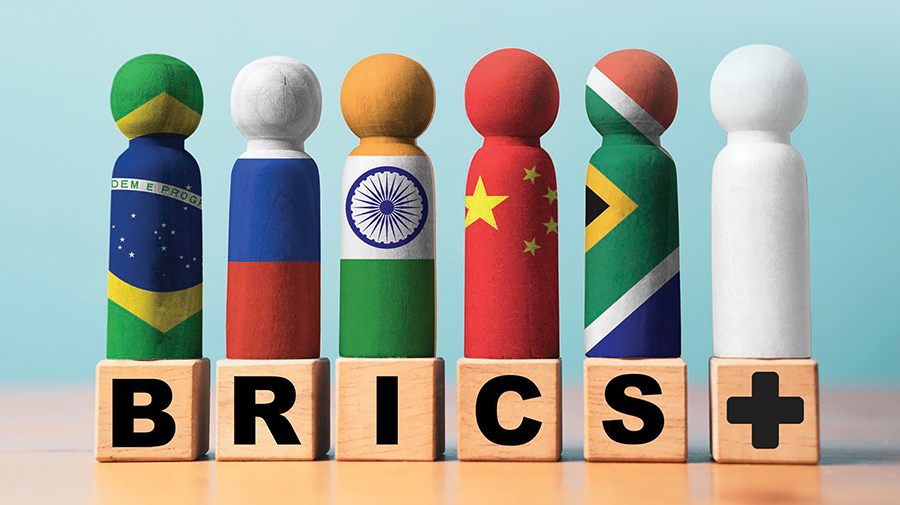
On 1st January 2024, BRICS – the eponymous interregional organisation comprising Brazil, Russia, India, China and South Africa respectively — was expanded for the first time since it added South Africa in 2010, a year after its inception. The four new additions include two countries from Africa, Egypt and Ethiopia and two from Asia, Iran and the United Arab Emirates, leading to the popular renaming of the group as BRICS+. Though Argentina was granted permission to join the group, it had turned down the invitation, owing to the victory of the right-wing leader Javier Milei. Be it so, Southeast Asian countries have shown immense interest in membership in BRICS, especially countries like Malaysia, Thailand and Vietnam.
Since the economic report was brought out by Jim O’Neill in 2005, the grouping had been hailing for global governance that is an alternative multipolar order, as well as emphasised an economic system that diverged from and parallel to the West-led financial system. They have been committed to proposing an inclusive global system that has the potential to overpower the economic hegemony and empower the Global South countries. The new developments attest to the enthusiasm of the Southeast Asian countries in the agenda of the BRICS+ grouping and open a new door to define the position of the BRICS+ grouping in the international matrix.
After the official BRICS expansion, Thailand submitted the membership request to join BRICS in March 2024 (Strangio, 2024). In the following May, Pham Thu Hang, Vietnam’s Foreign Ministry Spokesperson affirmed that “like many countries around the world, we are closely monitoring the process of BRICS membership expansion” (Sasipronkarn, 2024). Further, Malaysia also reportedly shared its interest in aligning with the BRICS’s goals. James Chin, a professor of Asian Studies at the University of Tasmania noted that “both Thailand and Malaysia are Middle Power – so, they will have a greater say in an organisation like BRICS and also major benefit from the BRICS is trade” (Sasipronkarn, 2024)
After the expansion of BRICS, the total population of this association became 45 percent of the world’s population (around 3.5 billion) (BBC, 2024). According to the World Bank data, BRICS+ countries’ economies are worth nearly $30 Trillion which constitutes 28 percent of the global economy (Vaseline, 2024). The three Southeast Asian countries that have shown interest in joining would enhance the capabilities of BRICS+ with their collaboration and contribution to the global and interregional economy.
Ahead of the BRICS summit in South Africa last year, there had been speculation that Indonesia — the only G20 country in Southeast Asia that hopes to complete the accession process with the OECD within three years — could become a BRICS member. Ultimately, Indonesian President Joko Widodo stated that his government had decided not to submit a letter of interest and the Indonesian Foreign Minister Retno Marsudi’s press conference confirmed that Jakarta was “still weighing the pros and cons of the BRICS membership” (Vaseline, 2024). Other nations of The Association of Southeast Asian Nations (ASEAN) like Vietnam, Laos and Cambodia are viewed to be potential applicants to BRICS+ since they have good ties with its key players like China, India and Russia.
For Thailand, as Thai Foreign Minister Maris Sangiampongsa puts it, choosing BRICS does not equate to “choosing sides” or as a way to counterbalance any other bloc (Welle, 2024). While China views Bangkok’s bid to join as an extension of its regional influence, complementing the Belt and Road Initiative (BRI); Russia perceives it as an opportunity to strengthen its regional ties amidst strategic competition with Western powers. For Thailand, BRICS is a leverage to enhance economic stability as well as a buffer against global economic uncertainties.
Additionally, Malaysia, Thailand and Indonesia are especially of strategic significance to China to dilute the Malacca dilemma, as safety nets in case of maritime tensions.
Southeast Asia’s position in global governance is increasingly pivotal, driven by its robust economic growth and strategic location. As a region boasting dynamic economies and a burgeoning middle class, Southeast Asia has become a focal point for global investment and trade. Concurrently, the BRICS+ nations have emerged as a formidable bloc reshaping global economic dynamics and policies.
The integration of Southeast Asia with BRICS+ presents a compelling narrative of expanding economic cooperation and mutual benefit. Bilateral and multilateral trade agreements between ASEAN and BRICS member countries serve as vital frameworks not only for enhancing trade and economic exchanges but also for fostering collaborative investment initiatives. Key sectors such as infrastructure, renewable energy, and technology stand to benefit significantly from such partnerships. These agreements pave the way for joint innovation programs aimed at advancing technology and sharing knowledge. Further, the collaboration holds the potential to alleviate poverty, enhance education and healthcare systems, and contribute to sustainable development goals in both regions.
Strengthening financial ties within ASEAN and BRICS+ member countries holds promise for enhancing both regional and global financial stability. Exploring currency swap agreements and promoting the use of local currencies in transactions can simplify international trade and stimulate foreign direct investment. This approach reduces dependency on Dollars, mitigates currency risks, and enhances economic resilience against global uncertainties.
The New Development Bank (NBD), established by BRICS nations, augments financial stability and facilitates sustainable development across emerging economies, including ASEAN, by financing infrastructure and technological projects, fostering cooperative governance, and amplifying their collective influence in global financial systems (About NDB, n.d.). Such multilateral platforms will be further fertilised when combined with ASEAN’s multilateral interests.
The hegemonic status of the US dollar in global trade is being contested as ASEAN and BRICS nations advocate de-dollarisation and local currency usage. Recent agreements indicate a strategic pivot towards alternative financial arrangements (Bai, 2024). ASEAN’s initiatives enhance technological capabilities in electronic payments and data management, fostering regional economic integration and resilience. Similarly, the 2023 BRICS Summit highlighted promoting local currencies and developing alternative payment systems (XV BRICS Summit Johannesburg II Declaration, 2023). The endorsement by BRICS finance ministers of interlinked cross-border payment systems underscores efforts to diversify currency usage and enhance financial autonomy. This strategic pivot aims to mitigate currency risks and assert greater influence in global finance, challenging the dominance of traditional reserve currencies.
The robust Southeast Asia is entering a new era where it is ready to balance its relations and interests with the Global North and the Global South. It has shown symptoms to align with other emerging economies voicing an alternative global order. However, even though the idea of the Southeast Asian addition to BRICS+ sounds rosy, it does not come without concerns for its existing members like India, who has observed the inclination of the countries joining BRICS and are willing to join the group having more inclination towards China. China’s domination is viewed as a threat to the potential of smooth global governance, especially since difficulty in decision-making is observed with chances of fewer resolutions passing as receiving the consent of many members could be cumbersome and time-consuming. India is also apprehensive about a majority consent that is unfavourable to its global interests. To add to the concerns, for more than a decade China has been the largest trading partner to Malaysia and Thailand and with these countries joining BRICS+, China-Southeast Asia will thrive within the grouping.
Despite the looming concerns, there is seldom doubt among the critics that BRICS+ and Southeast Asia is a recipe for success in terms of their capacity as a counterforce to West-led economic monopoly and as a living and burgeoning foundational source of multipolarity. With the tiger economies joining the most important developing countries, the group’s strength is sure to challenge the existing world order. As ASEAN contemplates its multipolarity moves, the BRICS+ and the prospects of Global Governance forward a new feat.
“About NDB.” n.d. New Development Bank. Accessed from, https://www.ndb.int/about-ndb/, on July 8, 2024.
Bai, Gao. 2024. “From De-Risking to De-Dollarisation: The BRICS Currency and the Future of the International Financial Order.” Wenhua Zongheng: A Journal of Contemporary Chinese Thought, vol. 2, no. 1, pp. 10-33. Accessed from, https://thetricontinental.org/wp-content/uploads/2024/05/20240514_WHZH_Vol2No1_EN.pdf, on July 10, 2024.
BBC. 2024. “Brics: What is the group and which countries have joined?” BBC. Accessed from, https://www.bbc.com/news/world-66525474 on July 10, 2024.
Sasipornkarn, Emmy. 2024. “Why are Southeast Asian countries looking to join BRICS?” DW. Accessed from, https://www.dw.com/en/why-are-southeast-asian-countries-looking-to-join-brics/a-69547127, on July 9, 2024.
Strangio, Sebastian. 2024. “Thai Cabinet Formally Approves Bid For BRICS Membership.” The Diplomat. Accessed from, https://thediplomat.com/2024/05/thai-cabinet-formally-approves-bid-for-brics-membership/, on July 7, 2024.
Vaseline. 2024. “Why do Southeast Asian countries want to join BRICS? | News explained.” Verbwise. Accessed from, https://verbwise.ca/blog/stdc46ad208176cdvcetjon48.html, on July 7, 2024.
Wells, Deutsche. 2024. “Why are Southeast Asian countries looking to join BRICS?” ABS-CBN News. Accessed from, https://news.abs-cbn.com/business/2024/7/6/why-are-southeast-asian-countries-looking-to-join-brics-743, on July 8, 2024.
XV BRICS Summit Johannesburg II Declaration. 2023. BRICS 2023: Sandton, Gauteng, South Africa.Accessed from, http://brics2023.gov.za/wp-content/uploads/2023/08/Jhb-II-Declaration-24-August-2023-1.pdf, on July 10, 2024.




Leave a Reply