

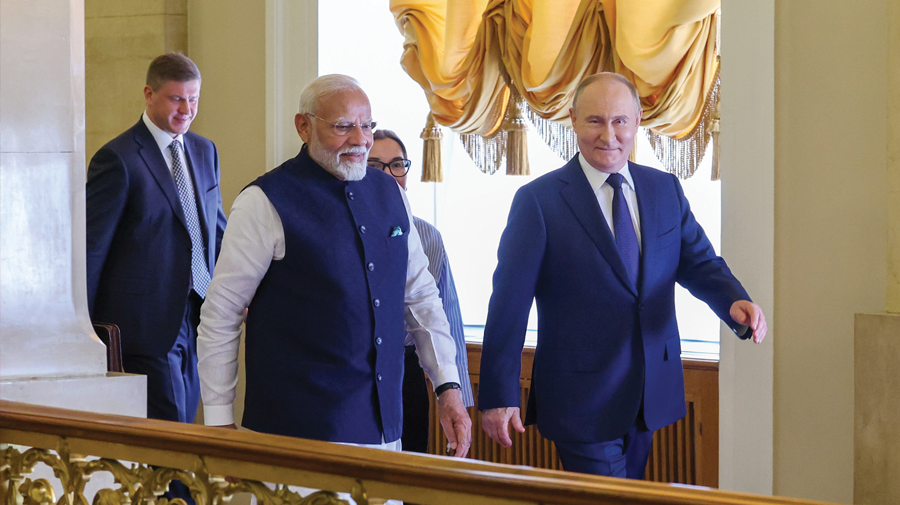
Prime Minister of the Republic of India, Shri Narendra Modi, paid an official visit to the Russian Federation on July 8-9, 2024, at the invitation of President Vladimir Putin. This visit, centered around the 22nd India-Russia Annual Summit, marked a significant milestone in the enduring partnership between the two nations.
During this visit, President Putin conferred Russia’s highest civilian honor, the “Order of Saint Andrew the Apostle,” on Prime Minister Modi. This prestigious award recognized Modi’s distinguished contribution to the development of the Special and Privileged Strategic Partnership between India and Russia and the fostering of friendly ties between the peoples of the two countries.
Political Relations: A Special and Privileged Strategic Partnership
The leaders underscored the strengthening and deepening of the Special and Privileged Strategic Partnership between India and Russia. They lauded the time-tested relationship characterized by trust, mutual understanding, and strategic convergence. Regular bilateral engagements at all levels, including India’s Chairship of the SCO and G20 in 2023 and Russia’s Chairship of BRICS in 2024, have facilitated the further deepening and expansion of this partnership.
The multi-faceted and mutually beneficial India-Russia relations span all possible areas of cooperation. These include political and strategic, military and security, trade and investment, energy, science and technology, nuclear, space, cultural, education, and humanitarian cooperation. Both sides are actively exploring new avenues for cooperation while further strengthening traditional areas.
Despite the complex, challenging, and uncertain geopolitical situation, India-Russia ties have remained resilient. Both sides have strived to forge a contemporary, balanced, mutually beneficial, sustainable, and long-term partnership. The development of India-Russia relations over the entire spectrum of cooperation areas remains a shared foreign policy priority. The leaders agreed to make all efforts to unlock the full potential of the strategic partnership.
Cooperation at the Level of Foreign Ministries
The leaders appreciated the close cooperation between the Foreign Ministries and the frequent meetings and exchanges between the Foreign Ministers. This regular engagement has nurtured and steered the bilateral partnership through the evolving geopolitical scenario. It has also facilitated a deeper understanding and appreciation of each other’s core interests and positions on international issues.
The Protocol on Foreign Office Consultations for the period 2024-28, signed in December 2023, lays the foundation for exchanges and dialogue on pressing bilateral, global, and regional issues. The regular holding of Foreign Office Consultations on various matters, including UN-related, Counter-Terrorism, Consular, and Property issues, reflects the strong commitment to bilateral cooperation.
Parliamentary Cooperation
The leaders noted the importance of close inter-parliamentary interaction. They emphasized the significance of regular meetings of the Inter-Parliamentary Commission and Parliamentary Friendship Groups as valuable components of India-Russia relations. The visit of the Speaker of the Russian Federation Council to New Delhi in October 2023 for the 9th G20 Parliamentary Speakers’ Summit was particularly appreciated.
Cooperation between National Security Councils
The security dialogue at the level of National Security Advisors and National Security Councils has been crucial in facilitating greater strategic understanding and coordination between the two countries on bilateral, global, and regional issues of mutual concern.
Trade and Economic Partnership
Bilateral trade between India and Russia has seen significant growth, doubling the bilateral trade target of USD 30 billion set for 2025. To achieve balanced and sustainable bilateral trade in the long term, the leaders stressed the need to increase Indian exports to Russia by strengthening industrial cooperation and forging new technological and investment partnerships.
Aiming to further accelerate and sustain the growth in bilateral trade, the leaders set an ambitious target of USD 100 billion by 2030. The 24th Session of the India-Russia Intergovernmental Commission on Trade, Economic, Scientific, Technical, and Cultural Cooperation (IRIGC-TEC) and the India-Russia Business Forum held in New Delhi in April 2023 were pivotal in ensuring the further expansion and diversification of bilateral economic relations.
The leaders instructed the concerned agencies to prepare a Programme for the development of promising areas of Russian-Indian economic cooperation till 2030 (Programme-2030). This initiative aims to provide an additional impetus to the deepening of trade and economic cooperation. The overall coordination of its implementation will be carried out by the IRIGC-TEC.
Transport and Connectivity
Both sides share approaches to building a new architecture of stable and efficient transport corridors, paying close attention to the development of promising production and marketing chains in Eurasia. They expressed readiness to expand logistics links, including the implementation of the Chennai-Vladivostok (Eastern Maritime) Corridor and the International North-South Transport Corridor, as well as utilizing the potential of the Northern Sea Route.
Civil Nuclear Cooperation and Space Collaboration
The cooperation in the peaceful uses of nuclear energy remains a significant component of the strategic partnership. The construction of the remaining nuclear power plant units at Kudankulam is progressing as per the schedule. Discussions on the second site in India, technical discussions on the VVER 1200 of the Russian design, localization of equipment, and joint manufacturing of NPP components are ongoing.
Both sides confirmed their intention to broaden cooperation in Nuclear Power, including the fuel cycle, life cycle support for operating Kudankulam Nuclear Power Plants (KKNPPs), and non-power applications. The cooperation in space, including satellite launches, joint space missions, and space exploration projects, continues to be a vital area of collaboration.


Leave a Reply