

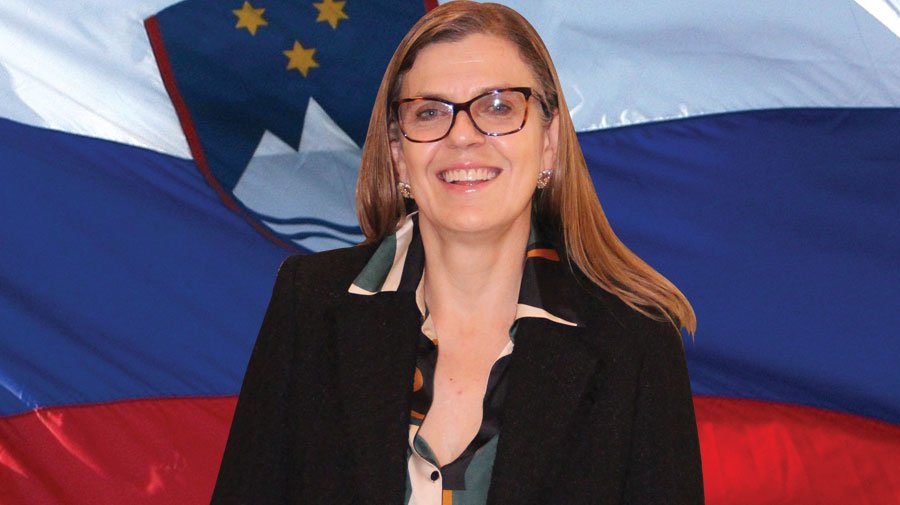
Kanchi Batra, Managing Editor, conducted an interview with H.E. Mateja Vodeb Ghosh, Ambassador of Slovenia to India. In this dialogue, we explore Slovenia’s recent election as a non-permanent member of the UN Security Council for the 2024-2025 term. We delve into Slovenia’s strategic priorities and objectives during its tenure on the Security Council, particularly in addressing global security challenges. Additionally, we discussed Slovenia’s vision for strengthening relations with India and potential areas of collaboration.
Congratulations on Slovenia’s election as a non-permanent member of the UN Security Council for the 2024-2025 term. What are Slovenia’s priorities and objectives during its tenure on the Security Council, particularly in addressing global security challenges?
As Slovenia assumes the UN Security Council membership in the 2024–2025 period, our country has outlined strategic priorities based on a thematic approach and areas where we have demonstrated strength in the past. We have identified four key priorities to guide our efforts.
Firstly, our primary focus lies on conflict prevention. Within this framework, we are committed to addressing violations of human rights that have the potential to escalate into conflicts. We will advocate for the strengthening and timely adoption of preventive measures, including mediation, leveraging our extensive knowledge in this area. Additionally, we will actively promote cooperation among regional organizations, various UN bodies, and civil society to enhance conflict prevention efforts.
Secondly, we are dedicated to protecting populations in armed conflicts. We will consistently emphasise the importance of upholding international law and, in particular, international humanitarian law. Our focus will extend to safeguarding water resources and infrastructure, crucial elements in conflict zones. Furthermore, we will lend our support to international courts, such as the International Criminal Tribunals, to ensure accountability for perpetrators of international crimes. Additionally, we will actively promote and support the invaluable work of humanitarian organizations.
The third priority area for Slovenia is advancing women, peace, and security. We are committed to promoting greater involvement of women in the work of the Security Council and enhancing their participation in conflict resolution processes. Moreover, we will prioritise addressing sexual abuses and gender-based violence in conflict situations effectively and comprehensively.
Lastly, our fourth priority encompasses the intersection of conflict, peace, and security with pressing global challenges such as climate change, environmental degradation, water security, and food security. We recognise the interconnectedness of these issues and will endeavour to incorporate them into the work of the Security Council and broader international efforts.
Slovenia is poised to make meaningful contributions to the UNSC by focusing on these four strategic priorities. Through proactive engagement and collaboration, we are committed to advancing peace, security, and stability on the global stage.
How do you envision strengthening Slovenia-India relations? Are there any specific areas of collaboration or mutual interests that you hope to focus on?
Certainly, the cooperation and collaboration between India and Slovenia span various levels and domains. At the bilateral level, our engagement has been robust, marked by frequent political exchanges and consultations. Over the past few years, there has been a notable increase in political visits, which has contributed to strengthening ties between our nations. We have collaborated on organizing significant events such as the Bled Strategic Forum and the Raisina Dialogue, reflecting our shared commitment to fostering dialogue and cooperation.
Furthermore, our economic cooperation has witnessed significant growth, with trade between our countries increasing notably in recent years. Of particular promise is the field of innovation, where we have seen encouraging developments. The inaugural Slovenia-India Innovation Day held on February 6th showcased our shared commitment to fostering innovation and technological advancement.
At the multilateral level, our cooperation within international organizations and through our membership in the European Union offers additional avenues for collaboration. We are committed to furthering our partnership across various platforms to address shared challenges and pursue common objectives.
Looking ahead, we are optimistic about the prospects for deeper collaboration between India and Slovenia. Through continued engagement and initiatives such as the Innovation Day, we are confident that our partnership will continue to flourish, benefiting both our nations and contributing to regional and global progress.
Slovenia has been an active member of the European Union (EU) since 2004. How has EU membership benefited Slovenia, and how does Slovenia contribute to the EU’s initiatives and policies?
Slovenia’s membership in the European Union, which commenced in 2004, has significantly transformed our nation over the past two decades. This year, as we commemorate 20 years of EU membership, it’s essential to reflect on the profound impact it has had on our country’s development.
First and foremost, EU membership has expanded Slovenia’s horizons, transforming us from a market of 2.1 million people into much larger – few hundred million people European market. This has unlocked numerous business opportunities, making Slovenia an attractive destination for both domestic and foreign businesses seeking access to the broader European market. Additionally, adoption of the Euro currency has simplified travel and trade, eliminating currency exchange concerns and facilitating seamless transactions across borders. The Schengen Agreement further enhances mobility, allowing for unrestricted movement within the Schengen Area.
Moreover, EU membership has facilitated the free movement of labour, enabling Slovenian citizens to explore employment opportunities across Europe. This has not only enriched cultural exchanges but also contributed to the growth of our workforce and economy.
In terms of our contribution to the EU, Slovenia actively participates in various decision-making processes and discussions. Our ministers regularly convene in Brussels to address pertinent issues outlined by working groups, allowing Slovenia to voice its opinions, approaches, and requests. Through our diplomatic missions, we advocate for policies that align with our national interests and values.
Slovenia also engages in high-level meetings, including those attended by prime ministers and heads of government, providing additional avenues to convey our views and opinions on matters of European importance. These interactions underscore Slovenia’s commitment to actively shaping the future of the European Union and ensuring that our perspectives are duly considered in the decision-making process.
Slovenia is known for its commitment to green energy and sustainability. Could you elaborate on Slovenia’s efforts in promoting renewable energy sources and combating climate change? Are there any potential areas for collaboration with India in this regard?
Sustainability and environmental protection are deeply ingrained in Slovenia’s ethos, reflecting our commitment to preserving the planet for future generations. This ethos is not only intrinsic to Slovenia but also resonates with the overarching agenda of the European Union. In alignment with this vision, our government has allocated a significant portion of our budget, including funds received from Brussels, towards green transformation initiatives. Nearly 50% of these funds are dedicated to fostering green innovation and sustainable development.
The concept of green transformation encompasses various aspects, including enhancing energy efficiency in buildings, augmenting the proportion of renewable energy sources in our energy mix, and expanding public transportation options. While Slovenia currently relies on a diverse energy mix, including hydro, nuclear, and coal, our focus is shifting towards increasing the share of renewable energy sources. Currently, solar energy accounts for a modest 3%, primarily sourced from rooftop installations. However, there is a concerted effort to phase out coal energy and ramp up investments in renewables.
In collaboration with India, discussions are underway to formalize a mutual cooperation agreement on renewable energies. This presents a promising avenue for future collaboration, particularly in emerging sectors such as green hydrogen. Additionally, there is potential for technology transfer to enhance the efficiency of coal plants and reduce emissions. Slovenia boasts considerable expertise in smart city solutions and water management, areas where collaboration with India could yield significant mutual benefits.
Tourism plays a significant role in Slovenia’s economy, with its natural beauty and cultural heritage attracting visitors from around the world. How do you plan to promote Slovenian tourism in India, and what unique experiences can Indian travellers expect in Slovenia?
While India may not be a primary market for Slovenia’s tourism efforts, we are dedicated to promoting Slovenia as a desirable tourist destination through various avenues. One such example is our embassy’s assistance to groups of businesspeople seeking leisure travel opportunities in Slovenia. We hope that their positive experiences will be shared with friends and colleagues, further amplifying Slovenia’s appeal.
Additionally, Slovenia has attracted attention from South Indian film productions seeking picturesque locations for filming. Notably, we have cultivated ambassadors in various fields, including renowned chefs like Ana Roš, who showcase Slovenian cuisine and culture to international audiences. Sports personalities such as cyclists and basketball players also draw attention to Slovenia’s natural beauty and recreational opportunities.
What sets Slovenia apart as a tourist destination is its unique blend of diverse cultures and landscapes. Situated at the crossroads of Mediterranean, Germanic, Austrian, and Balkan influences, Slovenia offers a rich tapestry of culinary experiences and different styles of architecture. From seaside resorts to mountain retreats, cave explorations to cultural excursions, Slovenia boasts a wide array of attractions within a compact area. Visitors can easily traverse the country in just three hours, making it an ideal destination for immersive experiences within a short timeframe.
Slovenia’s cultural heritage is another highlight, with cities adorned with castles, intriguing architecture, and a vibrant arts scene. Whether exploring Ljubljana’s historic streets or marvelling at the natural wonders of the Julian Alps, visitors are immersed in Slovenia’s captivating beauty and charm.
Could you highlight Slovenia -India cooperation in the healthcare sector?
Regarding healthcare cooperation between India and Slovenia, I must acknowledge that there isn’t currently an active partnership in this sector. However, Slovenia does have a few companies that specialise in providing high-tech medical equipment for quality control in medicine, and they have seen considerable success in India. Additionally, there are efforts by other Slovenian companies to venture into the field of medical devices.
If we broaden the scope to include pharmaceuticals, Slovenia does have a presence in India. For instance, Krka, a Slovenian company, has established an office in Bangalore and is looking to expand its operations not only in India but also in neighbouring countries to further enhance its regional presence.
On the Indian side, while there are small-scale Indian companies in Slovenia, we have yet to witness significant investments in this sector. However, there is room for improvement in fostering greater collaboration between Indian and Slovenian healthcare industries.
Additionally, joint venture Mahle in Coimbatore focuses on automobile components, while Iskraemeco, headquartered in Kolkata, specializes in smart electrical meters. Moreover, a cable production company Cablex based in Pune, has recently established its offices and production units in India.
Is there anything else you would like to share with our readers about Slovenia’s role on the global stage, its partnership with India, or any other matters of importance?
I would like to highlight the numerous similarities between the people of India and Slovenia. The social aspect of our relations, characterized by warm and welcoming interactions between our citizens, is of paramount importance. This mutual warmth serves as a strong foundation for our bilateral relations.
Allow me to share a heartwarming story that exemplifies the depth of our people-to-people connections. There is a school near Kolkata that was established by a Slovenian-Bengali couple. Together, they dedicated themselves to improving the education of underprivileged girls in the region. This story is a testament to the collaborative spirit and shared values that underpin our relationship.
As we look towards the future, let us endeavour to continue nurturing these bonds and working together for the mutual benefit and progress of both our nations. Through collective efforts and shared aspirations, we can build a brighter and more prosperous future for all.


Leave a Reply