

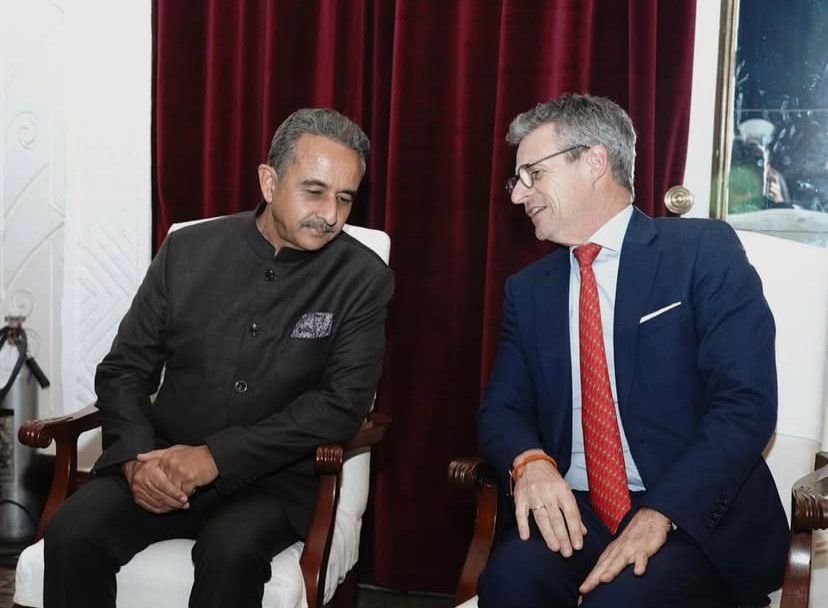
As the European Union marked the inception of a new Presidency of the Council of the EU, Ambassador Hervé Delphin underlined that Europe’s rotating presidencies are not a limitation but a strength of its institutional architecture. “One may say many presidencies, many presidents—but that’s the beauty of our institutional construct,” he observed, emphasising that continuity of purpose remains the EU’s greatest asset.
He was speaking at a reception hosted by the High Commission of Cyprus in India on 2nd February 2026 in New Delhi.
At the heart of this continuity lies a shared commitment to strategic autonomy—a concept that, according to Ambassador Delphin, has acquired renewed urgency in today’s turbulent global landscape. “These are challenging times for everyone in this brave new world,” he said, noting that Europe is asserting itself economically, strategically, and socially as it looks towards 2030.
He described this phase as one of comprehensive rearmament—not merely in military terms, but across economic and societal domains. “There is an economic rearmament with competitiveness, a military rearmament with readiness to 2030, and a rearmament of our societies to face emerging challenges,” he explained. Crucially, however, he clarified that strategic autonomy does not imply isolation.
“Autonomy does not mean you are going alone. You are working with partners.” It is within this framework that the EU–India partnership has assumed unprecedented significance. Reflecting on the outcomes of high-level engagements in New Delhi, Ambassador Delphin stated that the message was unequivocal: “India and the EU are definitely partners,” and their relationship is deepening in ways that are “becoming a defining and consequential partnership for the future.”
Few would have anticipated the pace and breadth of progress achieved in recent months. “Maybe not so many would have bet that by this time we would have an FTA, that we would have concluded a security and defence partnership, an agreement on mobility, and so many other deliverables announced last week,” he remarked. These achievements, he noted, are not standalone successes but part of a comprehensive strategic agenda where “there is no part that does not support each other.”
Ambassador Delphin was particularly emphatic about the collective effort behind this progress, highlighting the role of Team Europe. “This would never have been possible without the EU and its Member States pulling their weight together,” he said, adding that each Presidency carries responsibility, influence, and momentum that helps advance shared priorities. With past and forthcoming Presidencies—from Cyprus to Ireland and beyond—there is, he noted, a strong and unified commitment across Europe to further deepen ties with India.
While acknowledging that significant work lies ahead in implementing the agreements reached, Ambassador Delphin described the start of the current Presidency as exceptionally promising. “You are starting your Presidency on a very high note here in India,” he said, adding that European businesses, citizens, and governments alike have reason to welcome this “new opening, this new chapter in EU–India relations.”
In an era marked by global uncertainty, he stressed that the EU and India are bound by more than convenience. “We are partners not only of necessity, but partners of choice,” he affirmed, pointing to the strong convergence of strategic interests that underpins the relationship.
The global resonance of this partnership has also been striking. Ambassador Delphin recalled how, following President of the European Council António Costa’s visit to India, leaders in Vietnam congratulated the EU on its agreement with India—an indication of how closely the world is watching this relationship. “It shows how much the EU–India partnership has resonance and is welcomed in many parts of the world,” he noted.


Leave a Reply